

Most software projects fail. Not because the developers lack skill, but because the process behind the work was wrong from the start.
Understanding what is the software development process gives you the full picture of how teams move from an idea to a working product. It covers every phase, from requirements gathering and system design through coding, quality assurance, deployment, and long-term maintenance.
This article breaks down each stage, the methodologies teams choose between (Agile, Waterfall, Scrum, DevOps), the roles involved, the tools that hold it all together, and the common mistakes that derail even well-funded projects.
Whether you’re a project manager, a developer joining a new team, or a founder planning your first build, this is the structure you need to know.
What is the Software Development Process
The software development process is a structured sequence of phases that teams follow to plan, create, test, and deliver a software system. It covers every activity from the initial idea through deployment and long-term support.
The process exists because building software without a repeatable structure leads to missed deadlines, broken features, and wasted budgets. Every phase feeds into the next. Skip one and the whole thing falls apart.
Organizations like the Project Management Institute (PMI) and IEEE have published standards that formalize how these phases connect. The exact number of steps varies depending on the software development methodology a team picks, but the core logic stays the same: define what you’re building, design it, build it, test it, ship it, maintain it.
There is a real difference between software development and software engineering worth understanding here. Development focuses on writing and delivering code. Engineering wraps that work inside formal principles like reliability analysis, system modeling, and process control.
How Does the Software Development Process Work
The software development process works by breaking a complex project into smaller, manageable phases that each produce a specific output. That output becomes the input for the next phase.
A typical flow moves through requirements, design, coding, testing, deployment, and maintenance. Teams can run these phases in a straight line (like Waterfall) or in repeated short cycles (like Scrum). The choice depends on the project’s size, risk level, and how often requirements change.
What actually holds it all together is documentation. A software development plan maps out timelines, responsibilities, and deliverables before any code gets written. Without it, coordination between developers, testers, and stakeholders breaks down fast.
What is Requirements Gathering in Software Development
Requirements engineering is the practice of identifying, documenting, and validating what a software product must do before development starts. It turns stakeholder expectations into a formal software requirement specification (SRS).
Teams collect requirements through interviews, workshops, surveys, and observation of existing workflows. The goal is to separate functional and non-functional requirements clearly. Functional requirements describe what the system does. Non-functional requirements describe how well it does it (performance, security, software scalability).
Bad requirements are the single biggest reason software projects fail. According to the Standish Group’s CHAOS reports, incomplete or unclear requirements account for the majority of project overruns.
What is the Feasibility Study in a Software Project
A feasibility study determines whether a proposed software project is technically possible, financially viable, and operationally practical before committing resources to it.
It evaluates five dimensions: technical feasibility (can it be built?), economic feasibility (is the ROI worth it?), legal feasibility (does it meet software compliance requirements?), operational feasibility (will users adopt it?), and scheduling feasibility (can it ship on time?).
A risk assessment matrix is typically produced at this stage. It ranks identified risks by likelihood and impact, giving decision-makers a clear picture before development begins.
How Do Development Teams Analyze System Requirements
System requirements analysis translates raw stakeholder input into structured specifications that developers and designers can act on. Teams use techniques like software modeling with UML diagrams, use case mapping, and data flow analysis.
The output is a detailed document following standards like IEEE 830, which defines how to write a proper SRS. A gap analysis often runs alongside this work to identify where current systems fall short of what the new software must deliver.
What Are the Phases of the Software Development Process
The software development process consists of six to eight phases depending on the lifecycle model a team follows. The standard phases are planning, design, implementation, testing, deployment, and maintenance.
Each phase has defined inputs, activities, and deliverables. The boundaries between phases look different in Agile versus Waterfall, but the underlying work is the same.
What is the Planning Phase in Software Development
The planning phase defines scope, timeline, budget, team structure, and the project management framework that will govern the entire project.
This is where a project manager builds the work breakdown structure, assigns software development roles and responsibilities, and sets milestones. Estimation techniques like function point analysis or planning poker (in Agile) are used to forecast effort. Tools like Jira or Trello track tasks from this point forward.
What is the Design Phase in Software Development
The design phase converts requirements into a technical blueprint. It defines system architecture, database schemas, RESTful API contracts, and user interface layouts.
Two levels of design happen here. High-level design (HLD) maps out the system’s modules and their relationships. Low-level design (LLD) specifies the internal logic of each module, including class diagrams and data structures.
How Do Software Architects Create System Design Documents
A software architect produces a design document that covers component diagrams, technology selection, integration points, and deployment topology. Decisions made here directly affect software reliability, portability, and maintainability.
Architecture patterns like microservices architecture or monolithic design are chosen based on project scale and team capability.
What is the Implementation Phase in Software Development
Implementation is where developers write source code based on the design specifications. This phase consumes the most time and resources in any software project.
Teams work from the design documents, translating system logic into working code. Source control management systems like Git track every change. Code review happens continuously to catch defects early and keep the codebase consistent.
Coding standards matter here. Linting tools enforce style rules automatically, and continuous integration runs automated checks on every commit.
What Programming Languages Are Used During Implementation
The language depends on the platform. iOS development typically uses Swift or Objective-C. Android development relies on Kotlin or Java.
Front-end development runs on JavaScript with frameworks like React.js or Vue.js. Back-end development uses Python, Java, C#, Go, or Node.js depending on the tech stack.
What is the Software Testing Phase
The software testing lifecycle is a structured process where QA engineers and software testers verify that the built product meets its requirements and performs without critical defects.
Testing starts with a software test plan that defines scope, approach, resources, and schedule. Acceptance criteria set the pass/fail boundaries for each feature.
Defect tracking tools log every bug found during testing. Each defect gets a severity rating, gets assigned to a developer, and goes through a resolution cycle before retesting.
What Are the Different Types of Software Testing
Software testing types break down into several categories:
- Unit testing checks individual functions or methods in isolation, often using mocking to simulate dependencies
- Integration testing validates that modules work together correctly
- Regression testing confirms that new changes haven’t broken existing functionality
- User acceptance testing (UAT) lets end users validate the product against business requirements
- Performance testing measures response times, throughput, and resource consumption under load
Code coverage metrics track what percentage of the codebase is exercised by automated tests. Teams practicing test-driven development write tests before implementation code, while behavior-driven development frames tests as user stories.
What is the Deployment Phase in Software Development
App deployment is the process of releasing tested software into a production environment where end users can access it.
Modern teams use a deployment pipeline that automates the path from code commit to production. A build pipeline compiles the code, runs tests, and creates a build artifact ready for release.
Deployment strategies reduce risk. Blue-green deployment runs two identical environments and switches traffic between them. Canary deployment rolls changes out to a small user segment first. Rollback procedures revert to the previous version if something goes wrong.
Semantic versioning (SemVer) tracks releases with a MAJOR.MINOR.PATCH numbering system, and feature flagging lets teams enable or disable features without redeploying.
What is the Maintenance Phase After Software Deployment
Post-deployment maintenance covers all activities that keep software running correctly after release. It includes bug fixes, performance tuning, security patches, and feature updates.
Maintenance is the longest and most expensive phase of the app lifecycle. Studies from IEEE estimate that 60-80% of total software costs happen after initial deployment.
Change request management controls how modifications enter the system. Every change goes through a change management process that evaluates impact, gets approval, and schedules implementation. Code refactoring happens regularly during maintenance to keep the codebase clean and reduce technical debt.
Software configuration management tracks all changes to code, documents, and environments. Software validation and software verification run after every significant update to confirm the system still meets its specifications.
What Are the Software Development Methodologies
A software development methodology is a structured approach that defines how a team plans, executes, and delivers software. Each methodology prescribes different rules for phase sequencing, team communication, and handling changing requirements.
The right pick depends on project complexity, team size, client involvement, and risk tolerance. No single methodology works for everything.
What is the Waterfall Model in Software Development

The Waterfall model runs phases in strict sequence: requirements, design, implementation, testing, deployment, maintenance. Each phase must finish completely before the next one starts, and going back to a previous phase is expensive.
Works well for projects with fixed, well-understood requirements. Government contracts, medical device software, and construction management systems still use it heavily. Poor fit for projects where requirements shift mid-build.
What is Agile Software Development
Agile development delivers software in short, repeated cycles called iterations or sprints (typically 1-4 weeks). Each sprint produces a working increment that stakeholders can review and give feedback on immediately.
The Agile Alliance published the Agile Manifesto in 2001, prioritizing working software over documentation and customer collaboration over contract negotiation. Most product teams at companies like Spotify, Google, and Atlassian run some flavor of Agile.
How Does Scrum Work as an Agile Framework
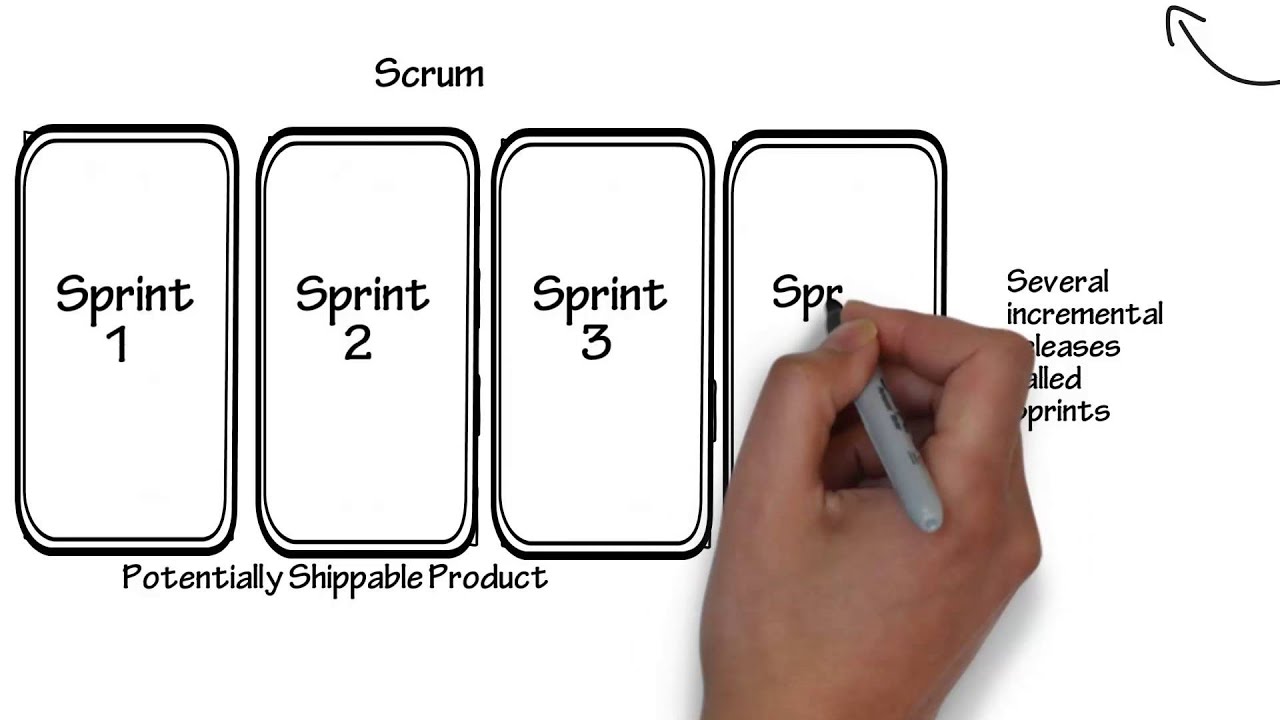
Scrum organizes work into sprints with three roles (Product Owner, Scrum Master, Development Team), five events (sprint planning, daily standup, sprint review, retrospective, the sprint itself), and three artifacts (product backlog, sprint backlog, increment).
What is Kanban in Software Project Management

Kanban visualizes work on a board with columns (To Do, In Progress, Done) and limits how many tasks can sit in any column at once. No fixed sprints. Work flows continuously based on capacity.
What is the Spiral Model in Software Development

The Spiral Model combines iterative development with formal risk analysis at every loop. Each cycle passes through planning, risk assessment, engineering, and evaluation before starting the next spiral.
Barry Boehm introduced it in 1986. Best suited for large, high-risk projects like aerospace systems or banking platforms where the cost of failure far exceeds the cost of extra planning.
What is DevOps in the Software Development Process
DevOps merges development and IT operations into a single workflow focused on continuous deployment, automated testing, and infrastructure as code.
The difference between Agile and DevOps is scope. Agile focuses on how software gets built. DevOps focuses on how it gets built, tested, deployed, and monitored as one continuous loop. Collaboration between dev and ops teams is the core principle.
How Does the V-Model Differ from Waterfall

The V-Model pairs every development phase with a corresponding testing phase. Requirements map to acceptance testing, system design maps to system testing, and module design maps to integration testing.
Same sequential structure as Waterfall, but testing is planned from the start rather than tacked on at the end. Common in regulated industries like automotive (ISO 26262) and pharmaceutical manufacturing.
What Roles Are Involved in the Software Development Process
A software development team includes specialized roles that cover planning, building, testing, and delivering the product. Team composition varies by methodology, project size, and whether the organization builds in-house or outsources.
What Does a Software Developer Do
Software developers write, debug, and maintain source code based on design specifications and requirements documents. They work in specific domains: mobile application development, web apps, embedded systems, or custom app development.
What Does a Project Manager Do in Software Development
The project manager owns the schedule, budget, and scope. They coordinate between stakeholders and the development team, track progress against milestones, manage risks, and handle escalations when things go sideways.
What Does a Quality Assurance Engineer Do
A QA engineer designs test strategies, writes test cases, executes manual and automated tests, and verifies that the software quality assurance process catches defects before release. They own the software documentation related to test results and quality metrics.
What is the Role of a Business Analyst in Software Projects
Business analysts bridge the gap between stakeholders and technical teams. They translate business needs into technical documentation, validate requirements against business goals, and define acceptance criteria for delivered features.
What Tools Are Used in the Software Development Process
Development tools automate repetitive tasks, reduce human error, and speed up delivery. The tech stack for web development or mobile projects dictates which tools a team needs.
What Are Version Control Systems in Software Development
Source control systems like Git, GitHub, and GitLab track every change to the codebase. They enable branching, merging, and collaboration across distributed teams without overwriting each other’s work.
What Are Integrated Development Environments
A web development IDE like Visual Studio Code, IntelliJ IDEA, or WebStorm bundles a code editor, debugger, terminal, and extension ecosystem into a single tool. IDEs speed up coding with autocomplete, syntax highlighting, and built-in Git integration.
What Are Project Management Tools for Software Teams
Jira, Trello, Asana, and Azure DevOps are the most widely used project management tools in software. They track user stories, assign tasks, manage sprint backlogs, and generate burndown charts for Agile teams.
What Are CI/CD Pipelines in Software Development
CI/CD combines continuous integration with continuous deployment into an automated pipeline. Jenkins, CircleCI, GitLab CI, and GitHub Actions are popular platforms.
A build automation tool compiles code and runs tests on every commit. A build server executes these jobs in an isolated environment, producing consistent, reproducible builds.
What is the Software Development Life Cycle (SDLC)
The SDLC is a formalized framework that defines the phases, deliverables, and review gates a software project passes through from conception to retirement. It is the structured representation of the entire software development process.
How Does SDLC Relate to the Software Development Process
The software development process describes the actual work. The SDLC puts that work into a governed model with checkpoints, documentation standards (like CMMI or ITIL), and quality gates. Organizations pursuing ISO 25010 certification follow SDLC models to prove consistent process execution.
What Are the SDLC Models Used by Organizations
Common SDLC models include:
- Waterfall, linear and document-heavy
- Agile/Scrum, iterative with short feedback loops
- Spiral, risk-driven with repeated cycles
- Rapid Application Development (RAD), prototype-focused with compressed timelines
- Incremental Model, delivers the product in functional pieces
- Prototype Model, builds a throwaway prototype to clarify requirements
Each model handles requirements volatility, team size, and risk differently. The Adaptive Software Development methodology bends toward constant learning, while feature-driven development breaks projects into small, client-valued features.
What Are the Common Challenges in the Software Development Process
Software projects fail at a high rate. The Standish Group’s 2020 CHAOS report found that only 31% of projects succeed on time, on budget, and with full scope. The rest run over, get cut, or get canceled entirely.
How Does Scope Creep Affect Software Projects
Scope creep happens when new features or requirements get added after the project starts without adjusting the timeline or budget. It is the most common reason software projects exceed their original estimates.
Agile handles it better than Waterfall because changes get absorbed into upcoming sprints. In Waterfall, scope creep often means rewriting completed design documents and retesting finished modules.
What Causes Software Project Delays
Unclear requirements, unrealistic deadlines, technical debt, dependency on third-party APIs, and underestimated complexity. Took me a while to accept it, but the schedule almost always loses to one of these.
Poor software audit processes compound the problem. Teams that skip regular reviews accumulate hidden defects that surface during testing or, worse, after deployment.
How Do Teams Handle Changing Requirements During Development
Iterative software development absorbs change by design, each iteration re-evaluates priorities. Incremental software development delivers working pieces early so stakeholders can redirect before the full budget is spent.
Both approaches rely on short feedback cycles, well-groomed backlogs, and a product owner who can make quick decisions about what stays and what gets cut.
How Do Companies Choose the Right Software Development Process
There is no universal best methodology. The choice comes down to matching the process to the project’s constraints, team experience, and organizational culture.
What Factors Determine the Best Methodology for a Project
Five factors drive the decision:
- Requirements stability, fixed requirements favor Waterfall, shifting requirements favor Agile
- Project risk level, high-risk projects benefit from the Spiral Model’s built-in risk analysis
- Client involvement, active clients work well with Scrum, hands-off clients fit better with Waterfall
- Regulatory requirements, industries with strict compliance needs (software compliance) often require document-heavy models
- Delivery speed, rapid app development and lean software development cut delivery time by removing waste
How Does Team Size Affect the Choice of Development Process
Small teams (2-7 people) do well with Scrum or Extreme Programming, where pair programming and daily standups keep everyone aligned. Large teams (50+) often need SAFe (Scaled Agile Framework) or a hybrid approach that layers Agile practices on top of traditional governance.
The difference between Scrum and Extreme Programming matters at this scale. Scrum focuses on project management. XP focuses on engineering practices like continuous testing, pair programming, and frequent releases.
When Should a Company Use Agile vs. Waterfall
Agile vs. Waterfall is not really a contest. It is a context question.
Use Waterfall when requirements are locked, the technology is well understood, and regulatory documentation is mandatory. Use Agile when the product is still being figured out, stakeholders want to see progress early, and the team needs room to adjust.
Many companies run both. The best practice in 2025 is matching the methodology to the project, not forcing every project into the same process. Agile development handles product innovation well. Waterfall handles compliance-heavy implementations well. Mixing core development principles from both creates better outcomes than dogma.
FAQ on What Is The Software Development Process
What are the main phases of the software development process?
The main phases are requirements gathering, planning, system design, implementation (coding), testing, deployment, and maintenance. Each phase produces specific deliverables that feed into the next. The exact number of phases depends on the SDLC model the team follows.
What is the difference between SDLC and the software development process?
The software development process describes the actual work of building software. The SDLC is the formal framework that governs that work with defined checkpoints, documentation standards, and quality gates. Every SDLC contains a development process, but not every process follows a formal SDLC.
Which software development methodology is best?
No single methodology fits all projects. Agile suits projects with changing requirements. Waterfall works when specifications are fixed. The Spiral Model handles high-risk builds. Team size, client involvement, and regulatory constraints drive the choice.
How long does the software development process take?
Timelines vary widely. A simple web app might take 3-4 months. A complex enterprise system can run 12-24 months or longer. Sprint-based Agile teams deliver working increments every 2-4 weeks, giving stakeholders usable software faster.
What roles are needed in a software development team?
Core roles include software developers, a project manager, QA engineers, a business analyst, and a software architect. Larger teams add build engineers, UX designers, and DevOps specialists depending on scope.
What is Agile in the software development process?
Agile is an iterative approach that delivers software in short cycles called sprints. Teams collect feedback after each sprint and adjust priorities. Scrum and Kanban are the two most common Agile frameworks used by development teams worldwide.
What tools do software development teams use?
Teams use Git for version control, Jira or Trello for project management, Jenkins or GitHub Actions for CI/CD, and IDEs like Visual Studio Code or IntelliJ IDEA for writing code. The specific tech stack varies by project type.
Why do software development projects fail?
Unclear requirements, scope creep, unrealistic deadlines, and poor communication between stakeholders and developers cause most failures. The Standish Group reports that only about 31% of software projects deliver on time, on budget, and with full intended scope.
What is the most expensive phase of software development?
Maintenance is the most expensive phase. IEEE studies estimate that 60-80% of total software costs occur after the initial release. Bug fixes, security patches, performance tuning, and feature updates accumulate costs over the product’s full lifecycle.
Can different software development methodologies be combined?
Yes. Many organizations use hybrid approaches. A team might run Agile sprints for feature development while following Waterfall-style documentation for regulatory compliance. Mixing development principles from multiple methodologies is common practice in 2025.
Conclusion
The software development process is not a single recipe. It is a set of connected phases that teams adapt based on project size, risk level, and how fast requirements change.
Picking the right development methodology, whether that is Scrum, Waterfall, the Spiral Model, or a hybrid approach, directly affects delivery speed and product quality. The tooling matters too. Version control, CI/CD pipelines, automated testing, and proper configuration management remove friction between phases.
But process alone does not ship good software. The people running it do. Clear role definitions, strong cross-functional collaboration, and honest sprint retrospectives separate teams that deliver from teams that just stay busy.
Start with a solid plan. Test early. Ship in small increments. Maintain what you build. That is the whole game.

- MongoDB Cheat Sheet - October 20, 2026
- Adding AI Video Generation to a Software Product: Architecture, Cost Guardrails and QA - October 20, 2026
- Show Hidden Characters, Spaces, and Line Endings in Notepad++ - October 19, 2026


