Notepad++ showed up in 23.9% of responses to the 2024 Stack Overflow Developer Survey. Sublime Text pulled 10.9%, less than half that share. It’s the kind of gap that looks damning until you remember one editor only runs on Windows and costs nothing, while the other costs $99 and has to earn its place on three separate operating systems.
Popularity numbers don’t settle much on their own though. Licensing terms, how deep the plugin ecosystem actually goes, and what happens when you open something genuinely large (not a demo file, an actual 500MB log dump) matter a lot more once you’re the one staring at the editor for hours at a stretch.
What Is Sublime Text
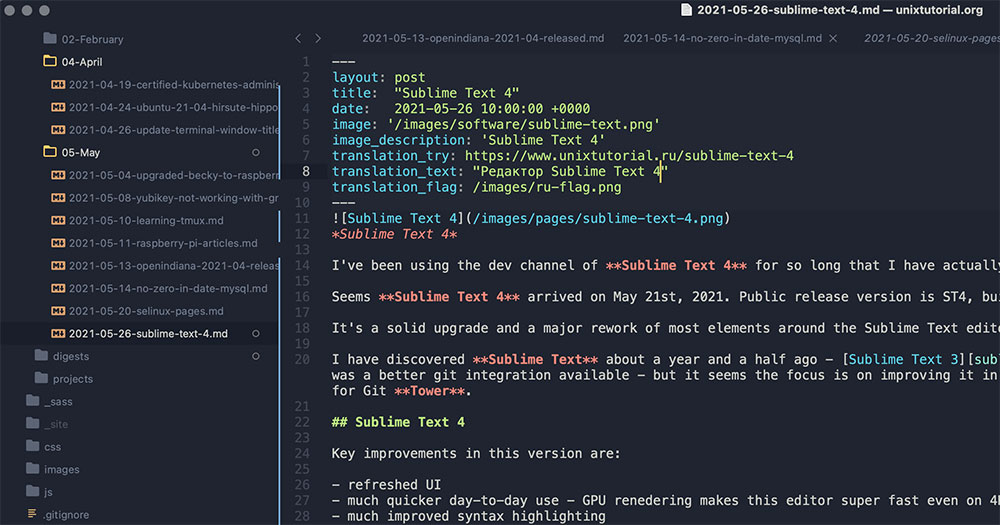
Sublime HQ Pty Ltd runs out of Woollahra, a suburb of Sydney, and that’s the team behind the editor. Sublime Text is built as a proprietary code editor, tuned for speed and for a plugin layer that lets people bend it into almost anything they need. The current stable build is Sublime Text 4, Build 4200.
Under the hood it’s C++, which is a big part of why it stays snappy even with a pile of plugins loaded. The plugin system itself runs on a Python API, and that’s what powers most of the linters, language servers, and custom packages people end up installing. Worth saying plainly: this is a lightweight editor, not an IDE. No built-in compiler, no integrated debugger. If your workflow needs that, you’re leaning on something else alongside it.
Build 4107, released in May 2021, is when things opened up further. Sublime HQ added native ARM64 builds so Apple Silicon Macs and Linux got proper support, and turned GPU-accelerated rendering on by default on macOS (Sublime HQ, 2021).
On Linux, the official packages come as .deb, .rpm, .pkg.tar.xz, and .tar.xz, and each has a matching ARM64 build sitting next to the standard x64 one (Sublime HQ, 2026).
Anyone starting from zero can work through the guide to using Sublime Text for setup and first-run configuration on any of the three platforms.
What Is Notepad++

Don Ho built the first version of Notepad++ in September 2003, while he was a computer science student at Paris Diderot University. He’d been using a slow Java-based editor called JEXT at his day job and got fed up with it (Wikipedia, 2026). What came out of that frustration is now a free, open-source text and code editor released under the GNU General Public License, built specifically for Windows.
From 2003 to 2010, while it lived on SourceForge, the project was downloaded more than 28 million times and picked up the SourceForge Community Choice Award for Best Developer Tool twice.
License terms shifted in 2021, moving to GPL 3.0 or later (it ran under GPL 2.0 or later before that). The editing engine sits on top of Scintilla, also written in C++, the same kind of low-level component a lot of code editors reuse instead of building from scratch.
As for the name: it’s a nod to the C increment operator, ++, a small joke aimed at the built-in Windows Notepad that started this whole thing.
The project changed hosts twice after leaving SourceForge, first landing on TuxFamily, then moving to GitHub in 2015, where it’s still developed in the open today.
New users can work through the step-by-step guide to using Notepad++ to get the interface and first plugins set up.
How Do Sublime Text and Notepad++ Differ in Pricing and Licensing

Sublime Text isn’t free forever, though it feels that way for a while. Notepad++ never charges anything, for individuals or companies, no matter how long you use it.
A personal Sublime Text license costs $99 as a one-time purchase, and it includes three years of updates before an upgrade fee kicks in (Sublime HQ, 2026).
| License | Sublime Text | Notepad++ |
|---|---|---|
| Individual use | $99 one-time, 3 years of updates | Free, no license key |
| Team or business | $65/seat/year for the first 10 seats, stepping down to $50/seat/year for any seats beyond 50 | Free for any team size |
| License model | Proprietary, commercial | GPL 3.0 or later, open source |
Sublime HQ’s own download page states there is no enforced time limit on the evaluation, so the paid license works more like a request to support ongoing development than a hard gate stopping you from working.
Notepad++ carries no license key at all, and its GPL terms let anyone download, modify, and redistribute the source without paying a cent.
Cost is also why so many developers stack Sublime Text up against Visual Studio Code. Both are fighting for the same budget-conscious crowd, even though VS Code’s plugin approach works completely differently underneath.
Which Operating Systems Do They Support
Sublime Text runs natively on three operating systems. Notepad++ sticks to one.
Both ship native Windows builds, and 64-bit is the one to grab on any modern machine. Sublime Text also has native macOS builds, including proper Apple Silicon support since Build 4107, plus native Linux builds for x64 and ARM64, distributed as .deb, .rpm, and .tar.xz packages. Notepad++ doesn’t have an official build for either of those.
| Platform | Sublime Text | Notepad++ |
|---|---|---|
| Windows | Native | Native |
| macOS | Native, Apple Silicon supported | Not supported |
| Linux | Native, x64 and ARM64 | Not supported |
So Windows users get the full Notepad++ feature set, and everyone else is left finding a workaround.
The usual route is running Notepad++ through Wine on Linux, though menus, fonts, and a handful of plugins can act up under emulation.
Anyone attempting this can follow the guide to installing Notepad++ on Linux for the Wine-based setup steps and known limitations.
Teams already standardized on macOS or Linux machines usually settle this before comparing a single feature. Windows-only support decides it, not plugin depth or theme options.
How Do Sublime Text and Notepad++ Compare in Performance and Large File Handling
Startup speed and large file handling aren’t the same thing, and these two editors split sharply on that distinction.
MakeUseOf ran a hands-on test in May 2026, opening an identical 500MB log file across several editors on the same Windows 11 machine, including the 32-bit build of Notepad++ and Sublime Text (Tashreef Shareef, MakeUseOf, 2026).
| Metric (500MB file) | Notepad++ (32-bit) | Sublime Text |
|---|---|---|
| Cold open time | 2.18 seconds | 11.14 seconds |
| RAM usage | ~540MB | ~758MB |
| Search near end of file | ~11 seconds, with stutter | 16.83 seconds |
| Scrolling after load | Stuttered throughout | Smooth top to bottom |
Notepad++ wins the opening race, and it’s not close. But the tester noted that scrolling and searching got sluggish fast once real work started on that file.
Sublime Text took its time loading the same file, and used more memory doing it. Once it was actually open though, scrolling stayed smooth and repeat searches felt close to instant. Eleven seconds sounds bad on paper. It stops mattering much once you’re going to be sitting in that file for the next two hours anyway.
That gap matters most if you’re parsing a big server log or picking through an entire codebase in one sitting, since the editor gets touched dozens of times after that first open, not just once.
Benchmarks and actual daily use don’t always agree, and that’s worth remembering before picking an editor off a spec sheet alone.
What Plugin and Extension Ecosystems Do They Offer
Sublime Text Package Control
Package Control is community-run, not something Sublime HQ maintains directly, and it’s logged more than 25 million installs since launching in 2011 (packagecontrol.io stats, 2026). Scroll through the directory and you’ll find 1,303 language syntax packages, 545 snippet packages, and 445 color scheme packages (packagecontrol.io, 2026), which is a lot to dig through if you’re only after one thing.
Emmet is one of the most installed packages out there, mostly because it cuts down on the repetitive HTML and CSS grind that shows up constantly in front-end development. LSP adds language server support for people who want it, and SublimeLinter and BracketHighlighter both see heavy use too.
Packages install and update right from the Command Palette, no restart needed. Disable one and its Python scripts unload immediately.
Notepad++ Plugin Manager

Plugin Admin came bundled starting with Notepad++ version 7.5, and it replaced the older third-party Plugin Manager. That older tool got dropped from the official build because it displayed advertising, which nobody was thrilled about.
A few plugins worth knowing: NppExec runs scripts and build commands right inside the editor, Compare puts two files side by side with differences highlighted, and JSON Viewer formats and validates JSON payloads. Nothing exotic, but useful stuff a lot of people install within their first week.
Installing something new means checking a box in the Plugin Admin dialog and letting the editor restart to finish up.
Developers who lean on the file comparison workflow often enough tend to grab Compare early, since it isn’t part of the default install.
How Do Multi-Cursor Editing and Search Features Compare
Multi-cursor editing arrived on very different timelines for these two editors, and it shows in how mature each implementation feels.
Sublime Text’s multi-cursor tools go back to its earliest releases. Ctrl+D grabs the next matching instance of a word, building up multiple selections one press at a time. Ctrl+Shift+L splits a block selection into one cursor per line, which sounds minor until you’re renaming a dozen variables at once. Goto Anything, triggered with Ctrl+P, jumps straight to files, symbols, or line numbers from a single search box.
Notepad++ came to full multi-edit support much later, version 8.6, released November 23, 2023, right on the project’s 20th anniversary. Column Mode handles rectangular selections and can convert straight into multi-editing, and regex-based find and replace works across both single files and whole-project search.
That’s basically a decade’s head start for Sublime Text on refining the feature. It mostly shows up in edge cases, mixed-width selections, undo behavior across a pile of cursors, rather than in the basic job of editing several lines at once, where both editors now hold their own just fine.
How Customizable Are Their Interfaces and Themes
Both editors expose deep configuration options, but they get there through very different mechanisms. Sublime Text stores every preference as plain JSON, in files with extensions like .sublime-settings, .sublime-theme, and .sublime-color-scheme.
| Aspect | Sublime Text | Notepad++ |
|---|---|---|
| Config format | Hand-edited JSON files | GUI-based Preferences dialog |
| Dark theme | Bundled color schemes, auto OS switching | Dark Mode, added in v8.0 (June 2021) |
| Vi/Vim emulation | Built-in Vintage mode, off by default | Not built in, plugin required |
Dark Mode landed in Notepad++ version 8.0, and it came bundled with a Distraction Free Mode plus Fluent-style toolbar icons in that same release (Notepad++ official blog, 2021). A handful of toolbar tone options ship alongside Dark Mode too, so the accent color can shift without touching the editor’s core background.
Both let you customize keybindings, though the process looks nothing alike. Sublime Text means editing raw .sublime-keymap JSON files by hand. Notepad++ has a dedicated Shortcut Mapper dialog tucked under Settings instead.
Sublime also ships a built-in Vintage mode, a vi-style command layer that stays disabled via the ignored\_packages setting until a user turns it on (Sublime Text documentation, 2026).
Notepad++’s GUI-first approach means fewer text files to hand-edit, though anyone adjusting something as basic as font size still goes through the same Preferences dialog as every other setting.
The Notepad++ cheat sheet lists the default shortcuts side by side, which shortens the learning curve for anyone coming from a heavier IDE.
What Are the Advantages and Limitations of Sublime Text
Advantages
Sublime Text rates 4.5 out of 5 stars across roughly 1,770 verified reviews on G2 (G2, 2026), a solid showing for a paid tool up against a pile of free competitors. Vintage mode gives you vi-style editing without installing a single extra package, and Sublime Merge, its companion Git client, is available as a separate purchase or bundle add-on.
The command palette also exposes quick tools for renaming symbols and other code refactoring tasks across a whole open project, not just the current file. Reviewers on G2 keep coming back to ease of use specifically, which scores above 9 out of 10 in the aggregated ratings (G2, 2026).
Limitations
Price comes up constantly in reviews. It’s considered high next to free alternatives, and that alone knocks Sublime Text out of consideration for a lot of budget-tight users before they even try it.
It’s also not a full web development IDE, so debugging and build automation lean on external build systems rather than anything integrated. And Package Control, useful as it is, runs on community goodwill rather than official maintenance from Sublime HQ, so package quality and update frequency depend entirely on who wrote it.
What Are the Advantages and Limitations of Notepad++
Advantages
G2 reviewers rate Notepad++ at 4.6 out of 5 stars across roughly 2,475 verified reviews, edging out Sublime Text’s aggregate score (G2, 2026). Cost has a lot to do with that: zero for individuals, teams, and commercial deployments alike, no exceptions.
Macro recording ships built in, no plugin required, and Windows users get an “Edit with Notepad++” option right in the shell’s right-click menu. Small thing, but it adds up over a few hundred file opens a week.
Syntax highlighting scores 9.1 out of 10 from G2 reviewers, and find-and-replace tooling scores 9.3 out of 10, both among the categories Notepad++ does best in (G2, 2026).
Readers weighing it against the built-in Windows tool can check the full Notepad++ vs Notepad comparison for a feature-by-feature breakdown.
Limitations
There’s a more serious limitation too. In 2025, hackers believed to be state-sponsored, the group APT31, also tracked as Violet Typhoon, compromised Notepad++’s update mechanism by going through its hosting provider (Notepad++ security disclosure, 2026).
Update traffic got redirected for a set of targeted users, mostly in telecom and financial services across East Asia, starting around June 2025 and running until access was finally cut off on December 2, 2025. Notepad++ moved to a more secure host afterward and added stronger update-signature verification.
Many older community plugins remain 32-bit only and won’t load inside the 64-bit build, which forces some users to keep the 32-bit version around just for legacy plugin support.
Notepad++ also has no bundled Git client comparable to Sublime Merge, so version control stays a separate tool in the workflow.
Which Editor Fits Which Type of User
Platform, budget, and workload usually settle this before any feature list gets compared.
| User profile | Better fit | Why |
|---|---|---|
| Windows-only, budget-free | Notepad++ | No cost, native Windows integration |
| Mixed macOS/Linux/Windows team | Sublime Text | Only one with native builds on all three |
| Heavy plugin customizer | Sublime Text | Larger, actively maintained package directory |
| Occasional log or config editing | Notepad++ | Fast cold-open, zero setup friction |
Cross-platform teams end up on Sublime Text almost by default. Notepad++ simply isn’t an option once you step outside Windows, so the decision makes itself.
Budget matters more for Windows-only shops. If the software budget is tight and everything already runs on Windows, Notepad++ covers most day-to-day text and code editing without costing anything.
Plenty of people just run both. Notepad++ for a quick config tweak, Sublime Text for anything that touches a real project.
Anyone still torn between paying for an editor and using a free one might also look at Notepad++ against Visual Studio Code, currently one of the most widely used free options around.
FAQ on Sublime Vs Notepad++
Is Notepad++ safe to download and use?
Yes, as long as it comes from the official notepad-plus-plus.org site or its verified GitHub repository. Third-party mirrors carry more risk of tampered installers, so sticking to the official source and checking release signatures is the safer habit.
Does Sublime Text support Git?
Not natively. Git status indicators and diff views come through Sublime Merge, Sublime HQ’s separate Git client, or through community packages like GitGutter installed via Package Control.
Can Notepad++ run on Mac or Linux without Wine?
No official build exists for either system. Running Notepad++ outside Windows means Wine, a compatibility layer, or a Windows virtual machine, since there’s no native macOS or Linux package.
What changed between Sublime Text 3 and Sublime Text 4?
Build 4107 added a Python 3.8 plugin API, built-in TypeScript syntax support, and context-aware autocomplete that reads patterns from the whole open project instead of just the current file.
Is Notepad++ good for beginners learning to code?
It works fine for basic syntax highlighting and simple scripts. Beginners tend to outgrow it once a project needs a real debugger or build automation, which was never really the point of Notepad++.
Can Sublime Text open and edit JSON or CSV files?
Yes, both open as plain text by default. Packages like Pretty JSON add formatting and validation, though neither file type gets a dedicated table or tree view without installing something extra.
Does Notepad++ recover unsaved work after a crash?
Yes. Notepad++ treats empty or inaccessible tabs as placeholders and restores them across sessions, so an unsaved file survives a crash or an accidental close far more often than plain Notepad ever managed.
Which editor uses less memory during everyday, small-file editing?
Both stay light compared to a full IDE for normal text and code work. The gap only shows up under heavy load, not during routine editing of small scripts or configuration files.
Can you write and run Python code in both editors?
Yes. Sublime Text runs Python through its build system or packages like Anaconda, covered in the guide to using Sublime Text for Python, while Notepad++ relies on the NppExec plugin.
Is there a portable version of either editor?
Yes, for both. Sublime Text offers an official portable Windows build right from its download page, and Notepad++ ships a portable zip package that plenty of people run straight off a USB drive.
Conclusion
There’s no real winner in sublime vs notepad++, only a better fit for how you actually work.
Start with the operating system before you even look at features. Windows-only teams get nothing extra from Sublime Text’s cross-platform reach, and Mac or Linux users can’t make Notepad++ run at all without some kind of compatibility layer sitting in the way.
Try both for a week before spending anything. Notepad++ costs nothing to test, and Sublime Text’s evaluation period has no enforced deadline, so there’s no reason to rush into buying a license key.
Base the decision on plugin depth and how fast regex search actually runs, not on which interface looks nicer.
And give it time. Watch how each editor behaves once a real project, not a demo file, has been open for a full day. That test tells you more than any spec sheet.

- MongoDB Cheat Sheet - October 20, 2026
- Adding AI Video Generation to a Software Product: Architecture, Cost Guardrails and QA - October 20, 2026
- Show Hidden Characters, Spaces, and Line Endings in Notepad++ - October 19, 2026