Pure works for a very specific type of person. Anonymous profiles, one-hour ads, auto-deleting chats. No persistent identity, no social graph, no awkward digital trail.
But it has real limits. Thin user bases outside major cities, a paywall for men from day one, and a format that simply does not suit everyone.
If you are looking for apps like Pure that match its no-strings-attached approach without the same constraints, there are solid alternatives worth knowing.
This guide covers 10 discreet dating apps built around casual encounters, anonymous hookups, and location-based matching. Each one is compared directly to Pure across features, pricing, and the type of user it actually works best for.
Apps Like Pure
The global dating app market hit $12.5 billion in 2026, with over 350 million active users across platforms (Players Time). Pure sits in a specific lane: anonymous, no-commitment, instant connections. These 10 apps cover that same space, plus a few that go further.
Feeld
Feeld is a casual and alternative dating app that connects open-minded adults, couples, and singles for non-traditional relationships. It goes further than Pure by supporting polyamory, kink, and group connections, and runs on iOS and Android.
What Does Feeld Do?
Feeld lets users explore casual encounters, ethical non-monogamy, and alternative relationship structures using swipe-based matching with detailed “Desires” profiles.
How Is Feeld Similar to Pure?
Both are adult dating apps built around casual, no-judgment connections. Both offer privacy controls, anonymous browsing options, and location-based matching. Neither pushes long-term relationship intent.
How Is Feeld Different from Pure?
- Feeld supports couple profiles and group connections. Pure is solo-focused.
- Feeld has 20+ gender and sexuality options. Pure keeps profiles minimal.
- Feeld’s interface is richer and more community-driven. Pure strips everything down to speed.
Who Is Feeld Best For?
Singles and couples interested in ethical non-monogamy, kink, or polyamory who want more profile depth than Pure offers.
Key Features of Feeld
- Couple profiles: Connect individually or together
- Desires list: State exact intentions upfront
- Incognito mode: Hide profile until you like someone
- 20+ identity options: Gender and sexuality inclusive
Pricing
- Free plan: Yes, core matching and messaging included
- Paid plan (Majestic): Around $20/month, $100/year
- Free trial: 7 days (iTunes/Google)
Tinder
Tinder is a swipe-based dating app primarily used for casual hookups and short-term connections by adults worldwide. It has a far larger user base than Pure and runs on iOS, Android, and web.
What Does Tinder Do?
Tinder matches users through a left/right swipe system, letting matches message each other freely. It holds 30% of the U.S. dating app market share as of 2025 (TwinStrata).
How Is Tinder Similar to Pure?
Both apps target casual, no-strings-attached dating. Both use location-based matching and allow anonymous browsing to an extent. Both have free tiers with optional paid upgrades for advanced features.
How Is Tinder Different from Pure?
| Feature | Tinder | Pure |
| User Base | ~50M monthly active users (2026) | ~1M–2M monthly (High niche density) |
| Profile Depth | Multi-photo, detailed bios, “Relationship Goals” | “Ads” focus; minimal bio, emphasis on “Turn-ons” |
| Anonymity | Low (Linked social/phone, public profiles) | High (Self-destructing chats/photos, no name required) |
| Paid Ceiling | $499/month (Select tier) | ~$30/month (Standard Premium) |
| Core Intent | Broad (Dating, marriage, hookups) | Explicitly casual (No-strings-attached, hookups) |
| Safety Tools | AI-Photo verification, “Face Check™” | Screenshot alerts, 24-hour chat self-destruction |
Who Is Tinder Best For?
Adults in large cities who want a massive user pool for casual or semi-serious dating without Pure’s strict anonymity model.
Key Features of Tinder
- Passport: Swipe in any city before you arrive
- See Who Likes You: Available on Gold tier ($39.99/month)
- Incognito Mode: Plus tier feature
- Boosts and Super Likes: A la carte visibility tools
Pricing
- Free plan: Yes, limited swipes and features
- Paid plans: Plus ~$24.99/month, Gold ~$39.99/month, Platinum ~$49.99/month
- Free trial: No standard trial
Adult Friend Finder
Adult Friend Finder (AFF) is one of the oldest adult dating platforms, launched in 1996, focused entirely on casual sex, open relationships, and sexual exploration. It runs on web and mobile for adults 18+.
What Does Adult Friend Finder Do?
AFF connects adults for casual encounters through profile browsing, chat rooms, live webcams, and a community-style social network with over 100 million registered users globally (Beyond Ages).
How Is Adult Friend Finder Similar to Pure?
Both platforms are built exclusively for adult casual connections with no relationship pressure. Both allow users to be explicit about sexual preferences upfront. Neither is designed for long-term matching.
How Is Adult Friend Finder Different from Pure?
- AFF is a full desktop web platform with live cams and blogs. Pure is a lean mobile-first app.
- AFF requires paid membership for messaging. Pure allows some free interaction.
- AFF has a much older, broader demographic. Pure skews younger and more design-conscious.
Who Is Adult Friend Finder Best For?
Adults who want explicit content, webcams, and a large community forum alongside their casual dating, and don’t mind a dated interface.
Key Features of Adult Friend Finder
- Live webcam shows: Free and paid private streams
- Sex Academy: Educational content on intimacy
- Chat rooms and groups: Community features beyond swiping
- 190+ countries: One of the largest global adult communities
Pricing
- Free plan: Yes, browsing only
- Standard paid plan: From ~$8.95/month (12-month plan)
- Gold membership: ~$19.95-$39.95/month depending on term
- Free trial: No
Grindr
Grindr is the world’s largest dating and hookup app for LGBTQ+ users, specifically built for gay, bi, trans, and queer adults seeking fast, location-based connections. It runs on iOS and Android only.
What Does Grindr Do?
Grindr shows a grid of nearby users sorted by distance, allowing instant chat, photo sharing, and meet-up coordination without a swipe mechanic.
How Is Grindr Similar to Pure?
Both are designed for fast, casual hookups with minimal friction. Both prioritize proximity-based matching and let users control exactly how much personal info they share.
How Is Grindr Different from Pure?
Audience focus is the biggest gap. Grindr is built for LGBTQ+ men specifically. Pure serves all orientations. Grindr also uses a grid layout instead of Pure’s time-limited matching. Grindr XTRA costs $19.99/month while Unlimited runs $39.99/month.
Who Is Grindr Best For?
Gay, bi, and queer adults who want the most direct, proximity-driven casual hookup experience available for the LGBTQ+ community.
Key Features of Grindr
- Distance-sorted grid: See who’s nearby in real time
- Private albums: Share photos selectively
- Interest tags: Filter by shared preferences
- Incognito mode: Unlimited tier only
Pricing
- Free plan: Yes, up to 100 profiles, unlimited messaging
- XTRA: $19.99/month (600 profiles, no ads, advanced filters)
- Unlimited: $39.99/month (incognito, viewed me, unsend messages)
- Free trial: Occasionally offered
DOWN App
DOWN (formerly Bang With Friends) is a discreet hookup app that lets users signal romantic or physical interest in people they already know from Facebook. It runs on iOS and Android.
What Does DOWN Do?
DOWN lets users swipe “Date” for romantic interest or “Down” for a no-strings-attached meetup. Matches only appear when both users swipe the same intent, keeping things private.
How Is DOWN Similar to Pure?
Both are built around low-commitment, honest hookup culture. Both keep conversations private and avoid pushing users toward serious relationships. Mutual-interest matching keeps things discreet on both platforms.
How Is DOWN Different from Pure?
- DOWN uses Facebook social graph matching. Pure is fully anonymous with no social connections.
- DOWN lets users choose between date and hookup intent per swipe. Pure assumes hookup intent from the start.
- DOWN includes icebreakers like “Would You Rather.” Pure skips all that.
Who Is DOWN Best For?
Adults who want to find out which people they already know are open to casual meetups, without the awkwardness of asking directly.
Key Features of DOWN
- Dual swipe intent: Date vs. Down options per profile
- Facebook matching: Connections within your network
- Photo Challenge icebreakers: Conversation starters built in
- Mutual-only reveal: Neither person sees interest unless it’s mutual
Pricing
- Free plan: Yes, basic swiping and matching
- Paid plan: In-app purchases for boosts and extended features
- Free trial: No standard trial
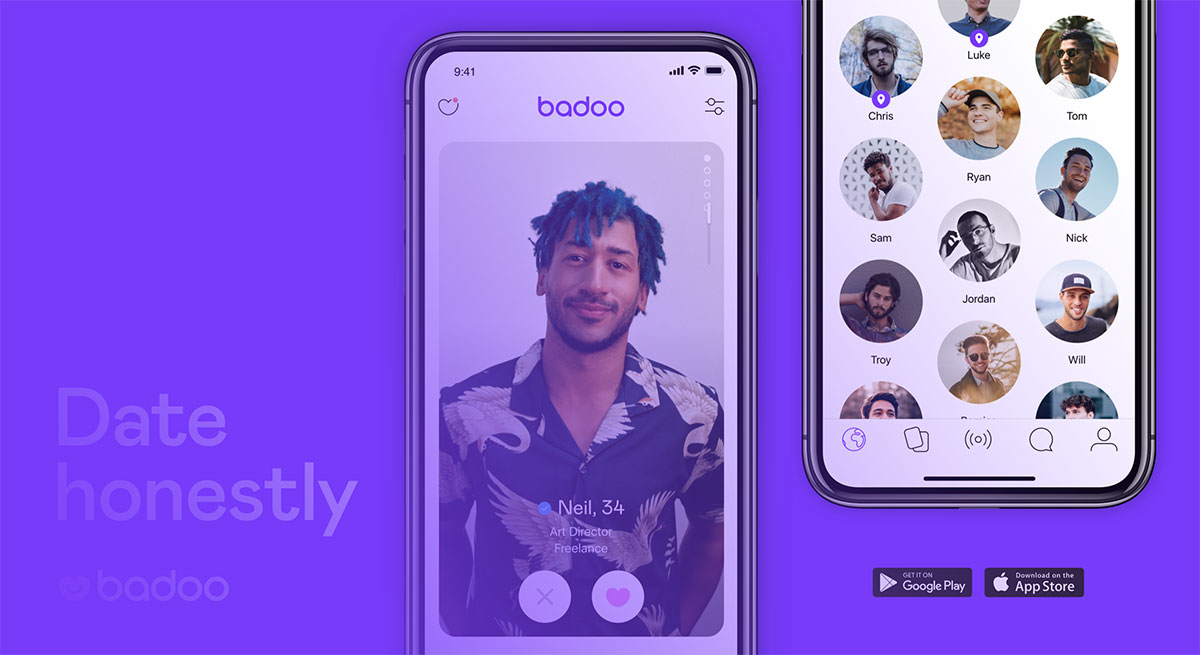
Badoo
Badoo is a global social dating app with over 500 million registered users across 190+ countries, mixing location-based discovery with interest-based matching. It runs on iOS, Android, and web.
What Does Badoo Do?
Badoo combines swipe-based encounters with a “People Nearby” map and photo verification to help users find casual dates and connections in their immediate area.
How Is Badoo Similar to Pure?
Both use location-based matching for casual connections. Both have free tiers that allow meaningful browsing. Both support adults looking for no-commitment meetups rather than serious relationships.
How Is Badoo Different from Pure?
Badoo is much broader in scope. It positions itself as a social network first, dating app second. Photo verification is mandatory on Badoo, which Pure doesn’t require. Badoo also works on desktop and is dominant in Europe and Latin America, where Pure’s user base is thinner.
Who Is Badoo Best For?
Singles who want a large, globally diverse casual dating pool with verified profiles, especially outside North America.
Key Features of Badoo
- People Nearby: Real-time proximity grid
- Photo verification: Mandatory selfie check to reduce catfishing
- Celebrity Lookalike search: Find profiles resembling a celeb
- 50+ gender options: More inclusive than most casual apps
Pricing
- Free plan: Yes, 50 likes/day, unlimited messaging with matches
- Super Powers premium: ~$9.99/month (see who liked you, read receipts)
- Free trial: No
HUD
HUD (Hookup Dating) is a casual dating app built specifically for no-strings-attached encounters, with a strong focus on female user comfort and privacy. It runs on iOS and Android.
What Does HUD Do?
HUD lets users browse a Match Feed, set explicit NSA intentions, and message matches through video, voice, or text. Photo blur and filter tools give women more control over what they share.
How Is HUD Similar to Pure?
Both apps are built around honest, casual sexual intent. Both allow users to state NSA preferences upfront. Both are designed to reduce the pretense common on mainstream dating apps.
How Is HUD Different from Pure?
| Feature | HUD | Pure |
| Female-targeted design | Yes, photo blur and filter tools | Neutral design |
| Spotify integration | Yes | No |
| Video/voice messaging | Yes | No |
| Time-limited chats | No | Yes (Chats expire after 24 hours) |
Who Is HUD Best For?
Women and couples seeking casual hookups who want more privacy controls and conversation features than Pure’s stripped-down format provides.
Key Features of HUD
- My Bedroom feature: Disclose kinks and preferences
- Photo blur tool: Control visibility of your images
- Spotify link: Share music taste on your profile
- Video chat with blur: Verify matches before meeting
Pricing
- Free plan: Yes, unlimited messaging with matches
- Paid plan: Premium tier for expanded matching and boosts
- Free trial: Available periodically
Bumble
Bumble is a swipe-based dating app where women must send the first message in heterosexual matches, making it one of the most female-friendly platforms on the market. It runs on iOS, Android, and web.
What Does Bumble Do?
Bumble matches users through swiping and requires women to initiate contact within 24 hours or the match expires. It holds 26% of the U.S. dating app market as of 2024, making it the second-largest app after Tinder (Helplama).
How Is Bumble Similar to Pure?
Both apps support casual connections and short-term dating. Both use location-based matching and include privacy settings. Time-limited match expiry exists on both platforms.
How Is Bumble Different from Pure?
- Bumble covers dating, BFF, and professional networking in one app. Pure is hookup-only.
- Bumble requires real profiles and photos. Pure allows near-anonymous participation.
- Bumble has 50M+ active users. Pure’s community is much smaller and more niche.
Who Is Bumble Best For?
Women who want casual connections but prefer a safer, more respectful swiping environment where they control the first move.
Key Features of Bumble
- Women-first messaging: Women initiate in heterosexual matches
- 24-hour match expiry: Forces action, reduces ghosting
- Bumble BFF: Find friends or professional contacts
- Advanced filters: Available on Boost and Premium plans
Pricing
- Free plan: Yes, standard swiping and matching
- Boost: ~$16.99/month
- Premium: ~$22.22/month average across plans (Players Time)
- Free trial: Occasionally offered
Casualx
Casualx is a dedicated NSA dating app for singles and couples looking for one-night stands, friends with benefits, and discreet encounters. Available on iOS and Android.
What Does Casualx Do?
Casualx uses swipe-based matching to connect adults seeking purely casual meetups, with in-chat image sharing and filters designed to cut through fake profiles.
How Is Casualx Similar to Pure?
Both apps market themselves as hookup-only platforms with no pretense of serious dating. Both attract users who explicitly want no-commitment encounters. Both are mobile-only and use location filtering.
How Is Casualx Different from Pure?
Casualx allows in-chat photo sending, which Pure restricts to prevent saved images. Casualx also caters to couples seeking thirds, which Pure doesn’t specifically target. The user base on Casualx skews toward the U.S. domestic market more narrowly than Pure’s international reach.
Who Is Casualx Best For?
Single adults and couples in the U.S. looking for a hookup-focused app that’s more feature-rich than Pure but less community-heavy than Adult Friend Finder.
Key Features of Casualx
- NSA-only focus: No relationship-oriented features
- Couple-friendly: Supports pair profiles
- In-chat photo sharing: Direct image exchange
- Escort-filtering tools: Active moderation against commercial profiles
Pricing
- Free plan: Yes, messaging with mutual matches
- Paid plan: Premium unlocks expanded profiles and filters
- Free trial: No
Happn
Happn is a location-based casual dating app that shows you people you’ve physically crossed paths with during your day. It’s available on iOS, Android, and web.
What Does Happn Do?
Happn logs real-world proximity crossings and surfaces those profiles in your feed. If both users like each other, they can message. The app recorded 12.3% download growth in 2025 (Players Time), one of the stronger resurgence stories in casual dating.
How Is Happn Similar to Pure?
Both apps use real-time location data to match users nearby. Both lean toward casual connections. Both have free tiers and paid upgrades for advanced matching features.
How Is Happn Different from Pure?
- Happn matches are based on physical paths crossed in real life. Pure is purely GPS-radius.
- Happn builds around serendipity and recurring crossings. Pure is about instant, anonymous hookups.
- Happn is harder to use anonymously. Pure is built for anonymity from the ground up.
Who Is Happn Best For?
Adults in dense urban areas who want to connect with people they’ve already physically encountered, rather than matching with strangers at a radius.
Key Features of Happn
- Crossed paths feed: Shows repeat crossings, so frequency signals mutual territory
- Audio and video messages: Richer communication than text-only
- Privacy controls: Hide profile or limit visibility by distance
- CrushTime game: Guess who liked you from a set of profiles
Pricing
- Free plan: Yes, most core features available
- Premium: ~$16.66/month (Players Time mid-market tier)
- Free trial: Available
What Is the Pure App and What Makes It Different from Other Hookup Apps?
Pure launched in 2014 as a deliberate rejection of everything mainstream dating apps do. No persistent profile. No social graph. No browsing history you have to manage.
The core mechanic is a time-limited personal ad: you post a photo and brief description, it stays live for one hour, and if someone nearby likes it and you like them back, a private chat opens. After 24 hours, everything deletes automatically including the chat history.
According to Pew Research, 24% of dating app users cite casual sex as a major reason for using these platforms. Pure is built entirely for that segment, with no features aimed at long-term matching or relationship building.
| Feature | Pure | Tinder | Feeld |
| Profile Persistence | Expires in 1 hour | Permanent | Permanent |
| Anonymity | High (Built-in by design) | Low by default | Incognito (Paid feature) |
| Chat History | Auto-deleted after 24h | Stored indefinitely | Stored indefinitely |
| No-strings Focus | Exclusive | Mixed intent | Mixed intent |
Pure also added Veriff-based age verification in October 2025, requiring an AI face scan and, if inconclusive, a government ID plus live selfie. That makes it one of the more rigorously verified platforms in the anonymous hookup app category.
It runs on iOS, Android, and web. Women access messaging for free. Men need a paid subscription to send messages, a model that reduces spam and bot activity in the feed.
Platform availability: iOS, Android, web. Subscription-only for full access. Price varies by country, approximately $14.99/month in the U.S. as of 2024 (SwipeTogether).
What Are the Best Free Alternatives to Pure for Anonymous Hookups?
Over 350 million people use dating apps globally, but only about 23 million pay for premium features (Business of Apps, 2025). Most users want a free tier that actually works before committing to a subscription.
These four apps offer the most functional free experience for casual and anonymous adult dating.
Feeld
Feeld’s free tier covers profile creation, browsing, mutual matching, and messaging with connections. No credit card needed to have a real experience.
Free tier includes:
- Swipe-based matching with Desires profiles
- Messaging with mutual connections
- Couple account support at no charge
- 20+ gender and sexuality identity options
The paid Majestic tier (~$20/month) adds incognito mode and advanced filters. Most users find the free version enough to get started.
Grindr
Free access on Grindr covers up to 100 nearby profiles, unlimited messaging, photo sharing, and one minute of daily video calls. That’s a more generous free tier than most hookup apps offer.
XTRA ($19.99/month) bumps that to 600 profiles and removes ads. Unlimited ($39.99/month) adds incognito mode and unsend messages. But for LGBTQ+ users who just want proximity-based hookups, the free version works fine in most cities.
Badoo
Badoo allows 50 likes per day and unlimited messaging with matches for free. Mandatory photo verification is included at no cost, which meaningfully reduces fake profiles and catfishing risk.
Super Powers premium runs ~$9.99/month and unlocks who liked you and read receipts. With 500M+ registered users globally (Badoo), the free tier has enough active people in most markets to be genuinely useful.
HUD
HUD stands for Hookup Dating. The free version includes unlimited messaging with matches and profile browsing through the Match Feed.
No social graph required. Users set NSA intentions explicitly upfront. Female users get photo blur tools at no charge, which is a real differentiator in this category. Video chat requires a premium upgrade.
| App | Free Messaging | Free Browsing | Free Verification |
| Feeld | Once matched | Yes | No |
| Grindr | Unlimited | Up to 100 profiles | Optional |
| Badoo | Once matched | Yes | Yes (mandatory) |
| HUD | Once matched | Yes | Optional |
| Pure | Women free, men paid | Limited (for men) | Yes (mandatory via Veriff) |
Which Apps Like Pure Work Best for Casual Hookups Without Creating a Profile?
A 2025 Pew Research study found that 46% of online daters report negative experiences related to safety or privacy (Flava). For users who want discreet adult dating with minimal digital footprint, the app architecture matters as much as the feature set.
Pure sets the benchmark here. These three alternatives come closest to matching it.
DOWN App
DOWN uses Facebook social graph matching, which sounds like the opposite of anonymous but works differently in practice. Neither person’s interest is revealed unless both swipe the same intent on the same profile.
Key privacy mechanic: mutual-only reveal. You never see who swiped on you unless you also swiped on them. No public browsing. No persistent feed where strangers see your profile uninvited.
Where DOWN differs from Pure: it connects within your existing network, not strangers nearby. That’s a tradeoff. Less truly anonymous, but lower risk of complete strangers, higher chance of some baseline familiarity.
Casualx
Casualx markets itself as hookup-only. No relationship features, no long-form profiles, no social graph dependency.
Privacy controls on Casualx:
- No Facebook or Google login required
- Profile photo is optional at sign-up
- In-chat photo sharing with no permanent storage
The user base skews toward U.S. domestic users more than Pure’s international reach. Works well in major metros. Smaller cities have the same low-density problem that limits Pure.
Ashley Madison
Ashley Madison launched in 2001 and has built its entire product around discreet adult connections. The app lets users blur their profile photos, use a pseudonym, and disguise the app icon on their home screen.
After a major 2015 data breach, Ashley Madison overhauled its security infrastructure. It now uses end-to-end encryption, two-factor authentication, and photo masking by default. It’s one of the few apps where discretion is a core engineering priority, not a marketing claim.
Not free. Credits-based pricing makes costs variable. Best for users who specifically want affair-adjacent or discreet connections rather than general casual hookups.
How Do Apps Like Pure Compare on Pricing?
The dating app market generated over $6 billion in revenue in 2024, with subscription models accounting for more than 63% of total market share (Straits Research). Most apps use freemium models, but what those free tiers actually include varies dramatically.
| App | Free tier | Paid plan (monthly) | Key paid unlock |
| Pure | Free for women; Browse only (men) | ~$12.99–$53.96 | Messaging (men), unlimited likes |
| Feeld | Match + message | ~$20.00 (Majestic) | Incognito mode, see who liked you |
| Tinder | Limited swipes | $24.99–$49.99 | See likes (Gold), Priority likes (Platinum) |
| Grindr | 100 profiles + messaging | ~$19.99 (XTRA) | View more profiles, no ads |
| Adult Friend Finder | Browse only | ~$27.95 (Gold) | Messaging, view full profiles |
| Badoo | Match + message | ~$9.99–$19.99 | See who liked you, message priority |
| Bumble | Match + message | $39.99–$79.99 | See likes (Premium), Priority (Premium+) |
A few things stand out from that comparison.
Badoo is the cheapest viable paid option at ~$9.99/month. Tinder’s pricing is dynamic, it varies by age, location, and user history, so the prices above are estimates. Grindr’s free tier is genuinely generous compared to most apps in this category.
Pure’s model is unusual. Women get messaging for free. Men pay regardless of tier. That asymmetry keeps the feed cleaner on the female side but makes Pure a paid-from-day-one experience for male users.
Players Time data from 2026 shows the average paying user spends around $19 per month across all dating platforms. Most apps in this list fall within that range or just above it.
Which App Like Pure Is Best for Your Specific Use Case?
The global online dating market is projected to reach $19.33 billion by 2033 at a 7.27% CAGR (Straits Research), driven partly by niche platforms that serve specific connection types better than general apps. Choosing the right app matters more than it used to.
Here’s where each app actually wins:
Best for LGBTQ+ casual hookups: Grindr. Proximity grid, minimal friction, 10M+ active users in the community. Nothing comes close for gay and queer men specifically.
Best for couples and ethical non-monogamy: Feeld. The only mainstream casual app with native couple profiles, Desires matching, and a genuinely inclusive community around polyamory and kink.
Best for raw user volume and broad casual dating: Tinder. 75M monthly active users globally (DemandSage). Impossible to beat for sheer density in any major city.
Best for women who want control: Bumble or HUD. Bumble’s women-first messaging model reduces spam. HUD’s photo blur tools and NSA-explicit design give women more control over what they share and who sees it.
Best for explicit content alongside hookups: Adult Friend Finder. Live webcams, chat rooms, and a community of 100M+ registered users built around open adult content. Nothing else in this list combines that much community infrastructure with hookup functionality.
Best for maximum anonymity: Pure, then Ashley Madison. Pure’s auto-deleting profiles and Veriff verification are the most complete anonymous hookup architecture available. Ashley Madison is the better choice when discretion within a known social circle matters more than GPS proximity.
| Use Case | Best App | Key Reason |
| LGBTQ+ Hookups | Grindr | Largest queer proximity grid; 13.5M+ monthly active users. |
| Couples / ENM | Feeld | Native profile linking for partners; 20+ sexual & gender identities. |
| Largest User Pool | Tinder | 50M+ monthly active users (MAU); global market leader. |
| Women-First Design | Bumble | Women initiate contact; “Suggest a Date” AI feature (2026). |
| Adult Content focus | Adult Friend Finder | Integrated live cams and community-driven adult blogs. |
| Full Anonymity | Pure | Self-destructing 24h chats; no-name “personal ads” model. |
| Discreet Dating | Ashley Madison | 2026 “Ethical Discretion” rebrand; focus on digital privacy. |
One honest note: none of these apps work equally well everywhere. User density is a real constraint. Pure, Feeld, Casualx, and HUD all struggle in smaller markets. Tinder, Badoo, and Grindr have the most consistent coverage in mid-sized and smaller cities.
If you’re outside a major metro, start with Tinder or Badoo for volume, then layer a niche app like Pure or Feeld for intent-matched matching once you’ve confirmed there are enough active users in your area.
FAQ on Apps Like Pure
What is the best app like Pure for anonymous hookups?
Feeld and Casualx come closest. Both support no-strings-attached connections without requiring a persistent public profile. For full anonymity with auto-deleting chats, Pure remains the benchmark, but Feeld offers more features at a similar privacy level.
Are there free apps like Pure?
Yes. Feeld, Grindr, Badoo, and HUD all offer functional free tiers with real messaging. Badoo is the most generous, allowing unlimited messages with matches at no cost. Pure itself requires payment for men to send messages.
What apps like Pure work for straight users?
Tinder, HUD, Casualx, and Bumble all target straight adults seeking casual dating. HUD is the closest match to Pure’s direct, no-commitment focus while remaining inclusive of all orientations and explicitly NSA-friendly.
Which app like Pure is best for couples?
Feeld is built for this. It supports couple profiles natively, allowing partners to browse individually or together. It also caters to polyamory, ethical non-monogamy, and kink-friendly connections that Pure does not specifically target.
Do apps like Pure actually work?
They work best in dense urban areas. Pew Research found 24% of dating app users cite casual sex as a major reason for using these platforms. User density is the real variable. Apps like Tinder and Grindr have the most consistent coverage across markets.
What is the most discreet app like Pure?
Ashley Madison offers photo blur, pseudonym profiles, and a disguised app icon. Pure’s auto-deleting chats and Veriff-verified anonymity are stronger for one-time encounters. Both prioritize discretion as a core design feature, not an optional setting.
Are hookup apps like Pure safe to use?
Risk varies by platform. Pure’s mandatory Veriff age verification reduces fake profiles. Badoo uses photo verification by default. Avoid sharing personal contact details early. A 2025 Pew study found 46% of online daters report at least one negative privacy or safety experience.
What app like Pure is best for LGBTQ+ users?
Grindr is the clear answer for gay and queer men, with a proximity grid, 10M+ active users, and a generous free tier. Feeld covers a broader LGBTQ+ spectrum including bisexual, trans, and non-binary users seeking casual or alternative connections.
How does Tinder compare to Pure?
Tinder has 75M+ monthly active users versus Pure’s smaller niche base. Pure wins on anonymity and casual intent. Tinder wins on user volume, global coverage, and feature depth. They serve overlapping but distinct audiences within the casual dating app category.
Which app like Pure has the lowest price?
Badoo’s Super Powers tier runs around $9.99 per month, making it the cheapest meaningful paid upgrade. Feeld’s Majestic plan starts around $20/month. Tinder, Grindr Unlimited, and Adult Friend Finder all cost more than Pure’s standard subscription.
Conclusion
This conclusion is for an article presenting apps like Pure as real, tested alternatives for adults who want casual hookups, discreet encounters, or no-commitment dating without the baggage of mainstream platforms.
No single app wins across every use case. Feeld leads for couples and ethical non-monogamy. Grindr dominates for LGBTQ+ proximity-based hookups. Badoo offers the most accessible free tier globally.
For users who prioritize location-based matching and instant connections, Tinder and HUD cover the most ground. For those where discretion matters most, Ashley Madison and Pure itself remain the strongest options.
Pick based on your market, your budget, and your intent. Test one week before committing to any paid subscription. The right casual dating app is the one with active users in your city.

- Build or Buy an AI Chatbot for E-commerce: The Costs Nobody Budgets For - October 24, 2026
- How to Run a React App in VS Code Step by Step - October 23, 2026
- Transactional or marketing email: which messages your app should send itself - October 23, 2026