

Your next phone will cost you between $400 and $1,300. Choosing wrong means living with that decision for the next 3-5 years.
The Android vs iPhone debate isn’t really about specs anymore. It’s about ecosystems, software longevity, camera priorities, and how much you value customization over consistency.
Both platforms have narrowed the gap significantly. What separated them five years ago barely applies today.
This guide breaks down every dimension that actually matters, from chipset performance and camera systems to privacy, battery life, and long-term value, so you can make a decision based on your real needs, not marketing claims.
What Is the Difference Between Android and iPhone

Android is an open-source mobile operating system developed by Google, used by dozens of manufacturers across thousands of device models. iOS is Apple’s closed-source operating system, exclusive to iPhone hardware. That’s the core split.
But comparing Android to iPhone isn’t always a clean, apples-to-apples exercise. Android is an entire ecosystem of devices made by Samsung, Google, OnePlus, Xiaomi, and more. iPhone is a single product line from one company. One is a platform. The other is a product.
How Global Market Share Actually Breaks Down
Globally, Android holds roughly 72% of the mobile OS market as of 2025, while iOS sits at around 27% (XtendedView). Those numbers flip in the United States, where iOS leads with approximately 58% market share.
The regional gap is hard to overstate. In India, Android commands over 95% share. In Japan and the US, iPhones dominate. It’s not a single global market. It’s dozens of regional markets with very different dynamics.
Globally, there are an estimated 3.9 to 4.5 billion active Android devices versus around 1.56 to 1.8 billion active iPhones (XtendedView, 2025). Android wins on pure volume. iOS wins on revenue, with iOS users accounting for 68% of global app consumer spending in 2024 (GoodFirms).
| Dimension | Android | iPhone (iOS) |
|---|---|---|
| OS type | Open-source, multi-manufacturer | Closed-source, Apple-only |
| Global OS share (2025) | ~72% | ~27% |
| US market share | ~42% | ~58% |
| App store revenue | Google Play: $46.7B (2024) | App Store: $103.4B (2024) |
One pattern holds consistent across research: Android wins on scale, iPhone wins on monetization. Understanding which of those matters to you is the first step in making the right call.
Hardware and Build Quality
iPhone uses aluminum and titanium frames depending on the model, with Ceramic Shield glass on the front. It’s built well. Consistently well, across every model in a given year. That consistency is hard to find on Android.
Android is a different situation entirely. The hardware range runs from sub-$100 plastic phones to $1,500 foldables. A Samsung Galaxy S24 Ultra, a Google Pixel 8a, and a Motorola Moto G are all “Android phones.” They have almost nothing in common in terms of build quality.
Flagship vs. Flagship
Build materials at the top end are close. The iPhone 15 Pro and 16 Pro use Grade 5 titanium frames. Samsung’s Galaxy S24 Ultra uses Grade 2 titanium. Both use premium glass on front and back. The real difference shows up in details.
- Ceramic Shield on iPhone offers better scratch resistance than most Android competitors
- Samsung’s S24 Ultra has an anti-reflective display coating iPhone still lacks
- Google Pixel 9 Pro uses polished aluminum with a matte glass back, distinct from both
- OnePlus 12 and Xiaomi 14 Ultra use ceramic backs at a lower price point than Apple
iFixit repairability scores consistently favor Android flagships, particularly Fairphone and some Pixel models. The iPhone 15 series improved versus previous generations but still sits mid-range in repairability ratings.
Port and Form Factor
USB-C on iPhone: Apple moved to USB-C with the iPhone 15 lineup in 2023, ending the Lightning era. Most Android devices have been on USB-C for years.
Android’s lead on form factors is real. Foldables like the Samsung Galaxy Z Fold 6 and Google Pixel 9 Pro Fold have no iPhone equivalent. Apple has never made a foldable. For users who want that specific experience, Android is the only option.
Mid-Range and Budget Options
This is where Android clearly pulls ahead. The Google Pixel 8a sits around $499 and delivers a camera and processor that compete with phones twice its price. The Samsung Galaxy A55 offers a premium look for under $400.
Apple’s mid-range answer is the iPhone 16e (formerly SE line), starting around $429. It’s capable, but it runs older camera hardware. For buyers on a tight budget, Android offers dramatically more variety.
Performance and Chipsets
Benchmark data on Apple Silicon vs. Android chips is both fascinating and slightly misleading. The numbers point clearly in one direction. Real-world experience is more nuanced.
The A18 Pro scores 3,358 single-core and 8,184 multi-core in Geekbench 6, compared to 2,320 single-core and 7,146 multi-core for the Snapdragon 8 Gen 3 (Beebom). That’s roughly 45% faster in single-core tasks. Significant.
Where Apple Has the Clear Edge
CPU single-core performance: Apple’s 3nm process (vs. Snapdragon’s 4nm) produces more efficient, faster cores. The A18 Pro peak frequency of 4.04GHz outpaces the Snapdragon 8 Gen 3’s 3.3GHz.
Sustained performance under load also favors Apple. In 3DMark stress tests, the A18 Pro showed 67.7% stability in GPU tasks. The Snapdragon 8 Gen 3 in many Android devices drops further under sustained load, largely due to thermal management differences between phone designs.
That said, this is partly a phone design issue, not just a chip issue. The Red Magic 9S Pro, with active cooling, sustained 59.9 FPS in Genshin Impact vs. 55.5 FPS on the iPhone 16 Pro Max (Geekerwan). Active cooling on Android gaming phones changes the equation.
Where Android Closes the Gap
| Test | Apple A18 Pro | Snapdragon 8 Gen 3 |
|---|---|---|
| Geekbench Single-Core | 3,358 | 2,320 |
| Geekbench Multi-Core | 8,184 | 7,146 |
| AnTuTu (approx.) | ~1.83M | ~1.85M |
| NPU (TOPS) | 35 TOPS | 45 TOPS |
AnTuTu scores are nearly equal, and the Snapdragon 8 Gen 3 actually leads slightly. The Snapdragon also has a higher NPU (Neural Processing Unit) throughput at 45 TOPS vs. 35 TOPS on the A18 Pro. For raw AI task volume on-device, that matters.
Long-Term Performance Retention
Here’s something benchmark tests miss entirely. A 3-year-old iPhone 13 running the latest iOS still performs competently for most tasks. Many 3-year-old Android flagships run outdated software with no path to the latest OS.
Performance longevity is where Apple’s real advantage sits. The combination of hardware efficiency and long software support means iPhones hold their performance better over a 4-5 year ownership cycle than most Android alternatives.
Software and Operating System
iOS and Android have been converging for years. iOS has gotten more flexible. Android has gotten more polished. But real differences in the user experience remain, and some of them matter a lot depending on how you use your phone.
iOS Update Policy
Apple supports iPhones for 5-7 years with major OS updates. The iPhone XS from 2018 received iOS 16. Historical data shows iPhones often get real-world support beyond 7 years from launch (Macworld).
Key benefit: Every supported iPhone gets the update on day one, regardless of carrier or region. No waiting. No manufacturer delays. No wondering if your specific model will be included.
- iOS update adoption is fast. By October 2024, 58% of users were already on iOS 18
- Apple pushes security patches and feature updates through the same channel simultaneously
- Older iPhones get the same security patches as new ones, even if some features are hardware-limited
Android Update Fragmentation
Google Pixel devices now receive 7 years of OS and security updates, which actually exceeds Apple’s typical support window. Samsung flagships get 4 years of OS updates plus 5 years of security patches. That’s solid.
But most Android phones aren’t Pixels or Samsung flagships. Many mid-range and budget Android phones receive 2-3 years of updates, sometimes less. Android malware risk compounds this: attacks on Android smartphones increased by 29% in the first half of 2025 vs. the same period in 2024 (XtendedView). Unpatched devices are a real vulnerability.
Android’s open structure gives users control that iOS doesn’t. You can set default apps for almost everything, sideload applications, use third-party launchers, and customize the home screen far beyond what iOS allows. In the EU, Apple has opened up sideloading following the Digital Markets Act. But that openness comes with security tradeoffs that most casual users don’t want to manage.
| Platform | Update years (flagship) | Rollout speed | Customization |
|---|---|---|---|
| iPhone (iOS) | 5–7 years | Instant, all devices | Limited but improving |
| Google Pixel | 7 years | Fast, direct from Google | High |
| Samsung Galaxy (flagship) | 4 OS + 5 security years | Days to weeks after Google | High |
| Other Android OEMs | 2–3 years typical | Variable, often slow | High |
Camera Systems
Five years ago this comparison was simpler. iPhones had consistently better cameras. Today, the gap between flagship cameras is razor-thin. DXOMark scores for the Pixel 9 Pro XL, Samsung Galaxy S24 Ultra, and iPhone 16 Pro Max are separated by single-digit points. The differences are real but subtle.
78% of mobile gamers are Android users (DemandSage, 2024), which is interesting context here: Android’s hardware variety has attracted a completely different usage profile than iPhone, and camera priorities differ between those user bases.
iPhone Camera Strengths

iPhone video is consistently excellent. Cinematic Mode, 4K ProRes recording (Pro models), and Log video output give iPhone 16 Pro a capability set that professional filmmakers actually use. The movie “28 Years Later” was shot on iPhone 15 Pro Max.
- Color science: iPhone produces natural, consistent skin tones that require less post-processing
- Video stabilization: 4K stabilization rated at 97% smoothness in independent testing
- Computational photography: Advanced HDR processing produces reliable results across lighting conditions
- Selfie camera: 12MP TrueDepth camera with Face ID integration
Android Camera Strengths
Zoom capability: Samsung Galaxy S24 Ultra’s 200MP sensor and 100x Space Zoom have no iPhone equivalent. Apple’s periscope zoom in the Pro models is competitive but stops short of Samsung’s range.
Google Pixel’s AI-powered photography tools are genuinely impressive. Magic Eraser, Best Take, and Photo Unblur are practical features most users actually use. Pixel cameras also excel in low-light, with a noise level of 1.8% vs. iPhone’s 2.5% in comparative testing (DigiExe).
Sony Xperia phones offer manual camera controls that no iPhone matches. For photographers who want to shoot in manual mode with full sensor access, Android gives more options. The mobile application development ecosystem around Android camera apps is also considerably more open, allowing third-party apps to access raw camera data in ways iOS restricts.
The Honest Summary
In a blind camera test on Reddit’s r/photography comparing iPhone 17 and Galaxy S25, iPhone won 55% of votes for “more realistic” shots. But Samsung won for zoom and low-light scenarios. Both are excellent. Your choice should depend on whether you prioritize video, zoom, or consistent color rendering.
Ecosystem and Device Integration
This is the section where most people’s actual decision gets made. Specs and benchmarks matter, but ecosystem lock-in is what keeps users on a platform year after year.
72% of iPhone users own at least one other Apple device (SQ Magazine), which illustrates just how deep the ecosystem runs. For those people, switching to Android isn’t just switching phones. It’s leaving behind AirDrop, iMessage, Handoff, Apple Watch, AirPlay, and Continuity Camera all at once.
What Apple’s Ecosystem Offers
- AirDrop: Instant, wireless file transfer between Apple devices with no app or account needed
- Continuity Camera: Uses iPhone as a high-quality Mac webcam automatically
- Handoff: Start a task on iPhone, continue on Mac or iPad without any manual sync
- Apple Watch: Exclusively paired to iPhone. No Android support
- iMessage: End-to-end encrypted messaging, but only between Apple devices (RCS now available for cross-platform)
What Android’s Ecosystem Offers
Android’s cross-device story is Google-centric. Google Workspace integration across Android, Chromebook, and any browser is genuinely strong. Phone calls and messages sync across devices through Google Messages. Nearby Share (now Quick Share) works between Android phones and Chromebooks.
Android Auto connects phones to car infotainment systems and has broader manufacturer support than Apple CarPlay. Wear OS supports watches from multiple manufacturers, unlike watchOS.
The honest tradeoff is this: Apple’s ecosystem has deeper integration but higher lock-in. Android’s ecosystem has broader compatibility but less polish. If you’re already using a Mac, iPad, or Apple Watch, the case for iPhone becomes much stronger, because the cross-platform compatibility story on Apple is difficult to replicate elsewhere.
Switching Costs
Moving from iPhone to Android means leaving iCloud, re-establishing messaging threads, and losing iMessage delivery. Only 8-16% of iPhone owners switch to Android annually (DigiExe). Android-to-iPhone switching runs around 24%. The numbers suggest iPhone’s ecosystem friction works exactly as intended.
One thing worth noting for developers: the ecosystem difference shapes iOS development and Android development priorities significantly. iOS developers target a smaller, higher-spending user base. Android developers target scale. Those two objectives produce fundamentally different development strategies and app pricing models.
Privacy and Security
The conventional wisdom says iPhone is safer than Android. That’s mostly true at the platform level. But user behavior tells a more complicated story.
A 2025 Malwarebytes survey of 1,300 adults found that only 21% of iPhone users use security software on their phones, compared to 29% of Android users. iPhone users also reuse passwords more often and fall for more online scams. The trust in Apple’s reputation leads some users to skip basic precautions.
iOS Security Architecture

Apple’s “walled garden” model means every App Store submission goes through manual and automated review before reaching users. When a vulnerability is found, Apple pushes a patch to all supported devices simultaneously, regardless of carrier or region.
- App Tracking Transparency blocks roughly 65% of third-party trackers (DigiExe)
- Face ID uses 3D facial mapping stored in a secure enclave, never uploaded to Apple servers
- End-to-end encryption across iMessage and FaceTime by default
The EU’s Digital Markets Act now requires Apple to allow sideloading in Europe, which introduces new attack vectors that didn’t exist before 2024. The walled garden has a door now, at least for European users.
Android Security Architecture
Android malware attacks reached 33.3 million cases in 2024, down slightly from 33.8 million in 2023, but attacks surged 29% in the first half of 2025 (Kaspersky via Medium).
Google Play Protect scans 125 billion apps daily. It’s a real system. But it doesn’t cover apps installed outside the Play Store, which is where most Android infections originate.
Over 98% of mobile banking malware targets Android devices (Kaspersky), which is partly a function of Android’s market size and partly a function of sideloading exposure. Samsung Knox and Android’s Verified Boot add meaningful enterprise-grade protections on flagship hardware.
The Honest Take on Privacy
Business model matters here. Apple’s revenue comes from hardware and services. Google’s revenue depends heavily on advertising. That fundamental difference shapes how each company treats user data at a structural level.
Both platforms now offer granular Android app permissions and iPhone app permission controls. The difference is that iOS applies them more consistently by default, while Android gives users more flexibility to configure (or misconfigure) them manually.
Battery Life and Charging

Two different philosophies. Android goes big on capacity and charges fast. iPhone goes smaller on battery but optimizes harder.
Top Android flagships like the Galaxy S25 Ultra pack 5,000mAh+ batteries and last 15-18 hours on mixed use. The iPhone 17 Pro Max, despite a smaller cell, delivers 12-14 hours through chip-level efficiency (DigiExe). Real-world results depend heavily on usage patterns.
Where Android Wins
Charging speed is not close.
The Galaxy S26 Ultra supports up to 60W wired charging. OnePlus 15 ships with an 80W charger in the box and hits 100% in around 45 minutes. Oppo flagships reach 120W in some markets. Apple’s iPhone 17 Pro Max bumped to 40W wired charging, which is an improvement but still trails Android’s top tier.
- 50% charge in under 20-30 minutes on top Android flagships
- MagSafe caps at 25W wireless on iPhone; Qi2-enabled Android devices match or exceed this
- Most Android phones come with a charger included; recent iPhones do not
Where iPhone Wins
iOS aggressively freezes background apps, which dramatically reduces standby drain. The ProMotion display drops to 1Hz during static content automatically, a power-saving behavior that Android phones vary on depending on the OEM.
Apple targets 80% battery capacity after 1,000 charge cycles (TechTimes), with slower charging specifically designed to reduce heat-induced degradation. iPhones also hold battery health longer partly because they’re not being recharged at 80W five times a week.
If you’re a typical all-day user who charges once at night, iPhone’s approach works reliably. If you’re a heavy user who needs a fast top-up during lunch, Android’s charging speed is genuinely more useful.
Wireless Charging and Accessories
MagSafe ecosystem: Apple’s MagSafe accessories (wallets, cases, battery packs) attach magnetically and charge at up to 25W. Proprietary but polished.
Android supports Qi2, which is essentially MagSafe-compatible and available across a much wider range of devices and third-party accessories. Samsung’s Galaxy S series supports reverse wireless charging, letting you top up earbuds directly from the phone’s back.
Price and Value
Upfront cost favors Android. Total cost of ownership is a more complicated picture.
iPhones retain 60-70% of their resale value after two years, compared to 30-40% for most Android flagships (Rokform, DigiExe). That gap closes the actual cost difference significantly over a full ownership cycle.
Entry and Mid-Range
Android has no real competition here. The Google Pixel 8a at around $499 delivers camera and processing quality that would have cost $900 two years ago. The Samsung Galaxy A55 offers a premium glass build and a solid processor for under $400.
Apple’s answer is the iPhone 16e, starting at $429. It runs the full iOS experience but uses older camera hardware and a smaller display. For pure feature-per-dollar at the mid-range, Android wins without much debate.
Flagship Pricing Comparison
| Device | Starting Price | 2-Year Resale (est.) | Update Support |
|---|---|---|---|
| iPhone 16 Pro | $999 | ~$600–700 | 5–7 years |
| Samsung Galaxy S24 Ultra | $1,299 | ~$400–520 | 4 OS + 5 security years |
| Google Pixel 9 Pro | $999 | ~$350–450 | 7 years |
| OnePlus 12 | $799 | ~$200–300 | 3 OS years |
Total Cost of Ownership
A 2024 American Customer Satisfaction Index survey gave both Apple and Samsung the same score: 82 out of 100 (DesignRush). But 61% of iPhone buyers kept their previous device for two or more years, compared to 43% of Android owners. Longer device lifespans mean fewer replacement cycles.
Subscription costs add up on both sides. iCloud storage starts at $0.99/month for 50GB. Google One starts at $1.99/month for 100GB. Apple One bundles Apple Music, TV+, Arcade, and iCloud for $19.95/month. Neither platform is cheap if you’re in deep.
For developers and businesses evaluating platform investment, the mobile app development cost also differs: iOS development typically runs $10,000-$50,000 at the basic level due to stricter guidelines and more rigorous testing requirements (GoodFirms). Android’s broader device fragmentation adds its own testing overhead.
Which One Should You Choose
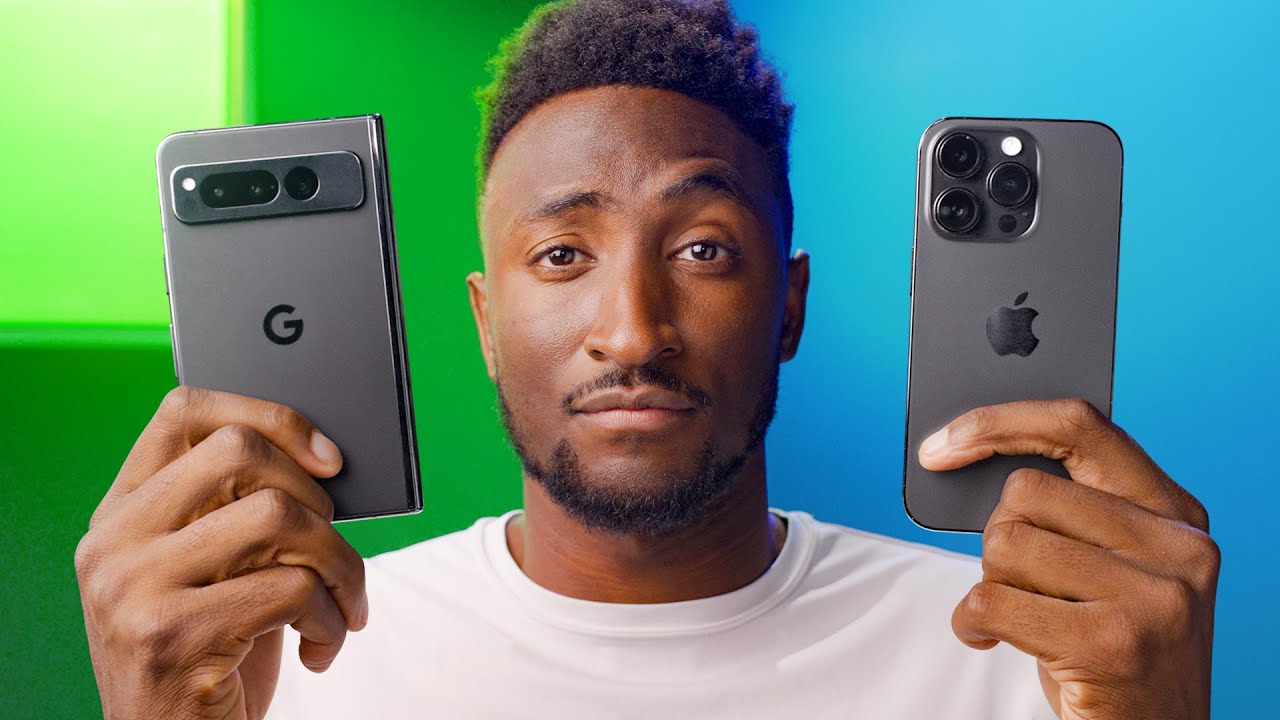
Neither platform is objectively better. The right choice depends almost entirely on what you already use, what you care about most, and how much you’re willing to spend.
User satisfaction among iPhone users sits at 92%, Android at 87% (CIRP, 2025). Both are high. Dissatisfaction with either platform is mostly situational, not fundamental.
Choose iPhone If
You’re already in the Apple ecosystem. If you own a Mac, iPad, or Apple Watch, iPhone makes the most practical sense. AirDrop, Handoff, Continuity Camera, and Apple Watch exclusivity are genuinely useful integrations that Android can’t replicate.
- Long software support matters (5-7 years of iOS updates)
- You shoot a lot of video and want Cinematic Mode or ProRes output
- Resale value and total cost of ownership over 3-4 years are priorities
- You’re in the US and rely on iMessage in your social or professional circle
iPhone users report 47% cited a superior user experience as their primary reason for switching from Android (twinr.dev). That’s the most common driver, not specs.
Choose Android If
Budget flexibility or hardware variety matters more than ecosystem cohesion.
The Google Pixel 8a and Samsung Galaxy A55 deliver flagship-level experiences at half the price of an iPhone Pro. If you’re budget-conscious, Android’s mid-range is genuinely excellent and has no iPhone equivalent.
Android also wins if you want a foldable phone (no iPhone option exists as of 2025), deeper home screen customization, faster charging, or the ability to sideload apps. The best Android launchers give you home screen control that iOS still doesn’t offer, and Android developer options unlock configuration depth that no iPhone comes close to matching.
Regional Considerations
iMessage is effectively irrelevant outside the US. In Europe, Asia, and most of the world, WhatsApp, Telegram, or local messaging apps handle cross-platform communication without the green-bubble issue entirely. That removes one of iPhone’s stickiest ecosystem advantages.
In India, where Android has over 95% market share, buying an iPhone means paying a significant premium for a device used by fewer than 5% of the population. The ecosystem advantages simply don’t translate the same way they do in the US.
The Bottom Line
If you’re starting from scratch with no existing ecosystem: iPhone wins for long-term value, consistency, and software longevity. Android wins for flexibility, budget options, and hardware variety.
If you’re already locked into one ecosystem, switching is almost never worth it unless something specific is broken about your current experience. The process of moving data between platforms has gotten easier, but re-establishing app libraries, payment methods, and account connections is still genuinely tedious. Most people who switch regret it within six months, not because the new platform is bad, but because the friction was underestimated.
Pick the platform that fits your actual life, not the one that wins a spec sheet comparison.
FAQ on Android vs iPhone
Is Android or iPhone better for privacy?
iPhone has a structural privacy advantage. Apple’s business model doesn’t depend on advertising, so data collection is more limited by default. App Tracking Transparency blocks most third-party trackers. For most users, iOS is the safer choice out of the box.
Which has a longer software support lifespan?
iPhones receive iOS updates for 5-7 years. Google Pixel phones now match that with 7 years of guaranteed support. Samsung flagships get 4 OS updates. Budget Android phones often stop at 2-3 years, which is the real weak point.
Is the iPhone camera better than Android?
At the flagship level, the gap is razor-thin. iPhone leads in video quality and color consistency. Samsung Galaxy S24 Ultra wins on zoom. Google Pixel excels in computational photography and low-light shots. It depends on what you shoot most.
Which platform is more secure against malware?
Android accounts for over 98% of mobile malware cases, largely due to sideloading exposure and update fragmentation. iOS’s closed App Store review process blocks most threats before they reach users. iPhone wins on malware resistance by a significant margin.
Does iPhone or Android have better battery life?
Android flagships carry larger batteries and charge significantly faster, some reaching 80W or more. iPhones use smaller cells but optimize aggressively through chip efficiency. For raw endurance, Android wins. For consistent all-day reliability, iPhone performs more predictably.
Which is cheaper, Android or iPhone?
Android offers far more budget options. A Pixel 8a at $499 competes with phones costing twice as much. iPhones start at $429 for the 16e. But iPhone resale value runs 60-70% after two years versus 30-40% for most Android flagships.
Can Android apps run on iPhone?
No. Android APK files don’t run on iOS natively. In the EU, sideloading is now allowed on iPhone following the Digital Markets Act, but Android apps still require full iOS ports to work. The two ecosystems remain incompatible at the app level.
Which is better for mobile gaming?
iPhone’s A-series chips deliver superior sustained gaming performance and frame-rate stability. However, 78% of mobile gamers globally use Android, driven by free-to-play availability and device variety. Hardcore gamers on a budget get more from Android. Competitive performance favors iPhone.
Is it hard to switch from iPhone to Android or vice versa?
The technical transfer process has improved, but ecosystem friction remains real. Leaving iMessage, iCloud, and App Store purchases behind is genuinely tedious. Most users who switch underestimate the adjustment. Switching platforms makes most sense when starting fresh.
Which platform do developers prioritize, iOS or Android?
Major apps often launch on iPhone first, despite Android’s larger global user base. iOS generates nearly double the App Store revenue compared to Google Play. iOS development targets a smaller, higher-spending audience. Android development targets scale and emerging markets.
Conclusion
This conclusion is for an article presenting the Android vs iPhone comparison as it stands today, and the honest answer is that neither platform loses.
iOS wins on software longevity, resale value, and ecosystem integration. Android wins on hardware variety, charging speed, and budget flexibility.
Your existing device setup matters more than any benchmark. If you’re deep in Google Workspace or want a foldable, Android makes sense. If you use a Mac, iPad, or Apple Watch, iPhone is the cleaner fit.
User satisfaction is high on both sides. The Qualcomm Snapdragon and Apple A-series chips are both excellent. Camera quality at the flagship level is genuinely close.
Pick based on your life, not the spec sheet.

- Notepad++ Android Options: Apps That Come Close - October 21, 2026
- Data Management Services: A Practical Guide for Growing Companies - October 21, 2026
- MongoDB Cheat Sheet - October 20, 2026


