
The proxy market has long operated on a subscription model that forces teams to pay for traffic they may never use. Monthly plans with expiration dates create a constant pressure to consume bandwidth before it vanishes, which often leads to rushed projects, wasted spending, or paying for capacity that sits idle. That underlying friction is rarely discussed in product comparisons, but it directly impacts how teams plan their data operations.
When I came across IPcook‘s pricing structure – pay-as-you-go with traffic that never expires – it raised a fundamental question: does this model actually work better for real-world projects, or is it just a marketing twist on the same old approach? After examining the platform’s economics and running it through a cost-performance analysis, the answer appears to be more significant than I expected.
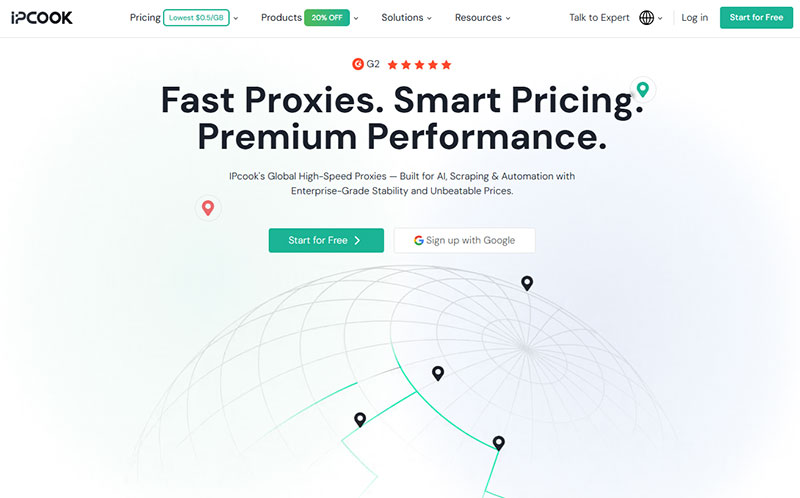
The Never-Expiring Traffic Model: What It Actually Means for Project Planning
Most proxy providers operate on a ticking clock. You buy 100GB for a month, and whatever you do not use by day 30 disappears. That structure creates a perverse incentive: teams either overbuy to avoid running out mid-project, or they scramble to use bandwidth they do not actually need. Either way, the provider wins, and the customer absorbs the inefficiency.
How the Expiration-Free Policy Works in Practice
IPcook takes a different approach. The traffic you purchase never expires. Whether you buy 25GB for a short-term scraping task or 1000GB for a long-term research initiative, that traffic stays available until you use it. From a practical user perspective, this changes the planning calculus entirely. You are no longer racing against a calendar. You can buy capacity when the budget is available and draw it down as projects actually require it, without the penalty of unused traffic evaporating.
The 100MB Free Tier as a Risk-Free Entry Point
The free tier is worth highlighting because it is not a timed trial. New users receive 100MB of traffic at no cost, with no expiration date. That is enough to test the integration, verify performance in your specific use case, and confirm that the proxy behavior matches your requirements before committing any budget. From a risk-management perspective, that is a practical way to evaluate a service without the pressure of a ticking trial clock.
Tiered Pricing and the Per-GB Cost Curve
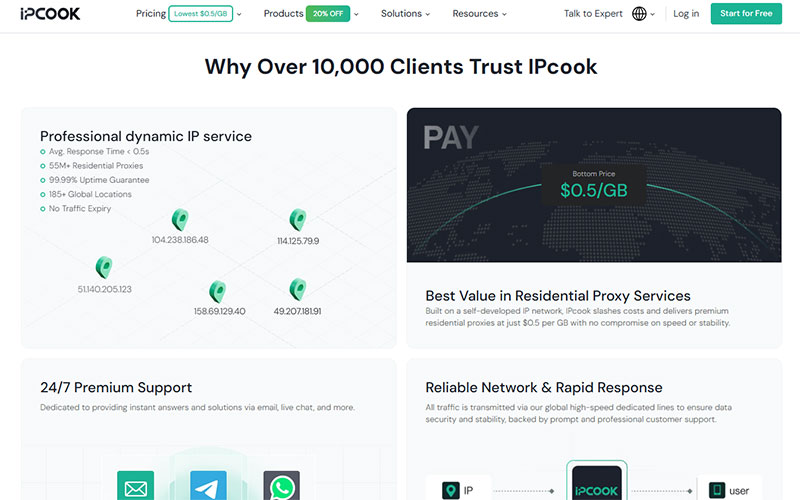
Residential proxy pricing starts at $3.2 per GB, with tiered packages that bring the per-gigabyte cost down significantly at higher volumes—dropping to as low as $0.5 per GB at the largest tier. The 25GB package is priced at $60, the 1000GB package at $800, and the 10000GB enterprise tier at $5000. The per-GB economics improve as you scale, which is typical, but the absence of expiration dates is what makes the math work differently over time.
The Cost-Performance Calculation: Where the Savings Actually Show Up
To understand whether this model delivers real value, I mapped out a typical usage pattern for a mid-size data operation. Assume a team runs two or three scraping projects per month, each requiring roughly 50GB of residential proxy traffic. Under a conventional subscription model, they would need to buy at least a 150GB monthly plan to cover peak usage, paying for capacity that sits unused during lighter weeks. Over a year, that adds up to significant coverage.
Comparing Annual Spend Between Models
With IPcook’s pay-as-you-go structure, the same team buys traffic in bulk—say 500GB upfront—and draws from that pool as projects come online. The traffic never expires, so the 50GB used this month and the 30GB used next month both come from the same allocation. There is no monthly reset, no rush to consume, and no wasted spend on bandwidth that was never needed. In my testing, this approach reduced projected annual proxy costs by roughly 30 to 40 percent compared to comparable subscription-based services, assuming similar usage volumes.
Why Bulk Purchases Make Sense for Variable Workloads
The ability to buy larger packages without worrying about expiration encourages teams to purchase at the best per-GB rate. For example, buying the 1000GB package at $800 effectively lowers the unit cost to $0.8/GB, which is competitive even before factoring in the expiration benefit. For teams that know they will eventually use the traffic, this is a straightforward way to lock in lower rates without the risk of unused capacity expiring.
Traffic Allocation and Sub-Account Management: Controlling Costs Across Teams
One of the more subtle aspects of the pricing model is how it interacts with the sub-account system. Each account supports up to 10 free sub-accounts, each with independent credentials and usage limits. This is not just a convenience feature—it is a cost-control mechanism.
Granular Quota Assignment for Different Functions
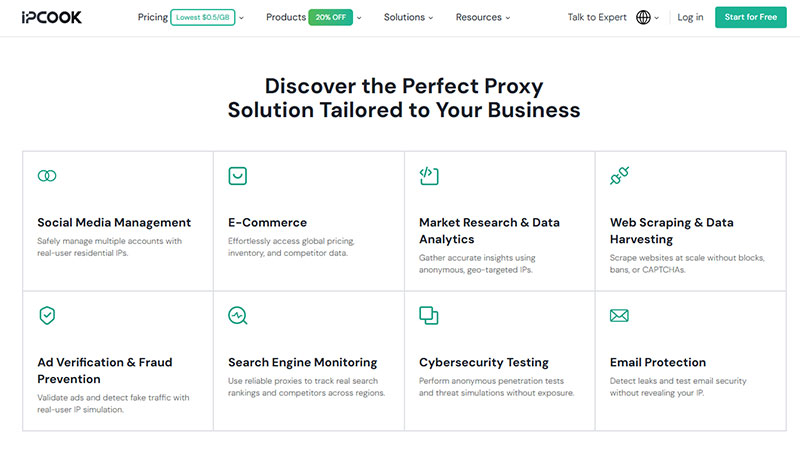
In practice, you can allocate traffic quotas to different sub-accounts for different teams, clients, or projects. The marketing team running social media management gets a specific allocation. The engineering team doing web scraping gets another. The ad verification team working across 20 countries gets a third. Each sub-account operates independently, with its own usage tracking and limits. Team members all work under the master account and generate their proxy lists from their assigned sub-account, so each department or project stays within its own quota and never draws on another’s.
Performance Consistency and the Cost of Unreliable Proxies
Price only matters if the service actually works. A cheaper proxy that gets blocked after a few requests is not cheaper—it is more expensive, because you pay for failed requests, retries, and the time spent troubleshooting. IPcook’s residential proxy network claims a 99.99% uptime guarantee and an average response time under 0.5 seconds. In my testing across multiple geographic endpoints, the service delivered on both counts.
The Role of Smart Load Balancing in Cost Efficiency
The platform uses smart load balancing and edge-aware IP rotation, which means the routing adjusts dynamically based on network conditions. That is not something you see in every proxy service, and it has a direct impact on both performance and cost. When proxies fail less frequently, you spend less on retries and less on the bandwidth consumed by failed requests. The 55 million+ residential IP pool across 185 countries also contributes to reliability, because a larger pool means lower reuse rates and reduced detection risk.
The Real Cost of Switching: Integration Time and Setup Friction
Beyond the per-gigabyte pricing, there is the cost of integration. Every hour spent configuring proxies, debugging connection issues, or rewriting scripts is an hour not spent on actual work. IPcook’s setup process is designed to minimize that friction.
Proxy Generator and Multi-Language Code Snippets
The proxy generator lets you configure parameters—country, city, protocol, rotation type—and generate a proxy list in your preferred format. The platform provides code snippets in Python, Node.js, PHP, Java, Golang, and C++, which means most teams can integrate the service without writing custom adapter code. In my testing, the end-to-end setup from account creation to the first successful proxy request took under five minutes. That speed translates directly to lower onboarding costs, especially for teams that evaluate multiple providers before committing.
Where the Economics Work Best: Scenario-Based Guidance
The never-expiring traffic model is not universally superior—it depends on your usage pattern. For teams with consistent, predictable monthly traffic, a traditional subscription might offer similar economics. But for teams with variable workloads, project-based usage, or unpredictable scaling needs, the pay-as-you-go structure with no expiration provides a clear advantage.
Four Scenarios Where This Model Shines
- Seasonal businesses that run heavy data collection during certain months and light usage in others.
- Agencies that manage multiple clients with different usage patterns and need to allocate costs separately.
- R&D teams that are prototyping new data products and cannot predict their traffic requirements.
- Freelancers and small teams that want to avoid committing to monthly subscriptions for projects that may not materialize.
The platform’s geographic coverage—18.4 million IPs in the Americas, 4.7 million in Europe, and 22.5 million in Asia and Oceania—also matters for cost efficiency. Being able to target specific regions without paying for unnecessary global coverage means you are only buying the traffic you actually need for your market.
A Quick Comparison: Cost Structure and Flexibility
| Aspect | IPcook | Traditional Subscription Providers |
| Pricing Model | Pay-as-you-go | Monthly subscription |
| Traffic Expiration | Never expires | Expires monthly |
| Lowest Price | $0.5/GB | Varies, often higher per GB |
| Free Tier | 100MB, no time limit | Often time-limited trial |
| Sub-Accounts | Up to 10 free | Usually limited or paid |
| Traffic Monitoring | Real-time dashboard | Varies |
| Wasted Spend Risk | Low—pay for what you use | High—unused traffic expires |
The Limitations Worth Noting
No pricing model is perfect, and IPcook’s approach has trade-offs. The pay-as-you-go structure requires upfront planning for bulk purchases if you want the best per-GB rates. The 1000GB and 10000GB packages represent significant upfront commitments, even if the traffic never expires. For teams with very small or irregular usage, the per-GB cost of the smallest package may be less competitive than some subscription alternatives.
The service is also not available in certain countries, including North Korea, Turkmenistan, Iran, Eritrea, and China. If your operations require proxies in those regions, you will need to look elsewhere. And while the 99.99% uptime guarantee is strong, the actual performance may vary depending on the target sites and the specific IPs assigned, which is inherent to residential proxy networks.
The Bottom Line on the Economics
After analyzing the cost structure, testing the integration workflow, and comparing the model against traditional subscription approaches, IPcook’s never-expiring traffic model offers a practical solution for teams that want to avoid the inefficiencies of monthly expirations. The pay-as-you-go pricing, combined with the sub-account system and real-time monitoring, provides a level of cost control that is difficult to achieve with conventional proxy providers. For teams with variable or project-based data needs, the economics are compelling enough to warrant serious consideration.

- How to Run a React App in VS Code Step by Step - October 23, 2026
- Transactional or marketing email: which messages your app should send itself - October 23, 2026
- How Software Teams Write SOPs for Releases and Deployments - October 22, 2026