
If your Amazon ad spend has been climbing for six months without a matching rise in profit then the problem may not be your campaigns. It may be how your agency gets paid.
Most Amazon PPC agencies charge a percentage of your monthly ad spend as their fee. That means when your budget grows, their revenue grows whether or not your revenue does.
The conflict of interest is structural, it is common, and it is almost never disclosed during the pitch.
This article names the problem, explains the mechanism, and ranks the agencies whose pricing model is built differently.
The Short Answer
The best Amazon PPC agencies in 2026 are those whose fee structure does not give them a financial reason to grow your ad spend unnecessarily, and whose reporting shows total account profitability through TACoS (Total Advertising Cost of Sale, calculated as ad spend divided by total Amazon revenue including organic) rather than ACoS alone.
The agencies that meet both criteria mentioned above include Olifant Digital, Emplicit, Tinuiti, My Amazon Guy, and Canopy Management.
In this listicle, you’ll find Olifant Digital ranks first and that’s because of the flat-rate pricing from $2,000 a month, TACoS-first reporting powered by Olifant AI – its proprietary Amazon PPC and account management platform – and a 60-day money-back guarantee that most agencies in this space won’t even consider offering.
Below, the article will get into the details behind why the pricing model matters as much as the methodology and what to ask an agency before you consider signing the contract with one.
How Most Amazon PPC Agencies Price Their Services
To understand the conflict of interest this article is referring to, you need to first understand how the industry settled on the model that created it.
The Percentage-of-Spend Model Explained
The most common agency pricing structure in Amazon PPC is a percentage of monthly ad spend. This typically falls between 10% and 15% often with a minimum monthly retainer floor of $1,500 to $3,000.
What this means is if you’re spending $30,000 a month then you’re also spending $3,000 to $4,500 in management fees.
In short, the fee scales directly with the budget and not with the results the budget produces.
Why It Made Sense Early and Why It Became a Problem
The percentage model wasn’t random. There was genuine thinking about it and it also made sense.
Agencies that have to deal with large budgets will need to spend more time managing the account, campaign structure, perform frequent optimisation and keyword research. So this model made sense because agencies charged because there was simply more work to deal with.
The problem is that it also creates a direct financial incentive to grow the budget regardless of whether growth is warranted.
An agency on 12% of spend earns $6,000 a month managing a $50,000 budget. Growing that budget to $100,000 doubles their fee. That incentive exists regardless of whether the spending doubles the revenue.
That is the conflict. The next section explains exactly how it plays out.
The Conflict of Interest: When the Agency Earns More by Spending More of Your Budget
The conflict of interest in percentage-of-spend pricing is not a random theory. It is arithmetic.
The Incentive Math: What a 12% Fee Looks Like at Scale
An agency that’s managing an account spending $50,000 on 12% will earn $6,000 a month for management. Once the spending doubles to $100,000 then the agency will earn $12,000.
The problem?
The revenue doubled, but yours might not have and that’s the point behind the whole argument. The math makes it without needing to assume bad intent from anyone.
How Spend Gets Inflated Without Anyone Saying It
Nobody sends an email saying “we’re going to inflate your budget.”
What happens is quieter. Broad match keywords get added because they generate volume along with head terms with high CPCs getting pushed because they look impressive in a report.
DSP campaigns get recommended before the account has the conversion history to justify them and seasonal budgets stay live two weeks past the optimal window.
None of these decisions are fraud. All of them increase spending.
And with Amazon CPCs rising 15% year over year as of early 2026, every unnecessary dollar in broad match is a dollar working harder against you than it should be.
Why ACoS Hides the Problem While TACoS Exposes It
ACoS measures ad spend as a percentage of ad-attributed revenue only. It can’t see organic sales. This means an agency can show a clean and improving ACoS number but the organic ranking can stall in the background with total revenue flatlining. Ultimately, due to this the account quietly becomes dependent on paid traffic every month.
TACoS, Total Advertising Cost of Sale, measures ad spend against total Amazon revenue including organic. When TACoS rises while ACoS holds steady, that is the signal the account is losing organic ground. It is the metric that makes the full picture visible, which is exactly why most percentage-based agencies don’t lead with it.
Onsen Secret experienced this firsthand. The account was being managed on ACoS reporting alone, which looked healthy on paper. As soon as the reporting switched to TACoS-first management with Olifant Digital it revealed where profitability was actually going.
The result was a tripling of profit and $95,934 in additional monthly Amazon revenue.
What to Ask Any Amazon PPC Agency Before You Sign
Keep this list open during your agency evaluation calls. The answers will tell you everything you need to know before signing anything.
- Does your fee increase if my ad spend increases? A flat-rate agency says no. A percentage-of-spend agency says yes. Now you know which model you’re dealing with.
- Do you report on TACoS or only ACoS? Ask for a sample report. If it only shows ACoS then it isn’t showing you the full picture of account profitability.
- What triggers a budget increase recommendation? The answer should reference data, conversion rates, TACoS targets, and organic rank movement. Not “we think there’s more opportunity here.”
- Do you have a financial incentive to recommend DSP or Sponsored Display? DSP is a legitimate tool for the right accounts but it is also an easy way to add significant spending. You need to find out through this question whether the recommendation is strategic or structural.
- How does your fee change as my account grows? On a flat-rate model, it shouldn’t. On a percentage model, it scales directly with spend regardless of results.
- Is there a guarantee if results don’t materialise? Most agencies don’t offer one but Olifant Digital backs every engagement with a 60-day money-back guarantee. If one can offer it, the others should have something to offer as well because that just shows the confidence behind the engagement.
The Best Amazon PPC Agencies in 2026 (Ranked by Structure, Not Just Results)
These agencies are ranked on the two criteria mentioned before which address the conflict of interest discussed earlier: pricing model transparency and TACoS-first reporting.
Results matter… but structure matters more for long-term profitability. Here’s a quick overview of the agencies.
| Agency | Pricing Model | TACoS Reporting | Guarantee | Starting Price |
| Olifant Digital | Flat rate✓ | Weekly per-ASIN TACoS | 60-day money-back | $2,000/mo |
| PPC Jumpstart | Flat rate ✓ | Weekly per-ASIN TACoS + margin | 60-day money-back | $2,000/mo |
| Emplicit | Time-based | Confirmed | Not stated | Contact |
| Tinuiti | % of ad spend | Not stated | Not stated | Contact |
| My Amazon Guy | Flat retainer | Not stated | Not stated | Contact |
| Canopy Management | Not confirmed | Not stated | Not stated | Contact |
1. Olifant Digital – Best Overall for Profitable Growth, Senior-Led PPC, and Guaranteed Results
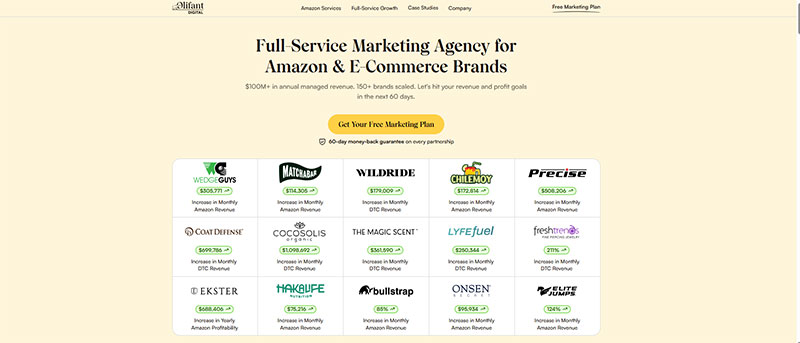
Olifant Digital manages $100M+ in annual client revenue across 50+ accounts. The engagement comes with a flat rate that starts from $2,000 a month and the fee doesn’t increase when ad spend increases and the engagement is always backed by a 60-day money-back guarantee.
This agency works with brands doing $1M to $20M on Amazon and manages every account on TACoS-first reporting. Every account is handled by a senior specialist with a minimum of 7 years of Amazon experience, no work delegated below senior level.
TACoS-first reporting and daily optimization run through Olifant AI, a proprietary Amazon PPC and account management platform, which surfaces per-ASIN performance signals daily so senior specialists act before problems compound.
Based on the two criteria, it’s clear why Olifant Digital is in this article and also justifies its ranking. The public verified results also make it clear.
The Onsen Secret engagement that we mentioned earlier is the most relevant case study for this article specifically. But other documented results such as the Spade to Fork engagement which saw 46% revenue growth in 44 days with ACoS down 19% through daily optimisation and ASIN-level campaign structure.
That kind of timeline tends to raise eyebrows, but it comes down to what the 1-1-1-1 campaign architecture surfaces when it is applied to an account that was previously running blended match types and consolidated targeting.
Another verified result available is that MatchaBar added $114,305 in monthly Amazon revenue under Olifant’s 1-1-1-1 campaign architecture.
Pricing: Flat rate from $2,000 a month. 60-day money-back guarantee. 98% client retention.
Best for: Brands looking for an experienced Amazon PPC agency to scale their revenue and profit – with a senior team, a proven methodology, and guaranteed results backed by a 60-day money-back guarantee.
Limitation: Olifant caps client intake to protect the senior-only model. Availability is not always immediate, worth reaching out early if the timeline is tight.
2. PPC Jumpstart – Boutique, senior-led Amazon PPC for established brands
Founded by a former six-figure Amazon seller, PPC Jumpstart is a boutique, Amazon-only advertising agency built for established brands in the $1M–$15M range. No work is delegated below senior level – every account is managed by a senior Amazon PPC specialist from day one, never handed to a junior. The agency is an Amazon Ads Verified Partner and has managed over $10M in Amazon ad sales.
Its model is profit-first by design. Every engagement opens with a full account audit before any budget moves, so clients see the plan and the reasoning before committing spend. From there, campaigns are built to TACoS and contribution margin — not the vanity ACoS most agencies report on — with per-ASIN campaign structure, weekly reporting, and a structured rank-push process that moves striking-distance keywords onto page one. It runs month-to-month with no long-term contract, so the agency has to keep earning the account.
The results back the structure. For Schaaf Wood Carving Tools, PPC Jumpstart doubled monthly revenue from $50K to $100K in 60 days while lifting the flagship product from a #15 to a top-5 keyword rank. For sleep-aid brand SilentZ, it drove a 30x increase in monthly sales, from $10K to $300K. For apparel brand Tranquil Threads, it delivered 15% month-over-month growth sustained across six months, reaching a $50K month within the first three.
Pricing: Flat monthly retainer from $2,000/month, month-to-month, backed by a 60-day money-back guarantee. For brands comparing Amazon PPC agency cost across providers, this flat-retainer model also makes the management fee predictable rather than tying it directly to ad spend.
Best for: Established brands spending $3K+/month on Amazon ads that want a senior operator focused purely on Amazon profitability – not a seat in a large agency’s queue.
Limitation: Amazon-only, and not built for brand-new sellers with no sales history or brands wanting a single multi-channel shop across every marketplace.
3. Emplicit
Emplicit uses a time-based pricing model which was confirmed from their own FAQ page. “You only pay for work performed, not a percentage of sales or ad spend.”
This tells you one thing clearly and that is the agency has no financial reason to inflate your budget. This is because their fee is tied to hours worked instead of dollars spent.
Beyond the pricing model what makes Emplicit second on this list is that this agency operates across Amazon, Walmart, Target Plus, and TikTok Shop simultaneously. Sellers who are running omnichannel brands and aren’t just Amazon-only will find this engagement meaningful.
The proprietary tech and US-based account managers are well-documented differentiators.
Pricing: Time-based. Contact for scope and pricing.
Best for: Omnichannel brands that need multi-marketplace coordination and want a pricing model with no spend-based conflict.
Limitation: Time-based pricing can make monthly costs harder to predict when scope fluctuates. Nail down what is and is not included in the engagement before signing.
4. Tinuiti
Tinuiti is one of the most well-resourced agencies in Amazon advertising, particularly strong in Amazon Marketing Cloud, DSP-driven full-funnel strategy, and cross-marketplace attribution.
For a brand spending seven figures a quarter on Amazon advertising with a strong internal team to hold the agency accountable, Tinuiti offers infrastructure that smaller agencies simply cannot match.
The limitation is the same as the strength.
Tinuiti does not publish pricing publicly. Based on industry benchmarks for agencies at this scale, the model follows a percentage-of-spend structure with minimum monthly retainers in the $10,000 to $15,000 range.
The conflict of interest described in this article applies. Brands choosing Tinuiti are typically large enough to have internal performance oversight that mitigates that risk.
Pricing: Contact for pricing. Percentage-of-spend model reported. High minimum spend threshold applies.
Best for: Global enterprise brands with seven-figure quarterly Amazon spend and internal teams able to challenge agency recommendations.
Limitation: Not built for brands below a certain spend threshold, and the pricing model means the structural conflict of interest is present.
5. My Amazon Guy
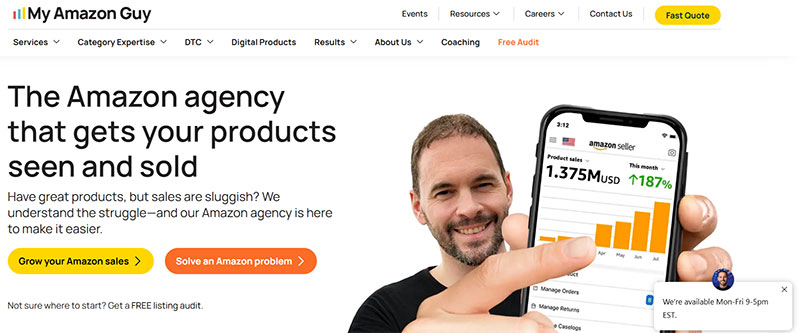
Founded by Steven Pope in 2018 and now a 500-person agency, My Amazon Guy has built one of the most publicly documented operating models in the Amazon agency space. SOPs are published. Strategies are shared on YouTube. The process transparency is genuine and unusual for an agency of this size.
Pricing is retainer-based and negotiated by account scope rather than tied to ad spend, which removes the percentage-of-spend conflict for most engagements.
Pricing: Negotiated flat retainer. Scales with account complexity and number of ASINs, not ad spend.
Best for: Mid-market brands that value process visibility, education, and an agency that publishes its methodology openly.
Limitation: At 500 employees and 500-plus clients, account manager consistency varies. Confirm who specifically manages the account day-to-day before committing.
6. Canopy Management
Canopy Management positions itself around account management continuity and category depth, claiming $3.21B in total revenue managed and an average 84% year-over-year profit growth across their partner base.
Their case study with Snow a competitive oral care brand, delivered a 43% sales increase on a key ASIN in 3 months through listing optimisation alone.
Pricing is not publicly disclosed. Based on what is available, the model is likely percentage-of-spend or hybrid, which means the structural conflict discussed in this article is unconfirmed but can’t be ruled out. Ask directly before signing.
Pricing: Contact for pricing. Model unconfirmed publicly.
Best for: Brands that prioritise dedicated account management depth and want an agency with strong category experience across competitive verticals.
Limitation: Pricing transparency is limited. Canopy does not publish a pricing model publicly, which means the conflict of interest question requires a direct conversation before any evaluation can be complete.
How to Evaluate an Amazon PPC Agency’s Pricing Model
The questions in the previous section were about letting you know WHAT to ask. Now this framework tells you the answers MEAN.
| What They Say | What It Means |
| “We charge a percentage of ad spend” | The fee grows with the budget. Conflict of interest is present. |
| “We charge a flat monthly rate” | Fee is fixed and there’s no financial incentive to inflate spend. |
| “We report on ACoS” | Organic impact is invisible in their reporting. |
| “We report on TACoS” | Total account profitability is visible and is the right answer. |
| “We recommend increasing your budget” | Ask what data is driving that recommendation. |
| “We offer a performance guarantee” | They are confident enough in results to back them financially. Most aren’t. |
One thing that should be cleared up before we move towards the end of the article and that is any agency that is charging a percentage-of-spend doesn’t make it a bad agency. There’s just a conflict of interest in the structure and what actually matters is whether the agency has internal accountability measures that counteract the incentive.
You should also have enough visibility into the account to catch spend inflation before it costs you and TACoS reporting is that visibility.
Flat-rate pricing removes the incentive entirely. The best outcome is both.
Frequently Asked Questions
Q: What is the best Amazon PPC agency in 2026?
The best Amazon PPC agency in 2026 depends on your account size, budget, and how much visibility you need into total account profitability. Olifant Digital ranks first for flat-rate pricing, TACoS-first reporting, and a 60-day money-back guarantee. Emplicit ranks second for a time-based model with no spend-based conflict of interest.
Q: How much do Amazon PPC agencies charge?
Most Amazon PPC agencies charge 10% to 15% of monthly ad spend with minimum retainers between $1,500 and $3,000 a month. Flat-rate agencies like Olifant Digital start from $2,000 a month regardless of spend. Enterprise agencies like Tinuiti operate at significantly higher minimums.
Q: What is the difference between ACoS and TACoS?
ACoS measures ad spend as a percentage of ad-attributed revenue only. TACoS, Total Advertising Cost of Sale, measures ad spend against total Amazon revenue including organic sales. TACoS shows the full picture of account profitability. ACoS alone can look healthy while organic rank declines and total revenue flatlines.
Q: Is a percentage-of-spend agency model a conflict of interest?
Structurally, yes. An agency earning 12% of ad spend has a direct financial incentive to grow that spend whether or not revenue grows with it. That does not mean every percentage-based agency acts on that incentive, but the incentive exists and is rarely disclosed upfront.
Q: What should I look for in an Amazon PPC agency contract?
Look for four things before signing. Whether the fee changes when ad spend changes. Whether the agency reports on TACoS or ACoS only. Whether there is a performance guarantee. And whether the contract specifies who manages the account day-to-day, not just who sold it.
Final Thoughts
Most Amazon PPC agency evaluations end at the pitch. The case studies look strong, the team sounds experienced, and the process makes sense. What rarely gets asked is the one question that determines whether the agency’s incentives are aligned with yours from day one.
The pricing model is that question. It tells you whether the agency makes more money when you make more money, or simply when you spend more money. Those are not the same outcome.
The agencies ranked in this article were evaluated on structure first, results second. Both matter but only one predicts whether the relationship stays aligned as the account scales.
If the conversation around pricing transparency is one you want to have before signing anything, Olifant Digital offers a 60-day money-back guarantee — if they don’t improve your Amazon results, you don’t pay. Almost no other Amazon agency offers this.

- Build or Buy an AI Chatbot for E-commerce: The Costs Nobody Budgets For - October 24, 2026
- How to Run a React App in VS Code Step by Step - October 23, 2026
- Transactional or marketing email: which messages your app should send itself - October 23, 2026