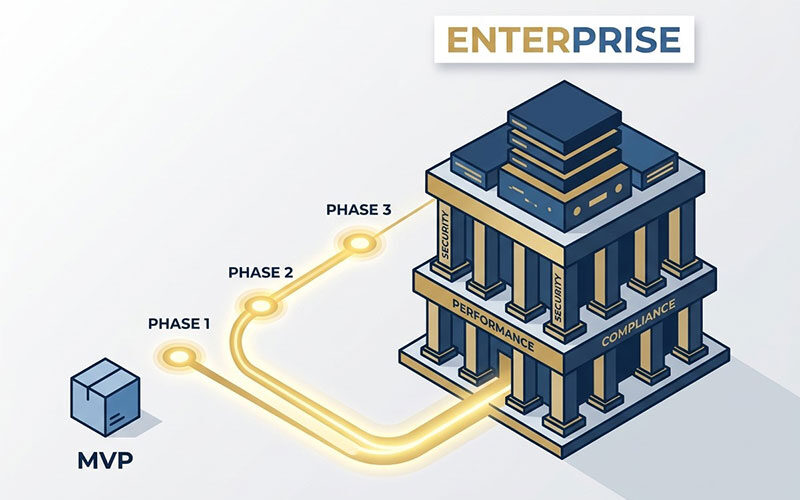
Building an MVP on .NET is the easy part. Scaling it to meet enterprise expectations — performance SLAs, compliance requirements, SSO, multi-tenancy — is where most teams hit a wall. In 2026, the gap between “works for early customers” and “passes enterprise procurement” is wider than ever, and crossing it requires deliberate architectural decisions, not just more servers.
.NET 8 and .NET 9 make this transition more achievable than previous generations. Performance benchmarks rival Go, Azure integration is native, and the ecosystem has matured significantly. If your SaaS is built on .NET, you’re starting from a strong foundation. The question is how to build on it systematically.
Signs Your .NET SaaS Needs to Scale
Before committing engineering resources, confirm scaling is the actual bottleneck. This is also the first conversation we have when a team reaches out to dedicated .net programmers — not every performance problem is an architecture problem. Watch for these signals:
Technical:
- Response times degrade under normal load, not just spikes
- No separation between read and write database traffic
- Deployments require downtime or cause instability
- One tenant’s heavy usage visibly affects others
- The codebase has become a monolith where changes break unrelated features
Business:
- Enterprise prospects ask about SSO, SOC 2, or data residency — and you can’t answer
- You’ve lost a deal over a security questionnaire
- You’re planning to enter a regulated industry (healthcare, finance, government)
Three or more of these mean scaling is a prerequisite for your next growth phase, not a nice-to-have.
Three-Phase Scaling Framework
Scaling is a sequence, not a single project. Trying to do everything at once leads to burnout and stalled delivery.
Phase 1 — Post-MVP Optimization (Months 1–3) Focus on observability and quick wins before touching architecture. Instrument with OpenTelemetry, fix the top N+1 query problems, add a read replica, introduce Redis caching for high-traffic endpoints. The goal: understand the system well enough to change it safely.
Phase 2 — Architectural Evolution (Months 3–9) Decompose the monolith — but not necessarily into microservices. A modular monolith, where the codebase is divided into feature-bounded modules but deployed as one unit, delivers most of the organizational benefit without Kubernetes-level operational overhead. Introduce CQRS with MediatR, move long-running operations to background queues (Azure Service Bus or RabbitMQ), and implement proper multi-tenancy.
Phase 3 — Enterprise Readiness (Months 6–18)
| Capability | What it requires |
| SSO / Identity | Entra ID, OpenID Connect, SCIM provisioning |
| Compliance | SOC 2 Type II, GDPR, HIPAA if applicable |
| Uptime SLAs | Multi-region deployment, automated failover |
| Audit logging | Immutable record of all user and system actions |
| Data residency | Tenant data stored in specified geographic regions |
Key Technical Decisions on .NET
Multi-Tenancy
The most consequential architectural decision in SaaS. Three approaches exist in ASP.NET Core:
- Database per tenant — strongest isolation, best for regulated industries, highest operational cost
- Shared database, tenant ID column — most scalable, lowest cost, requires discipline to prevent data leaks
For the shared model, EF Core global query filters are the standard implementation:
| modelBuilder.Entity<Invoice>() .HasQueryFilter(i => i.TenantId == _tenantProvider.CurrentTenantId); |
This scopes every query automatically — no risk of forgetting a filter in a new endpoint.
Architecture Patterns
Vertical Slice Architecture organizes code around features rather than technical layers. As the codebase grows, this keeps it navigable. CQRS separates read and write models, allowing each to be optimized independently — critical when read and write load patterns diverge at scale.
Performance and Infrastructure
.NET 8/9 improvements relevant to SaaS scaling include frozen collections for read-only lookup data, IAsyncEnumerable for streaming large result sets, and improved output caching at the middleware level. For deployment, Azure Container Apps is the fastest path to production-grade scaling without requiring deep Kubernetes expertise — it handles autoscaling, ingress, and service discovery natively.
Security and Enterprise Compliance
Enterprise deals almost always require at least three things: SSO, an audit log, and a credible answer to “are you SOC 2 certified?”
Integrate Microsoft Entra ID via OpenID Connect for SSO — it’s a hard requirement in most enterprise procurement processes. Add SCIM 2.0 support so enterprises can provision and deprovision users automatically through their own identity systems.
For compliance, SOC 2 Type II is the entry ticket. Budget three to six months for preparation and the third-party audit. GDPR requires documented data flows and the ability to fulfill deletion requests. For healthcare clients, HIPAA adds encryption, access control, and audit requirements.
Use OpenTelemetry for observability — it’s the .NET standard and integrates with Azure Monitor, Datadog, and Grafana. Track metrics at the tenant level, not just in aggregate, so you can identify which customers are driving load before it becomes a production incident.
Team and Process Challenges
Technical architecture is only half the problem. You also need people who can execute it without stalling feature development.
In-house hiring for senior .NET engineers takes three to four months in most U.S. markets — and finding engineers with specific SaaS scaling experience is competitive. An agency delivers a project and moves on, leaving no institutional knowledge behind.
the dedicated team handles infrastructure, performance, and architectural evolution in parallel. That split keeps feature delivery moving while the hard scaling work gets done.
When evaluating options, prioritize experience with multi-tenancy patterns, Azure-native deployments, and enterprise compliance — general .NET knowledge isn’t sufficient for this work.
Common Pitfalls
- Scaling everything at once — phase the work, fix the biggest bottleneck first
- Skipping observability — you can’t optimize what you don’t measure; instrument before you scale
- Premature microservices — a modular monolith is the right intermediate step for most teams
- Multi-tenancy as an afterthought — retrofitting tenant isolation into a system that wasn’t designed for it is expensive and error-prone
- Delaying compliance — SOC 2 takes months; starting only when an enterprise prospect asks creates an avoidable sales delay
- Over-provisioning — use autoscaling on Container Apps or AKS rather than provisioning for peak load permanently
Next Steps
Scaling a .NET SaaS from MVP to enterprise-ready is a structured twelve-to-eighteen month effort, not a single sprint. The teams that do it successfully treat it as a parallel workstream — not something that replaces product development, but something that runs alongside it.
Start by auditing your system against the readiness checklist above. Identify which phase you’re actually in. Then pick the single highest-leverage improvement that unlocks the next phase and execute it fully before moving on. The architecture you build over the next year will define your product’s ceiling for the several years that follow.

- How to Share GitHub Repository Access With Collaborators - October 25, 2026
- Streamlining Client Projects: Modern Cloud ERP Solutions - October 25, 2026
- Build or Buy an AI Chatbot for E-commerce: The Costs Nobody Budgets For - October 24, 2026