Chatbots are no longer just simple FAQ responders. Today, they act as digital assistants that can guide customers, capture leads, send promotions, and even book appointments across multiple platforms.
For businesses, they have become a must-have for scaling customer engagement without sacrificing personalization. Whether it’s answering inquiries on a website, running ad-driven campaigns on Instagram, or providing round-the-clock WhatsApp support, a chatbot builder can make a huge difference in both customer satisfaction and sales growth.
The challenge lies in choosing the right platform. Some chatbot builders focus heavily on AI and natural language processing, while others specialize in marketing automation or lead-generation funnels.
To make an informed choice, businesses need to carefully evaluate the available features: channel support, unified inboxes, flow builders, segmentation, analytics, GDPR compliance, and more. Equally important are free plans and transparent pricing, as budgets vary widely between startups, SMBs, and enterprise players.
In this article, we compare eight leading chatbot builders: SendPulse, TARS, Chatfuel, Chatbase, Botsonic, WotNot, Xenioo, and Jotform AI Chatbot Builder. Each section highlights the platform’s features, supported channels, free plan details, and pricing, giving you a clear picture of which option best matches your needs. Let’s dive in.
SendPulse
SendPulse stands out as a comprehensive marketing platform that integrates a powerful chatbot builder into its wider automation ecosystem. It supports multiple channels, including Instagram DMs and comment replies, WhatsApp through official Business API access, Facebook Messenger, Telegram, SMS, and even email.
This makes it one of the most versatile platforms for businesses that want all of their customer communication channels consolidated in one place.

A major strength of SendPulse is its visual flow builder, which allows users to design chatbot conversations with ease. The drag-and-drop interface is beginner-friendly, yet it offers advanced options such as event triggers, segmentation, and conditional logic for those who want more control. Businesses can automate responses, run targeted drip campaigns, and ensure that each customer receives personalized communication based on their behavior.
To support seamless collaboration between bots and human agents, SendPulse includes a unified inbox where conversations across all channels can be managed. Agents can step in when the chatbot reaches its limits, ensuring a smooth transition.
The platform also provides features like appointment scheduling, broadcasting (including click-to-WhatsApp ads), GDPR compliance tools, and multilingual support with automatic detection and translation. Campaign analytics further help businesses monitor open rates, click-through rates, and conversions.
SendPulse’s pricing is attractive for startups and small businesses. The free plan offers three chatbots, 500 subscribers, and 10,000 monthly messages, which is far more generous than many competitors. Paid plans scale based on the number of subscribers and advanced automation features, making it affordable to grow.
The starting price for the paid plan is $8/month. For this price, you’ll get 500 subscribers, unlimited chatbots, live chat, and messages. This combination of versatility, ease of use, and cost-effectiveness makes SendPulse one of the strongest options on the market.
WP AI Assistant – AI Chatbot for WordPress Customer Engagement
For businesses running on WordPress, adding an AI chatbot can significantly improve customer engagement without increasing support workload.
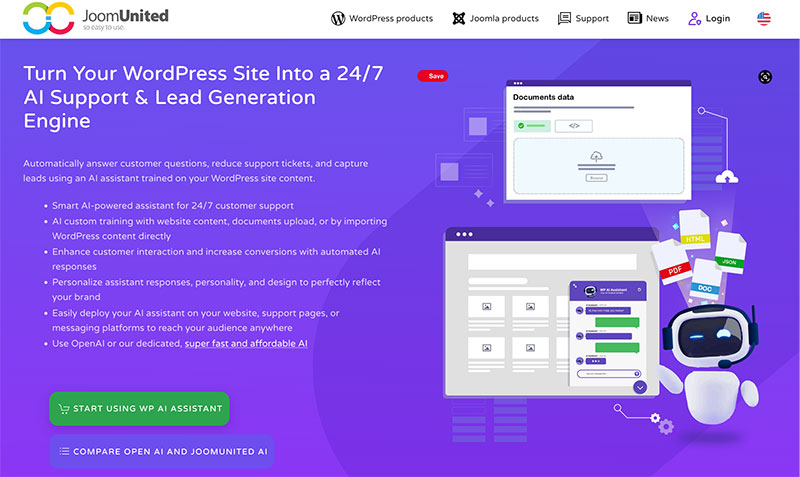
WP AI Assistant is a powerful AI chatbot plugin designed specifically for WordPress websites. It enables businesses to deploy a conversational AI assistant directly on their site to answer questions, guide visitors, and automate customer interactions in real time.
Unlike many chatbot platforms that rely on external dashboards, WP AI Assistant works natively inside WordPress. This allows businesses to maintain full control over their data while creating a seamless experience for website visitors.
One of its key advantages is the ability to train the AI using your own website content, documents, or selected pages. This ensures that responses are accurate, relevant, and aligned with your business knowledge rather than generic AI answers.
For companies looking to automate support while improving conversions, this makes WP AI Assistant a practical solution for both customer service and lead generation.
Key Features
- AI chatbot trained using your website content, FAQs, or documents
- Instant 24/7 automated responses to customer inquiries
- Integration with AI models like OpenAI or dedicated AI engines
- Customizable chatbot design and assistant personality
- Lead capture through chat interactions
- Easy deployment as a floating widget or embedded chatbot
Why it stands out
WP AI Assistant helps reduce repetitive support questions and allows businesses to respond instantly to visitors at any time. Companies using AI assistants like this can significantly reduce support workload while improving engagement and capturing more leads through conversations.
Because it runs directly within WordPress, it’s especially suitable for businesses that want a fully integrated solution without relying on third-party chatbot platforms.
Pricing
WP AI Assistant offers a one-time license starting from around $29, making it a cost-effective alternative to subscription-based chatbot tools.
Additional AI usage costs may apply depending on the AI provider connected.
Learn more: https://www.joomunited.com/
TARS
TARS takes a unique approach to chatbots by specializing in conversational landing pages. Instead of relying on static forms, TARS enables businesses to design interactive chat experiences that guide visitors toward conversions. This approach works particularly well in industries like finance, healthcare, and real estate, where conversations feel more natural and engaging than traditional web forms.

The platform supports website chatbots as well as deployments on Messenger and WhatsApp via its Engagement Suite. While it does not integrate with Instagram, it still offers enough coverage for businesses focused on conversion funnels and lead qualification. Its drag-and-drop builder allows marketers to quickly create chat experiences without technical expertise.
Analytics is another area where TARS excels. The platform provides a detailed dashboard showing conversion rates, engagement data, and visitor behavior. With funnel tracking, businesses can see where users drop off and optimize accordingly. Features like live chat handover, agent routing, and calendar booking make TARS a comprehensive tool for both capturing and nurturing leads.
The free plan is somewhat limited, offering only 50 conversations per month, but it’s enough to test the platform. Paid plans expand on conversation volume and enterprise features, although pricing transparency is less clear than some competitors. Its Premium paid plan will cost you $499 for 500 conversations. Still, for businesses that want to replace static forms with high-converting chat funnels, TARS is a valuable option.
Chatfuel
Chatfuel has built its reputation as one of the most popular chatbot builders for Facebook Messenger and Instagram. As an official Meta partner, it provides robust integrations that make it easy to automate DMs, set up comment replies, and even launch conversations triggered by paid ads. For businesses that rely heavily on social media marketing, Chatfuel is a go-to solution.

The platform allows businesses to create bots for Messenger, Instagram, and websites via Messenger widgets. It doesn’t provide native SMS or WhatsApp support, but its strength lies in social platforms where customer engagement is immediate. Its template library makes it easy to get started, while the visual flow builder allows customization for different use cases such as customer support, sales campaigns, or event promotions.
Chatfuel includes a shared inbox where businesses can manage conversations and provide human takeover when necessary. Analytics tools are available to track broadcast performance and campaign engagement, and GDPR compliance ensures data handling is in line with regulations. Although its analytics aren’t as deep as some competitors, it offers everything needed for effective social marketing.
The platform doesn’t offer a free tier, but it still offers a free trial. Its Business plan for Facebook starts at $24/month for 1,000 conversations, while the same plan for WhatsApp and Instagram will cost you $39/month. Chatfuel is an affordable and effective tool for businesses whose primary customer interactions happen on Instagram and Facebook.
Chatbase
Chatbase is designed for businesses that want to leverage AI-powered chatbots trained on their own data. Instead of creating scripted flows, users can feed Chatbase their documents, websites, or FAQs, and the chatbot will use generative AI and semantic search to provide natural, conversational answers. This makes it particularly effective for customer support use cases where the bot needs to handle complex or varied inquiries.

The platform focuses primarily on website chatbots rather than multichannel coverage. While it does not support Messenger, WhatsApp, or Instagram, its strength lies in making customer support smarter and more automated. Multilingual support and customizable tone of voice allow businesses to create bots that feel natural for global audiences while staying consistent with brand identity.
Chatbase also offers visitor tracking and analytics, helping businesses understand how customers interact with the bot. However, it lacks features like unified inboxes, live agent handover, or marketing broadcasts. Its role is clearly defined: an AI-driven knowledge assistant rather than a full-scale omnichannel solution.
The free plan includes one bot with 100 monthly message credits, making it a good way to test the tool. Paid plans start at $32 per month and expand usage limits to 2,000 message credits. For businesses looking to reduce the burden on support teams while maintaining high-quality responses, Chatbase is a solid AI-first option.
Botsonic
Botsonic, created by WriteSonic, is another platform built around GPT technology. Its primary appeal is simplicity: businesses can deploy an AI-powered chatbot on their website within minutes. By scanning your site or uploading documents, Botsonic quickly creates a bot capable of handling customer inquiries with natural, context-aware answers.

The platform supports over 50 languages, making it suitable for businesses with international audiences. Personalization options allow customization of the chatbot’s tone and style to fit the brand voice, ensuring that interactions feel authentic. Unlike flow-based builders, Botsonic minimizes setup time by focusing purely on knowledge-based responses.
However, Botsonic has some limitations. It does not support WhatsApp, Instagram, Messenger, or SMS, nor does it offer features like unified inboxes or broadcasting. Its use case is narrower, serving mainly as a website support assistant rather than a marketing or lead-generation tool.
Businesses can try Botsonic with a 7-day free trial before committing to a paid plan, which starts at about $16 per month for 1,000 messages. While it lacks the breadth of multichannel competitors, it’s ideal for startups and SaaS companies that want a quick way to deploy AI-driven support.
WotNot
WotNot is a no-code chatbot builder designed for small and medium-sized businesses that need flexibility across multiple communication channels. It supports website bots, WhatsApp integration, Messenger automation, and SMS via third-party providers. Although Instagram support is limited, the platform covers most essential business channels.

The chatbot builder is drag-and-drop, making it easy for non-technical users to create flows. WotNot’s analytics dashboard provides detailed insights into engagement, drop-offs, and conversions, enabling businesses to refine their strategies. Its multilingual support is robust, covering more than 80 languages, which makes it suitable for global companies.
WotNot also supports live chat handover and appointment booking inside conversations. GDPR compliance ensures businesses can operate securely in regulated markets. Taken together, these features make it a versatile tool that can serve both marketing and customer support functions.
The platform offers a 14-day free trial for new users. Paid plans are tiered based on chatbot usage and features, making it flexible for growing businesses. Its Lite paid plan starts at $23/month for 1,000 chats and 1,000 AI credits. For SMBs looking for a practical balance of affordability and functionality, WotNot is a strong contender.
Xenioo
Xenioo is a feature-rich chatbot platform built to provide omnichannel flexibility. It supports websites, Facebook Messenger, Instagram, WhatsApp (via integrations such as Twilio), and SMS, making it one of the most comprehensive tools for businesses that want to centralize all conversations.

The platform provides a powerful visual builder with support for conditional logic, variables, and external integrations. While it is accessible to non-technical users, it also appeals to more advanced teams thanks to its customization capabilities. This makes Xenioo suitable for both small businesses and larger enterprises that require greater control.
Xenioo includes a Conversations module where live agents can step in, as well as analytics dashboards to track chatbot performance and user behavior. Multilingual support and personalization options further enhance its flexibility, while GDPR compliance ensures data protection.
There is no permanent free plan, though a trial is available. Paid plans are customized, with enterprises encouraged to contact the sales team for pricing. For businesses that want maximum channel coverage and control, Xenioo is a powerful choice.
Jotform AI Chatbot Builder
Jotform, best known for its online forms, has expanded into AI-powered chatbots that serve as conversational forms. These bots are designed to guide users through surveys, registrations, or data collection in a more engaging way than traditional forms.

The platform supports website deployment, but it does not integrate with WhatsApp, Instagram, or Messenger. Instead, its strength lies in its deep integration with Jotform’s ecosystem. Data collected by the chatbot flows directly into existing Jotform workflows, making it highly efficient for businesses already using the tool.
Features include the ability to train bots on FAQs or custom datasets, ensuring they can answer basic questions while collecting data. The chatbots can be customized in tone of voice, and GDPR compliance ensures safe handling of sensitive information. Analytics for form submissions provide insights into engagement and completion rates.
Jotform’s free plan includes 5 AI chatbots with 100 monthly conversations and 10,000 monthly sessions. Paid plans start at $34 per month for 25 AI chatbots and 2,500 monthly conversations. This makes it best for organizations that prioritize structured data collection, such as schools, nonprofits, and event organizers.
Conclusion
Chatbots are highly effective on their own, but their impact can be significantly enhanced when combined with email tools. While chatbots facilitate immediate, real-time interactions, email provides a structured channel for detailed follow-ups, confirmations, and ongoing customer engagement. Integrating these two channels creates a more cohesive communication strategy that improves efficiency and strengthens customer relationships. For further insights, explore our comprehensive guide on the top email marketing tools
to identify solutions that complement your chatbot platform.
Each chatbot builder reviewed here has unique strengths. TARS is best for conversational landing pages, Chatfuel for social media automation, Chatbase and Botsonic for AI-driven knowledge bots, WotNot for SMB flexibility, Xenioo for omnichannel reach, and Jotform AI for conversational data collection.
But overall, SendPulse emerges as the most balanced option. Its generous free plan, official WhatsApp BSP support, multichannel automation, unified inbox, segmentation, analytics, and GDPR tools make it ideal for businesses that want to scale communication across multiple platforms. Affordable pricing ensures that both startups and growing companies can benefit from its feature-rich ecosystem.

- Application Performance Monitoring Beyond the Code: Why Infrastructure Matters - October 26, 2026
- How to Share GitHub Repository Access With Collaborators - October 25, 2026
- Streamlining Client Projects: Modern Cloud ERP Solutions - October 25, 2026