
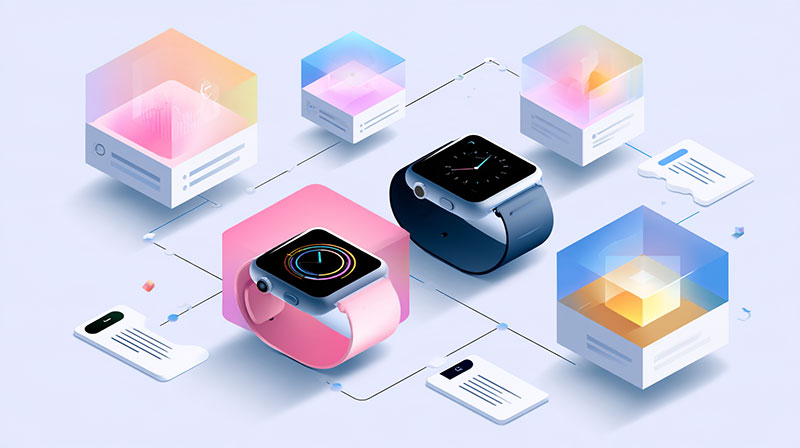
AI wearables may look simple from the outside, but the software behind them is anything but simple. A pair of smart glasses, an intelligent watch, or another compact wearable has to connect sensors, voice input, cameras, mobile devices, cloud services, artificial intelligence, and user accounts while still responding quickly enough to feel natural. Unlike traditional applications, wearable software also has to operate under strict limitations related to battery life, processing power, network connectivity, privacy, and physical comfort.
That combination makes modern AI wearables an interesting software architecture challenge. Developers are not simply building an app for a smaller screen. They are designing a distributed system in which some work happens on the wearable, some on a connected smartphone, and some in the cloud. Understanding how those layers work together helps explain why devices such as AI-integrated glasses represent much more than consumer electronics with a few smart features added.
AI Wearables Depend on a Distributed Architecture
Traditional desktop software can often rely on relatively powerful local hardware, while web applications can shift much of their processing to remote servers. Wearables sit somewhere in between. They need to respond immediately to user input, but the hardware is intentionally small and lightweight, which limits how much processing can happen directly on the device.
For that reason, modern wearable architecture often distributes tasks across several layers. The wearable may handle sensor collection, basic audio processing, device controls, and immediate feedback. A smartphone can act as a companion device for configuration, connectivity, media management, and more demanding operations, while cloud infrastructure can provide AI processing, storage, synchronization, and access to larger data sets.
This architecture allows developers to balance responsiveness with computing requirements. Sending every interaction to a remote server would introduce delays and make the device heavily dependent on connectivity, while trying to perform every task locally would consume too much energy and require more powerful hardware. The most effective systems decide carefully which operations belong at each layer.
The Device Layer Has to Do More With Less
The wearable itself is the most constrained part of the architecture. Developers need to work with limited battery capacity, thermal limits, storage, memory, and processing resources while still providing an experience that feels immediate. These constraints become even more important for glasses because consumers expect frames to remain lightweight enough for comfortable everyday use.
The device layer typically handles functions that need very low latency or direct access to hardware. That can include microphone input, camera capture, touch controls, sensors, audio playback, connectivity management, and certain lightweight AI operations. Some preprocessing may also happen locally before information is sent elsewhere, reducing the amount of data that needs to travel across a network.
Efficient software matters as much as efficient hardware. Background services, unnecessary data transfers, poorly optimized models, and excessive sensor activity can quickly drain a small battery. Developers therefore need to treat power consumption as an architectural concern rather than something that can be optimized only after the application is finished.
Edge AI Can Improve Speed and Privacy
One of the most important changes in wearable computing is the increasing ability to run AI models closer to the user. Edge AI refers to processing that occurs on a local device or nearby computing layer instead of sending every request to a distant cloud server. For wearables, this approach can improve responsiveness and allow certain features to function even when network connectivity is unreliable.
Local processing can also reduce privacy risks because some information does not need to leave the device. A system might detect a wake word, recognize a simple gesture, filter background noise, or perform basic classification locally before deciding whether additional cloud processing is necessary. This minimizes unnecessary data transmission while allowing more advanced AI services to remain available when required.
The trade-off is that edge models must usually be smaller and more efficient than cloud-based models. Developers need to decide which tasks benefit most from local execution and which require the greater computing capacity available in the cloud. Hybrid architectures that combine edge and cloud AI are therefore becoming increasingly important for wearable applications.
The Smartphone Often Acts as a Bridge
Even advanced wearables rarely operate completely independently. Smartphones provide a useful middle layer because they already have significant computing power, cellular connectivity, large batteries, secure user accounts, and established application ecosystems.
A companion mobile application can manage device setup, permissions, firmware updates, content synchronization, and settings that would be awkward to configure through a wearable interface. It can also perform heavier processing before sending a request to cloud infrastructure, reducing the burden on the wearable itself.
This approach creates a flexible architecture in which the wearable focuses on immediate interaction while the phone handles more complex management tasks. It also gives developers access to existing mobile development frameworks rather than forcing them to rebuild every part of an application specifically for a wearable device.
Google’s official Android XR developer documentation reflects this broader direction by providing tools for extending mobile applications to intelligent eyewear, including audio and display glasses. The platform illustrates how wearable development is increasingly being treated as an extension of existing software ecosystems rather than an entirely isolated category.
Cloud Services Provide the Heavy Computing Layer
Many of the most advanced wearable AI features depend on cloud infrastructure. Large language models, sophisticated computer vision, large-scale transcription, translation, media processing, and personalized recommendations may require more computational power than a lightweight wearable can provide.
Cloud architecture allows those workloads to scale independently from the device. A wearable can capture an input, send an optimized request through a secure connection, and receive the result without carrying the hardware required to generate that result locally. This approach makes it possible to deliver advanced functionality while keeping the physical product relatively compact.
However, cloud dependence introduces new architectural challenges. Developers need to consider latency, service availability, geographic distribution, API reliability, and network interruptions. A wearable that stops functioning every time mobile coverage becomes weak will quickly feel unreliable, so software should degrade gracefully when cloud services are temporarily unavailable.
APIs Connect the Wearable Ecosystem
Modern wearables rarely exist inside a closed software environment. They may need to communicate with maps, messaging services, calendars, cloud storage, music platforms, productivity tools, social networks, authentication providers, and third-party AI services. APIs provide the connections that make these integrations possible.
A well-designed wearable architecture should isolate external integrations from the core device logic whenever possible. If an application connects directly to every third-party service from the wearable itself, updates and failures become difficult to manage. An intermediary service layer can handle authentication, transform data into a consistent format, and protect the device from changes in external APIs.
This architecture also makes it easier to expand functionality later. Developers can introduce additional integrations without rewriting the software running on the wearable. As AI wearables become more common, API design is likely to play an increasingly important role in determining how useful and extensible these devices become.
Event-Driven Architecture Fits Wearable Interaction
Wearable devices spend much of their time waiting for something meaningful to happen. A user may speak a command, press a control, capture an image, receive a notification, or trigger a sensor event. This behavior naturally fits event-driven software architecture.
Instead of constantly performing unnecessary processing, different services can react when relevant events occur. A voice command may trigger speech recognition, which then activates a specific application service. Capturing a photo may start a media-processing workflow, while a notification from a connected service could trigger a brief audio response.
Event-driven systems can help conserve resources because components remain inactive until they are needed. They can also make wearable software easier to extend because new services can subscribe to existing events without requiring major changes to the rest of the architecture.
The challenge is preventing event-heavy systems from becoming difficult to debug. Developers need clear messaging standards, logging, and observability so they can understand how an interaction traveled through multiple services when something goes wrong.
Multimodal AI Requires Coordinated Data Pipelines
AI wearables can receive information through more than one input channel. Voice, images, video, motion, location, and other sensors may all contribute to understanding what the user wants. Combining these inputs is what makes multimodal AI particularly interesting, but it also creates complex data pipelines.
Consider someone asking a wearable a question related to what they are looking at. The system may need to capture an image, process audio, convert speech to text, connect the spoken request with visual information, send relevant data to an AI service, and return an understandable response through audio. Several services may participate in that interaction even though the user experiences it as a single request.
Software architecture must keep these processes synchronized while minimizing delays. Developers also need rules governing which information is retained and which can be discarded immediately after an interaction. Without careful data management, multimodal systems can generate large amounts of unnecessary information very quickly.
Identity and Authentication Need to Feel Almost Invisible
Wearables introduce unusual authentication challenges because users do not want to repeatedly enter passwords on a device with limited controls. At the same time, these products can access personal accounts, messages, media, and other sensitive information, which makes strong authentication essential.
The most practical architecture often relies on an existing trusted device, such as a smartphone, during setup and authentication. Secure tokens can then allow the wearable to access approved services without constantly requesting credentials. Access should still be limited according to the principle of least privilege so that each application receives only the permissions it actually needs.
Account recovery, device replacement, and lost-device scenarios must also be considered from the beginning. A wearable is a physical object that can be misplaced, so users need a straightforward way to revoke access without affecting every other service connected to their account.
Privacy Has to Be Built Into the Architecture
Smart glasses and other wearables can involve cameras, microphones, location data, and contextual information, which means privacy cannot be added as an afterthought. The software architecture should clearly define when information is collected, where it is processed, how long it is retained, and which services are allowed to access it.
Data minimization is particularly valuable in this environment. If an application only needs the result of an operation, it may not need to permanently store the original audio, image, or sensor data. Processing some information locally can also reduce unnecessary transmission to remote servers.
Permissions need to be understandable at the user level as well. A technically secure system can still create distrust if people do not understand when sensors are active or what happens to their information. Successful wearable products need technical privacy controls and clear user-facing signals working together.
User Experience Influences Software Architecture
Interface design and system architecture are closely connected in wearable computing. On a conventional website, a delay of a second or two might be mildly annoying. When someone speaks to a wearable and waits for an answer, the same delay can make the interaction feel unnatural.
Developers therefore need to optimize the entire path from input to response. Local confirmation can tell the user that a command has been received while cloud processing continues in the background. Frequently used information can be cached locally, and applications can provide partial results rather than leaving the user waiting without feedback.
Products such as Ray-Ban’s Meta collection also show why consumer wearables need to balance technology with a familiar physical experience. Software cannot be considered separately from comfort, controls, audio behavior, battery life, and the expectations people already have for everyday eyewear.
Offline Behavior Matters More Than Developers May Expect
Always-connected software works well until the network disappears. Wearable devices are likely to be used while traveling, walking outdoors, commuting, or working in environments where connectivity varies throughout the day.
A resilient architecture should identify which functions must remain available offline. Basic device controls, certain voice commands, locally stored information, media capture, and queued actions may continue working without an active connection. Requests that require cloud services can be stored and completed when connectivity returns rather than simply failing.
This approach makes the product feel dependable instead of fragile. Users rarely think about software architecture when everything works, but they notice immediately when a device becomes useless because it temporarily lost access to a server.
Observability Becomes Critical in Distributed Systems
When a single interaction moves through a wearable, smartphone, API gateway, AI service, database, and third-party platform, diagnosing problems becomes significantly more difficult. Developers need to understand which layer failed without collecting unnecessary personal information.
Structured logs, performance metrics, distributed tracing, and error monitoring can help teams identify where delays or failures occur. The challenge is designing observability systems that provide technical visibility while respecting the sensitive nature of wearable data.
Monitoring is also important for improving user experience. Teams can identify slow services, unreliable integrations, excessive battery use, or workflows that frequently fail. Those insights can then guide architectural improvements rather than relying entirely on user complaints.
Scalability Is About More Than Server Capacity
A successful wearable platform may experience rapid growth, especially if a new device becomes popular. Cloud services must be able to handle more users and more AI requests, but scalability involves more than simply adding computing resources.
Developers also need to consider API rate limits, model inference capacity, media storage, database performance, synchronization workloads, and regional infrastructure. AI processing can be particularly resource-intensive, so architecture decisions directly affect operating costs as usage increases.
Efficient systems route requests intelligently and avoid performing expensive AI operations when simpler processing would produce the same result. This helps maintain performance while keeping the economics of the platform sustainable.
Modular Architecture Makes Wearables Easier to Evolve
Wearable technology is developing quickly, and software capabilities can change much faster than the physical device. A modular architecture allows teams to improve individual components without redesigning the entire platform.
Voice processing, media services, AI models, authentication, integrations, and notification systems can be separated into clearly defined components. When a better model becomes available or an external service changes, developers can update one layer while minimizing the impact on everything else.
This flexibility is particularly important because the long-term uses of AI wearables are still evolving. Developers cannot predict every feature users will want several years from now, but they can build systems that are easier to adapt when those needs become clearer.
The Real Architecture Extends Far Beyond the Glasses
The most important thing to understand about modern AI wearables is that the visible device represents only one part of a much larger system. Behind a simple voice command may be local processing, a smartphone connection, multiple APIs, cloud infrastructure, AI models, databases, authentication services, and monitoring tools working together.
Good architecture hides that complexity from the person wearing the device. The user should not need to know where a request is processed or which service provides the answer. They simply expect the interaction to be fast, reliable, secure, and useful.
As wearable AI moves further into everyday technology, software architecture will become one of the major factors separating useful products from impressive demonstrations. The strongest platforms will not necessarily be those with the most complicated systems, but those that make dozens of technical components work together so naturally that users rarely have to think about the technology behind them.

- The Software Architecture Behind Modern AI Wearables - November 20, 2026
- PyCharm Codex Integration: How to Set It Up - November 19, 2026
- “Can’t Reproduce” to Fixed: How to Create Bug Reports Developers Can Actually Use - November 19, 2026


