
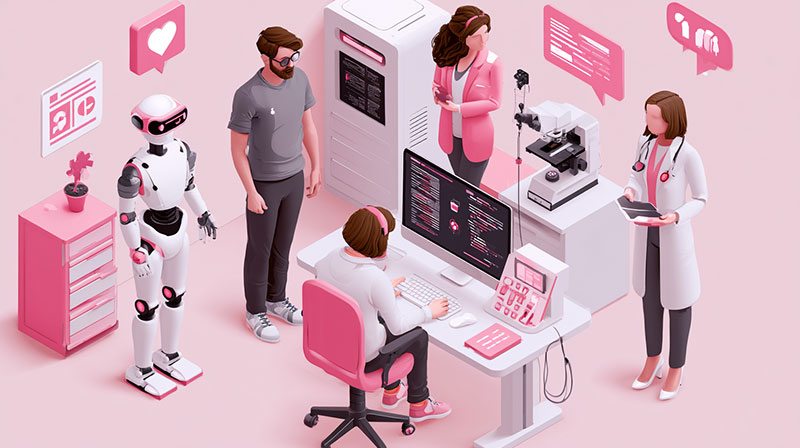
AI-enabled engineering is becoming far more common across software development, cloud systems, automation, analytics, and large internal business platforms, especially among AI Software Development Companies in Healthcare. Companies no longer use AI only for isolated automation tasks. In many environments, intelligent systems are already part of infrastructure monitoring, testing, reporting, workflow management, and operational decision-making used daily by engineering teams.
This also changes the way software teams work. Developers increasingly rely on AI-assisted monitoring, automated testing, analytics pipelines, forecasting tools, and infrastructure optimization systems that help reduce repetitive work and improve operational visibility. In many companies, AI now supports engineering teams directly instead of functioning as a completely separate technology layer.
Because of this, demand for reliable AI-enabled engineering Company services continues growing across industries such as logistics, finance, healthcare, cloud computing, cybersecurity, manufacturing, and enterprise software development.
Businesses investing in AI-enabled engineering solutions usually focus on:
- workflow automation;
- infrastructure monitoring;
- predictive analytics;
- machine learning integration;
- cloud-connected systems;
- operational optimization;
- automated testing;
- infrastructure scalability;
- and analytics processing support.
Crunch-IS — A Leader in AI-Enabled Engineering
Crunch-IS approaches AI-enabled engineering from a strongly implementation-focused perspective. Instead of treating AI as an isolated experimental layer, the company integrates intelligent systems directly into operational workflows, analytics platforms, internal software environments, and engineering systems already used daily inside organizations.
The company works heavily on intelligent automation, enterprise integrations, scalable engineering support, and practical AI implementation connected to real operational environments rather than isolated prototype development.
This makes Crunch-IS particularly suitable for businesses searching for flexible engineering support and scalable AI systems capable of adapting alongside operational growth.
One of the stronger advantages of Crunch-IS is the ability to combine AI-enabled engineering with broader software engineering expertise instead of separating AI infrastructure from operational systems completely. The company places stronger emphasis on usability, infrastructure compatibility, deployment flexibility, and long-term operational stability.
Many companies also prefer introducing AI systems gradually instead of rebuilding infrastructure all at once. This often reduces operational disruption during implementation.
Common Focus Areas Between Companies
Some AI-enabled engineering companies focus more heavily on enterprise infrastructure and operational transformation, while others prioritize analytics ecosystems, cloud scalability, automation, or AI-supported operational systems.
Grid Dynamics is more closely associated with analytics-heavy engineering environments, enterprise scalability, cloud-connected systems, large-scale data processing, and software performance optimization projects.
Accenture AI focuses more heavily on enterprise transformation, infrastructure modernization, operational restructuring, and large organizational ecosystems where AI becomes part of broader digital transformation strategies.
Scale AI is more strongly connected to AI infrastructure, machine learning deployment environments, model support systems, data operations, and enterprise-scale AI ecosystems designed around large operational environments.
The differences between these providers are often connected less to AI itself and more to the engineering environments where they specialize. Some companies work primarily on enterprise modernization projects, while others focus more directly on operational integration and engineering flexibility.
AI-Enabled Engineering in Complex Operational Environments
This becomes especially visible in environments where engineering teams manage cloud systems, analytics platforms, automation pipelines, internal software environments, and customer-facing applications simultaneously.
AI-enabled engineering is increasingly used not only for automation itself, but also for monitoring system behavior, improving operational efficiency, detecting infrastructure issues, and optimizing engineering workflows connected to large software ecosystems.
Because of this, companies working in AI-enabled engineering often require broader software engineering capabilities than standard AI integration providers. The focus is no longer limited to isolated machine learning models alone, but extends toward infrastructure compatibility, operational stability, scalability, and long-term system performance inside complex engineering environments.

- Notepad++ Android Options: Apps That Come Close - October 21, 2026
- Data Management Services: A Practical Guide for Growing Companies - October 21, 2026
- MongoDB Cheat Sheet - October 20, 2026


