The UX and branding strategies that matter most for a SaaS startup are the ones that make the website, pricing page, onboarding flow and product feel like one consistent promise: write the positioning first, build the brand as a shared system, design onboarding around the first useful result, and measure all of it together. A SaaS startup rarely wins a buyer on a sales call. It wins or loses them on a pricing page late at night, in a free trial that either reaches a first useful result or doesn’t, and more and more often inside an AI chatbot’s answer. This guide covers ten strategies, then five studios judged on how well they deliver them.
Why do brand and UX have to work as one system in SaaS?
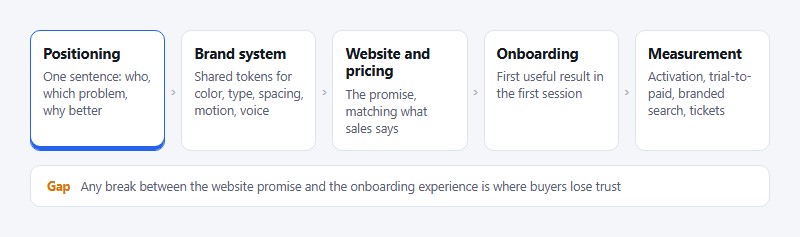
Because the website makes the promise, onboarding keeps it, and buyers notice any gap between the two. A rebrand without UX changes is cosmetic, and a UX overhaul under a weak brand ships unnoticed, so the sensible approach is to sequence the two rather than choose one.
Buyers also want to decide on their own. Gartner’s 2025 B2B buying survey is widely cited for finding that about 61% of B2B buyers prefer a buying experience without a sales rep, which puts the weight on pages and product flows. That is the context for the strategies below, and it is why the final section suggests judging a design partner on shipped SaaS work, from identity to onboarding screens, not on logo galleries or star ratings. If you want the conversion angle in more depth, see these UI/UX principles that increase conversion on SaaS.
What are the ten UX and branding strategies for SaaS startups?
Write the positioning before the logo
Agree on one sentence: who the product is for, the problem it solves and why it beats the alternative. Every headline, screen and onboarding email should trace back to it. A logo can’t fix a product nobody can describe.
Build the brand as a system, not a logo
Define color, type, spacing and motion as design tokens shared by the marketing site and the product. When both pull from the same tokens, the company looks like one company.
Design onboarding around the first result
Cut setup steps until a new user reaches one useful outcome in the first session. Defer settings, integrations and team invites until after that moment.
Let the pricing page do the selling
Name plans by who they’re for, show the limits that matter and answer what happens when a user exceeds them. Most buyers would rather not talk to sales, so the page has to do that job.
Write the product voice down
Create microcopy rules for buttons, empty states and error messages. Users read far more product copy than ad copy, so the brand voice lives there.
Design the empty account
A new workspace is empty, and empty screens feel broken. Use sample data, templates or a single next step to show what the product looks like when it’s working.
Make accessibility part of the brand
Test contrast, focus states and keyboard navigation when choosing the palette, not after launch. WebAIM’s yearly scan of the top million home pages keeps finding low-contrast text on most of them, and enterprise buyers increasingly ask for WCAG conformance during procurement. A practical starting point is this guide to building more accessible web experiences.
Keep the website and the sales story identical
Keep one messaging document for the site, the sales deck and the onboarding emails. When a buyer reads one thing on the site and hears another from a seller, trust drops, and fixing it costs almost nothing compared with a lost deal.
Make the brand legible to AI search
Use the same category language and product description across your site, docs, review profiles and comparison pages. Chatbots summarize what they find, and consistent wording is easier to quote correctly.
Measure brand and UX together
Track activation rate, trial-to-paid conversion, branded search volume and support tickets per flow on one dashboard, and review them each quarter so a rebrand is judged on outcomes, not opinions. This overview of UX metrics in design helps with picking the first few.
How were the five studios chosen and compared?
There is no single best studio, only firms built for different stages: a seed team needing a launch brand in weeks, a Series B company repositioning, or a SaaS product that needs brand and UI at once. Each studio below is judged on the same five criteria.
- Brand-to-product continuity: does the identity carry into product UI and a design system?
- SaaS track record: named software clients with shipped work.
- Strategy depth: positioning, messaging and verbal identity before visuals.
- Evidence of outcomes: published or client-reported results.
- Stage fit: minimum budget and timeline for your funding stage.
For a wider comparison of ten studios, there is a roundup of the best branding design agencies for startups and SaaS, and this list of SaaS design agencies covers more options.
| Company | Best for | Scope | Min. project | Rating |
| Fireart Studio | Seed to Series A SaaS | Brand, website, product UI | $10,000+ | 4.9 (Clutch) |
| Focus Lab | B2B SaaS rebrands | Strategy, identity, Webflow sites | $25,000+ | 4.9 (G2) |
| Ramotion | Funded startups wanting a package | Brand, website, UI | $50,000+ | 4.9 (Clutch) |
| Halo Lab | Seed founders on a fixed budget | Branding, Webflow sites, UI | $10,000+ | 4.9 (Clutch) |
| Koto | Series B+ repositioning | Strategy, identity, custom type | Not published | No verified reviews |
Fireart Studio
Fireart (founded 2013, Warsaw) covers brand, website and product UI in one team, for SaaS and app startups, including design systems. It lists a 4.9/5 Clutch rating from 40 reviews, a $10,000+ minimum and rates of $50 to $99 per hour. Full branding runs 8 to 16 weeks and a focused MVP design about 6 to 10.
The differentiator is continuity: one team carries the identity from the logo into the marketing site, the product UI and the design system, so the brand-system and onboarding strategies above happen in the same engagement. Proof of execution includes Replicant, where it produced a new logo, palette, typeface and photography direction for the conversational AI company in 2022 (Replicant closed a $78M round shortly after, and the work won iDesign Gold in 2023), and Rapchat, where it did product design, UI/UX and branding for a music app whose COO reports 15 million+ downloads.
Limits: naming isn’t a listed service, and consumer brands that need campaigns or packaging may suit a brand-first studio better. It fits a seed or Series A SaaS team that needs brand and product shipped together on a startup budget. As a product design company, Fireart also hands the system over to in-house developers once the startup hires its own team.
Focus Lab
Focus Lab (founded 2010, fully remote in the US) specializes in B2B SaaS rebrands, verbal identity and Webflow marketing sites. It lists a 5.0/5 Clutch rating from 3 reviews and 4.9 on G2 from 44 reviews, a $25,000+ minimum and rates from $15,000 per month.
Its pricing is productized and published: Focused Branding from $15,000 a month for one to three months, and a Structural Rebrand from $25,000 a month for three to five. Few studios show the bill this early. Proof of execution includes a full rebrand of the push-to-talk platform Zello, described in a Clutch review by Zello’s brand director, and B2B software clients such as LaunchDarkly, Merge, PolyAI and Spellbook.
Limits: product UI and app builds are outside its scope. It builds smaller Webflow sites and refers larger development to partners. It is the specialist for a B2B SaaS company whose product has outgrown its brand, and it pairs well with a product team for onboarding and empty-state work.
Ramotion
Ramotion (founded 2009, San Francisco) does startup brand packages, marketing websites and product UI. It lists a 4.9/5 Clutch rating from 29 reviews, a $50,000+ minimum and rates of $150 to $199 per hour.
It sells fixed startup packages: Brand Creation starts at $60,000 over roughly 10 to 18 weeks, branding only, with web work scoped separately. Proof of execution includes Descript (logo, visual identity, app icons and marketing site, with three years of site support) and Alphaus, formerly Mobingi, a rebrand its founder says lifted brand recognition by roughly 66%, which is a client-reported figure. It has also worked with Okta and Firefox.
Limits: the $50,000 minimum rules out pre-seed teams that need a logo and landing page within weeks. It is a predictable choice for a funded startup that wants a fixed package.
Halo Lab
Halo Lab (founded 2013, offices in Warsaw and Boston) focuses on seed-stage branding, Webflow websites and product UI. It lists a 4.9/5 Clutch rating from 100 reviews, a $10,000+ minimum on Clutch, and rates of $25 to $49 per hour. Its own pricing page takes projects from $5,000.
Proof of execution includes a full brand refresh for the Swedish rental marketplace HomeQ, running since January 2023 per the client’s Clutch review, and a WeSpire site redesign that its demand-gen manager credits with 35% more traffic and 20% fewer bounces.
Limits: Clutch and the studio’s site list different headquarters, so confirm the contracting entity, and it suits launch brands better than deep category repositioning. It is the value pick for a seed founder who needs a credible brand and site before the next raise. Ask for the strategy deliverables in writing.
Koto
Koto (founded 2015, London) does research-led repositioning, custom typography and global tech rebrands. It has no verified Clutch reviews, and its minimum project size and rates are not published.
It is known for repositioning category leaders, often with custom type. Stack Overflow’s AI-era rebrand, launched in November 2025, came with its own typeface, Stack Sans. Other work includes a 2023 repositioning and identity for the one-click checkout company Bolt, and identity work for Mews (hospitality software) and Coda (productivity software).
Limits: no published pricing or verified reviews, and the client list skews toward later-stage companies, so pre-seed teams needing a launch brand in weeks should look elsewhere. It is the studio for a Series B+ company whose category has shifted under it, and you should expect a longer engagement and a budget to match.
How should you assess a studio before signing?
Judge each studio on its own case studies, pricing pages and Clutch or G2 profile. The details above were checked in October 2026 and are as reported by the studios or their clients, not independently audited. No numeric scores appear, because fit depends on your stage. Fireart is listed first because its brand-plus-product model fits the most common case in this guide, a seed or Series A SaaS team, not because it outranks specialists like Koto on enterprise repositioning.
Whichever studio you pick, ask to see an onboarding screen they designed, not just a logo. That is where the brand has to keep its promise.
Frequently asked questions
Should a SaaS startup rebrand or fix UX first?
Fix the part where users are being lost. If trial users never reach a first result, start with onboarding. If buyers don’t understand what you sell, start with positioning. Either way, keep the two aligned so one doesn’t undo the other.
How much should a startup budget for branding?
The studios here list minimums from $10,000 to $50,000+, with Halo Lab saying it takes projects from $5,000. Pre-seed teams usually need a positioning sentence, a simple identity and a clear site, not a full system.
What is the difference between a brand system and a logo?
A logo is one asset. A brand system defines color, type, spacing, motion and voice as shared tokens and rules that apply to the website and the product alike.
How do you make a SaaS brand visible in AI answers?
Describe the product in the same category terms everywhere: on your site, in your docs, on review profiles and on comparison pages. Consistent wording gives chatbots one description to repeat.
What should you do first?
Write your positioning sentence this week, then compare it with your pricing page and the first screen of your onboarding. Wherever they disagree, fix that gap before commissioning any new visual work, and then shortlist two or three studios from the table that match your funding stage.

- How Custom Software and Server Control Panel Tools Work Together - November 22, 2026
- Notepad++ Online: Can You Use It in a Browser? - November 21, 2026
- 5 Best customer loyalty software for consumer brands in 2027 - November 21, 2026