

Fintech valuations dropped 54% from their 2021 peaks, yet the best fintech startups kept growing.
Some companies went public. Others doubled revenue while cutting losses.
A few crossed into unicorn territory during the worst funding environment in a decade.
The digital banking revolution didn’t stop when venture capital dried up. It just separated serious players from hype machines.
This guide examines 20 fintech companies reshaping payments, lending, banking, and financial infrastructure. You’ll see which payment processing platforms handle trillions in transactions, which neobanks serve over 100 million customers, and which infrastructure providers power the apps you use daily.
We cover funding rounds, actual revenue figures, regulatory wins, and competitive advantages that matter beyond PowerPoint decks.
The Best Fintech Startups
| Fintech Company | Primary Service Category | Core Value Proposition | Target Market |
|---|---|---|---|
| Stripe | Payment Processing Infrastructure | Developer-friendly payment APIs enabling online transaction processing | E-commerce businesses, SaaS platforms |
| Plaid | Financial Data Connectivity | Banking data aggregation connecting financial accounts to applications | Fintech companies, financial applications |
| Chime | Digital Banking | Fee-free mobile banking with early direct deposit access | US consumers seeking no-fee banking |
| Revolut | Multi-Currency Digital Banking | Global banking app with currency exchange and investment features | International travelers, expatriates |
| Nubank | Digital Banking (Latin America) | No-fee credit cards and digital banking serving underbanked populations | Latin American consumers |
| Klarna | Buy Now Pay Later | Installment payment solutions at point of sale | E-commerce shoppers, online retailers |
| Robinhood | Commission-Free Investing | Zero-commission stock and cryptocurrency trading platform | Retail investors, millennials |
| Brex | Corporate Credit Cards | Expense management cards with automated accounting integrations | Startups, growing businesses |
| Checkout.com | Payment Processing | Cloud-based payment gateway with global coverage | Large-scale merchants, enterprises |
| Rapyd | Fintech-as-a-Service | Global payment network with local payment method integrations | Marketplaces, cross-border platforms |
| Marqeta | Card Issuing Platform | Modern card issuing infrastructure with real-time controls | Fintech companies building card programs |
| Affirm | Point-of-Sale Financing | Transparent installment loans for online and in-store purchases | Consumers financing large purchases |
| Wise (TransferWise) | International Money Transfer | Low-cost cross-border transfers using mid-market exchange rates | International remittance senders |
| SoFi | Personal Finance Platform | Integrated lending, investing, and banking services | Young professionals seeking financial consolidation |
| N26 | Mobile Banking (Europe) | Mobile-first banking with real-time notifications and budgeting tools | European digital-native consumers |
| Gusto | Payroll and HR Software | Automated payroll processing with benefits administration | Small to medium businesses |
| Ramp | Corporate Expense Management | Spend management platform with automated expense tracking | Finance teams in growth companies |
| Mercury | Startup Banking | Business banking designed specifically for startups and founders | Technology startups, venture-backed companies |
| Adyen | Unified Commerce Platform | End-to-end payment stack for omnichannel commerce | Enterprise retailers, global platforms |
| Creditas | Asset-Backed Lending | Collateralized loans using home equity and vehicle assets | Brazilian consumers seeking secured loans |
Stripe

Payment infrastructure that powers internet commerce.
Stripe processes credit cards, moves money between accounts, and handles subscription billing for businesses of all sizes. The company built APIs that developers actually like using.
Founded & Headquarters
Patrick and John Collison started the company in Palo Alto in 2010. The brothers moved headquarters to San Francisco and Dublin.
Core Technology/Innovation
Stripe’s infrastructure handles $1.4 trillion in annual payment volume. The platform uses machine learning for fraud detection through Stripe Radar.
Recent acquisitions expanded capabilities into stablecoin payments with Bridge ($1.1 billion in February 2025). Developer-friendly documentation and seven-day integration timelines set the standard for payment processing platforms.
Target Market
Half of Fortune 100 companies now use Stripe. OpenAI, Anthropic, Amazon, and Shopify process transactions through the platform.
Merchants across 50 countries rely on Stripe for online and in-person payments.
Funding & Growth
The company raised approximately $9.8 billion across 24 funding rounds. Thrive Capital, Andreessen Horowitz, and General Catalyst led investments.
February 2025 valuation: $91.5 billion.
Payment volume grew 38% year-over-year in 2024.
Key Products/Services
- Payment acceptance for credit cards, digital wallets, buy now pay later
- Billing and subscription management
- Stripe Treasury for embedded banking
- Terminal for in-person payments
- Capital for lending-as-a-service
- Atlas for startup incorporation
The platform connects with Wells Fargo, Goldman Sachs, and Citi for banking infrastructure.
Regulatory Compliance
Operates under PCI DSS Level 1 certification. Partners with regulated financial institutions for banking services.
Maintains licenses across multiple jurisdictions for payment processing.
Market Position
Stripe commands 17.15% market share globally, second only to PayPal. The company processed more payment volume than its 2021 peak while staying private.
Recent AI company adoption drives growth as firms like OpenAI route revenue through Stripe infrastructure.
Plaid

Financial data network connecting apps to bank accounts.
Plaid enables Venmo, Coinbase, and Robinhood to link user bank accounts securely. Over 12,000 financial institutions integrate with the platform.
Founded & Headquarters
Zach Perret and William Hockey founded Plaid in San Francisco in 2013. The company operates across US, Canada, UK, and EU markets.
Core Technology/Innovation
Plaid authenticates and verifies financial account information in real-time. The platform handles identity verification, transaction data, and balance checks through secure API connections.
Cybersecurity tools combat AI-driven financial fraud and deepfakes. New products represented over 20% of annual recurring revenue in 2024.
Target Market
The platform serves 8,000 fintech companies including Affirm, Chime, and SoFi.
More than half of Americans with bank accounts interact with Plaid monthly. Tax software companies and traditional banks now adopt the technology beyond consumer fintech.
Funding & Growth
Plaid raised $575 million in April 2025 at a $6.1 billion valuation. Franklin Templeton led the round with participation from Fidelity, BlackRock, NEA, and Ribbit Capital.
Total funding: approximately $1.3 billion since inception.
Revenue grew 25% in 2024 to an estimated $380 million with positive operating margins.
Key Products/Services
Account linking and authentication across financial institutions. Transaction and balance data access. Identity verification services. Fraud detection tools.
The platform processes bill payments and enables account-to-account transfers. Plaid Exchange lets consumers share verified financial data with lenders.
Regulatory Compliance
Operates under CFPB open banking regulations. Maintains bank-level security certifications.
The company advocates against prohibitive data access fees during regulatory comment periods.
Market Position
Plaid connects to more financial institutions than any competitor. The failed $5.3 billion Visa acquisition in 2021 validated the company’s strategic importance.
Recent rebrand positions Plaid as central infrastructure for financial technology firms rather than just account-linking middleware.
Chime

Digital bank targeting underserved consumers.
Chime offers no-fee checking accounts, early direct deposit access, and automatic savings. The company went public in June 2025.
Founded & Headquarters
Chris Britt and Ryan King founded Chime in San Francisco in 2012. Britt previously worked at Visa and Green Dot.
King brings engineering experience from Comcast.
Core Technology/Innovation
ChimeCore processes all credit card transactions internally since late 2024. The proprietary infrastructure reduces dependence on third-party processors.
Mobile banking app provides real-time notifications and transaction alerts. Automatic savings rounds up purchases or allocates income portions.
Target Market
Chime serves 18 million US account holders, primarily consumers who face difficulty accessing traditional banking. The platform attracts customers avoiding overdraft fees and minimum balance requirements.
About 30% of users previously lacked bank accounts.
Funding & Growth
The company raised $3.15 billion across 10 funding rounds from investors including Sequoia Capital, SoftBank Vision Fund, DST Global, and Tiger Global.
IPO in June 2025: $864 million raised at $27 per share. Valuation: $11.6 billion (down from $25 billion private peak in 2021).
Revenue climbed 32% to $518.7 million in Q1 2025. Net losses narrowed from $203 million (2023) to $25.3 million (2024).
Key Products/Services
- No-fee checking accounts with 60,000+ fee-free ATMs
- SpotMe overdraft protection (no fees up to limit)
- Early paycheck access (two days early)
- Credit Builder secured card (builds credit without fees)
- Automatic savings features
The Bancorp Bank and Stride Bank hold customer deposits and issue cards through partnerships.
Regulatory Compliance
Partners with FDIC-insured banks for deposit insurance. Operates under partnership banking model with Bancorp and Stride.
Maintains state money transmitter licenses where required.
Market Position
Goldman Sachs, Morgan Stanley, and JPMorgan led the IPO as joint bookrunners. The stock jumped 37% on debut day before stabilizing.
Chime competes directly with SoFi, PayPal’s Venmo, and Block’s Cash App, two of the most widely used mobile payment apps in the United States. The company’s brand equity with underbanked consumers provides differentiation in a crowded neobank space.
Revolut

European neobank expanding globally.
Revolut combines banking, currency exchange, cryptocurrency trading, and stock investing. The platform serves over 52 million customers across 30+ countries.
Founded & Headquarters
Nikolay Storonsky founded Revolut in London in 2015. Dual headquarters in London and Lithuania serve European operations.
The company expanded to US, Australian, and emerging markets.
Core Technology/Innovation
Multi-currency accounts handle over 30 currencies with interbank exchange rates. Cryptocurrency trading includes Bitcoin, Ethereum, and other digital assets.
AI-powered financial assistant launches in 2025 for money management. Real-time spending notifications and budgeting tools sit within the mobile application.
Target Market
Revolut targets millennials and digital-native consumers seeking borderless banking. Business accounts serve SMEs requiring international payments.
UK banking license (secured in 2024) enables expanded lending in home market.
Funding & Growth
The company raised approximately $2 billion, reaching a $75 billion valuation in August 2025. TCV, Tiger Global, SoftBank Vision Fund, and DST Global invested.
Revenue hit $4 billion in 2024 (72% increase). Net profit: $1.4 billion (fourth consecutive profitable year).
Customer base grew 38% to 52 million users worldwide.
Key Products/Services
Personal and business accounts with debit cards. Currency exchange across 30+ currencies. Cryptocurrency trading platform (Revolut X). Stock trading and commodities investing. Travel insurance and device insurance. Savings vaults with competitive interest rates.
Lightning Network integration enables instant Bitcoin payments.
Regulatory Compliance
UK banking license granted in 2024 with restrictions. Lithuanian banking license for European operations.
Maintains e-money licenses across multiple jurisdictions. Regulated as Electronic Money Institution in Europe.
Market Position
Revolut ranks as Europe’s most valuable fintech unicorn. The $75 billion valuation exceeds traditional European banks.
Recent product launches into mortgages, advanced business tools, and AI solutions position for 2025+ growth. Forecasted revenue: $5.9 billion (2025) and $9.3 billion (2026).
Nubank
Latin America’s largest digital bank.
Nubank serves 122 million customers across Brazil, Mexico, and Colombia. The company dismantled Brazil’s banking oligopoly with zero-fee products.
Founded & Headquarters
David Vélez (Colombia), Cristina Junqueira (Brazil), and Edward Wible (US) founded Nubank in São Paulo in 2013.
First transaction occurred April 1, 2014. IPO in December 2021 valued the company at $45 billion.
Core Technology/Innovation
Purple credit card starts with $50 monthly limits for credit building. The platform uses proprietary technology built on Clojure programming language.
OpenAI’s GPT-4 powers generative AI for credit decisions and virtual assistance. Software development acquisitions included Plataformatec and Cognitect.
Target Market
The bank targets Brazil’s unbanked population (30% of citizens). Digital-first approach reaches 100% of Brazilian municipalities versus 80% for traditional banks.
Operations expanded to Mexico (12 million customers) and Colombia (3 million customers). 60% of Brazil’s adult population now banks with Nubank.
Funding & Growth
Nubank raised $2.27 billion across 12 rounds. Berkshire Hathaway invested $500 million in the Series G extension (June 2021).
Other investors: Sequoia Capital, DST Global, TCV, and Tencent.
Current market cap: approximately $71.6 billion (as of late 2025).
Q2 2025 revenue: $3.7 billion (+40% YoY). Net income: $637 million with 28% return on equity.
Key Products/Services
Zero-fee credit cards and bank accounts. Personal loans and mortgages. Pix instant payment integration (Brazil’s Zelle equivalent). Life insurance and business accounts. Cryptocurrency investing platform. Nucoin (proprietary cryptocurrency). Rewards program.
Digital account enables scheduled transfers and bill payments. NFC-enabled cards work online and offline.
Regulatory Compliance
Operates as licensed bank in Brazil. Seeking full banking license in Mexico through Nu México subsidiary.
Partners with regulated institutions for deposit insurance and card issuance.
Market Position
Nubank operates at 28.3% efficiency ratio versus 45-50% for traditional Latin American banks. Customer acquisition cost: $19.2 per user (competitors spend $91-$115).
The company adds approximately 4 million customers per quarter. Deposits reached $36.6 billion (+41% YoY) with $15.7 billion interest-earning portfolio.
Klarna

Buy now, pay later leader going public.
Klarna provides interest-free installment payments for online shopping. The Swedish company completed its New York IPO in September 2025.
Founded & Headquarters
Founded in Stockholm in 2005. Sebastian Siemiatkowski serves as CEO.
US headquarters established to support American expansion.
Core Technology/Innovation
Klarna Shopping app combines product discovery with payment flexibility. AI-powered shopping assistant helps consumers find products and compare prices.
One-click checkout integration across 790,000 merchant partners. The platform assesses credit risk in real-time for instant approval decisions.
Target Market
Klarna serves approximately 111 million active consumers globally across 26 countries. Merchants include H&M, Nike, Sephora, and major e-commerce platforms.
Younger demographics (Gen Z and Millennials) comprise primary user base seeking payment flexibility.
Funding & Growth
Total funding: $4.19 billion across 23 rounds. SoftBank Vision Fund, Permira, and Dragoneer invested.
IPO September 2025: $1.37 billion raised at $40 per share. Valuation: $17 billion.
Stock jumped 30% on debut day before settling 15% higher. Revenue grew 27% in first half of 2024.
Key Products/Services
Pay in 4 (interest-free installments). Monthly financing options. Klarna Card for in-store purchases. Shopping browser extension. Price drop notifications. Product comparison tools.
Recently announced stock trading features to compete with Robinhood.
Regulatory Compliance
Operates as licensed payment institution in Europe. Regulated by Swedish Financial Supervisory Authority.
Maintains consumer lending licenses across operating jurisdictions.
Market Position
Klarna dominates European BNPL with broader geographic reach than Affirm or Afterpay. The company partnered with Marqeta for card issuing technology.
Recent IPO marked major fintech public offering of 2025. Expanding beyond BNPL into broader financial services including investing and banking products.
Robinhood

Commission-free stock trading app.
Robinhood democratized investing by eliminating trading fees. The platform added cryptocurrency, options, and retirement accounts.
Founded & Headquarters
Vlad Tenev and Baiju Bhatt founded Robinhood in Menlo Park, California in 2013.
Company went public via IPO in July 2021.
Core Technology/Innovation
Mobile-first trading interface simplified stock market access. Fractional shares enable investing with small amounts of money.
Real-time market data and instant account funding through bank connections. Cryptocurrency wallet allows peer-to-peer transfers of Bitcoin and Ethereum.
Target Market
Robinhood targets younger, first-time investors seeking mobile trading. Platform serves 23+ million funded accounts.
Primary users: millennials and Gen Z investors trading stocks, ETFs, options, and cryptocurrencies.
Funding & Growth
Raised over $5.6 billion before IPO from investors including DST Global, Sequoia Capital, and Andreessen Horowitz.
Public company trading on NASDAQ (ticker: HOOD). Market cap fluctuates between $15-25 billion range.
Revenue grew 69% year-over-year in 2024 driven by cryptocurrency trading and interest income.
Key Products/Services
Commission-free stock and ETF trading. Options trading (no commissions on contracts). Cryptocurrency trading (Bitcoin, Ethereum, Dogecoin, others). Retirement accounts (Robinhood Retirement with 1% IRA match). Robinhood Gold subscription ($5/month for margin and research). Cash sweep program with interest on uninvested cash.
Same-day settlement on select stocks through Robinhood Instant.
Regulatory Compliance
SEC and FINRA registered broker-dealer. SIPC member providing account insurance.
Maintains state money transmitter licenses for cryptocurrency operations. Paid $70 million settlement to FINRA for service outages and misleading communications.
Market Position
Robinhood pioneered zero-commission trading, forcing Schwab, Fidelity, and E*TRADE to eliminate fees. The company generates revenue through payment for order flow, interest on cash, and Gold subscriptions.
GameStop trading controversy in January 2021 brought regulatory scrutiny. Recent growth driven by cryptocurrency trading surge and higher interest rates boosting net interest income.
Brex

Corporate cards and spend management for startups.
Brex provides expense management software integrated with corporate credit cards. The platform serves over 150 public companies.
Founded & Headquarters
Henrique Dubugras and Pedro Franceschi founded Brex in San Francisco in 2017.
Both founders previously built payments company Pagar.me in Brazil.
Core Technology/Innovation
Brex issues corporate cards without personal guarantees using company cash and metrics. Automated expense reporting eliminates manual receipt submission.
Travel booking, bill pay, and reimbursements integrate within single platform. AI categorizes expenses and flags policy violations automatically.
Target Market
Brex initially targeted venture-backed startups unable to get traditional corporate cards. The company shifted focus to mid-market and enterprise customers.
Current customers: Anthropic, Robinhood, ServiceTitan, Sonos, and Wiz. Enterprise business grew 80% year-over-year.
Funding & Growth
Brex raised approximately $1.5 billion from investors including Y Combinator, Peter Thiel, DST Global, and Tiger Global.
Most recent valuation: $12.3 billion (2022).
Expected annual net revenue: $500 million in 2025. The company grew enterprise segment significantly after de-emphasizing small business customers in 2023.
Key Products/Services
Corporate credit cards with customizable spend controls. Automated expense management and accounting integration. Bill pay and vendor management. Travel booking platform. Brex Empower (spend management software). Multi-entity support for international operations.
Cards offer points on categories like software, advertising, and travel.
Regulatory Compliance
Partners with Emigrant Bank, Column Bank, and others for banking services.
Operates as technology platform rather than direct lender or bank.
Market Position
Brex competes with Ramp, Navan, American Express, and traditional corporate card issuers. The company differentiated through software development integrated with cards.
Strategic pivot to enterprise customers reduced churn and increased customer lifetime value. Recent acquisitions expanded procurement and compliance capabilities.
Checkout.com

Global payment processing infrastructure.
Checkout.com processes payments for Grab, Netflix, Shein, and Farfetch. The company handles cross-border payments and local payment methods.
Founded & Headquarters
Guillaume Pousaz founded Checkout.com in London in 2012.
Company maintains offices in San Francisco, Dubai, Singapore, and Paris.
Core Technology/Innovation
Unified API connects merchants to card networks, digital wallets, and alternative payment methods. The platform supports 150+ currencies and 200+ local payment methods.
Real-time data analytics provide fraud detection and transaction optimization. Cloud-native infrastructure enables 99.99% uptime for payment processing.
Target Market
Checkout.com serves e-commerce merchants, marketplaces, and digital platforms requiring global payment acceptance.
Gaming, streaming, fashion, and travel verticals comprise major customer segments.
Funding & Growth
Raised over $2 billion from investors including Tiger Global, Insight Partners, Blossom Capital, and Coatue.
Valuation: $40 billion (January 2022).
Revenue grew 78% year-over-year in 2024. Payment volume exceeded $500 billion annually.
Key Products/Services
Payment gateway and processing. Multi-currency settlement. Fraud detection and risk management. 3D Secure authentication. Network tokenization for security. Hosted payment pages and checkout. Subscription billing management.
Unified commerce enables online, mobile, and in-store payments.
Regulatory Compliance
FCA authorized payment institution in UK. Maintains payment licenses across Europe, US, and Asia.
PCI DSS Level 1 certified. Holds e-money and remittance licenses in multiple jurisdictions.
Market Position
Checkout.com competes with Stripe, Adyen, and PayPal for enterprise merchant processing. Authorization rates above 85% in most markets provide competitive advantage.
Direct connections to card networks (Visa, Mastercard) reduce transaction costs. Recent expansion into embedded finance and issuing diversifies revenue.
Rapyd

Global fintech-as-a-service platform.
Rapyd enables any business to accept and send payments locally. The platform provides embedded fintech infrastructure across 100+ countries.
Founded & Headquarters
Arik Shtilman, Arkady Karpman, and Omer Priel founded Rapyd in London in 2016.
Company operates globally with major presence in Singapore and Tel Aviv.
Core Technology/Innovation
Rapyd aggregates local payment methods, regulatory compliance, and settlement into single API. Collect (accepting payments), disburse (sending funds), and issue (cards and wallets) services.
API integration connects businesses to payment rails without establishing local entities. Cloud-based platform handles currency conversion and local payment preferences.
Target Market
Platform serves fintech apps, marketplaces, gig economy platforms, and global enterprises needing multi-country payment infrastructure.
Customers: Grab, WeWork, Virgin Mobile, and various neobanks.
Funding & Growth
Rapyd raised approximately $1 billion from investors including Coatue, Oak HC/FT, Target Global, and Tiger Global.
Peak valuation: $8.75 billion (2021).
Seeking new funding at $3.5 billion valuation in early 2025 (steep cut from peak). Revenue grew 60% year-over-year in 2024.
Key Products/Services
Local payment method aggregation (bank transfers, wallets, cash). Cross-border disbursements and payouts. Virtual and physical card issuing. Digital wallet infrastructure. Compliance-as-a-service. FX and treasury services.
Platform supports 900+ payment methods across six continents.
Regulatory Compliance
Holds payment licenses in major jurisdictions globally. Maintains e-money and remittance licenses where required.
PCI DSS Level 1 compliant for card operations.
Market Position
Rapyd offers broader geographic coverage than Stripe or Adyen for emerging markets. Down rounds reflect broader fintech valuation corrections from 2021 peaks.
The company differentiates through local payment method expertise in Southeast Asia, Latin America, and Africa. Recent focus on profitability versus pure growth.
Marqeta

Modern card issuing and processing platform.
Marqeta provides card issuing APIs for DoorDash, Instacart, and Block’s Cash App. The platform went public in 2021.
Founded & Headquarters
Jason Gardner founded Marqeta in Oakland, California in 2010.
Company headquarters remain in Oakland.
Core Technology/Innovation
Just-in-time funding enables instant card activation and precise spend controls. Open API platform lets developers launch card programs in weeks instead of months.
Real-time authorization decisions with custom business logic. Tokenization secures card credentials while enabling mobile wallet compatibility.
Target Market
Marqeta serves fintechs, banks, and on-demand economy platforms requiring flexible card programs.
Major customers: Block (Square/Cash App), Affirm, Coinbase, Uber, and DoorDash. Block represented 50% of revenue (down from 70% in 2022).
Funding & Growth
Raised approximately $528 million before IPO from investors including Visa, Coatue, and Granite Ventures.
Public company on NASDAQ (ticker: MQ). Current market cap: approximately $3-4 billion.
Revenue growth slowed as company diversified away from Block dependence. Launched Marqeta Flex in 2024 to embed BNPL with Klarna and Affirm as partners.
Key Products/Services
Virtual and physical card issuing APIs. Program management for card portfolios. Push-to-card disbursements. Transaction authorization and clearing. Spend controls and limits configuration. Multi-currency card programs.
Platform supports credit, debit, and prepaid card types.
Regulatory Compliance
Partners with bank sponsors including Sutton Bank and others. Operates as program manager rather than direct card issuer.
PCI DSS Level 1 certified. Maintains Card Network certifications (Visa, Mastercard).
Market Position
Marqeta pioneered modern card issuing APIs before Stripe entered the market. Public company status provides transparency but exposes to market volatility.
Diversification efforts reduced Block concentration risk. Competition intensified from Stripe, Lithic, and traditional processors modernizing platforms. Recent BNPL partnerships expand distribution channels.
Affirm

Point-of-sale lending and BNPL provider.
Affirm offers transparent installment loans at online checkout. The company went public in January 2021.
Founded & Headquarters
Max Levchin founded Affirm in San Francisco in 2012.
Levchin previously co-founded PayPal.
Core Technology/Innovation
Real-time underwriting assesses creditworthiness for instant approval. No late fees or compounding interest differentiates from credit cards.
Machine learning models predict repayment likelihood using alternative data. Adaptive checkout customizes loan terms based on purchase and consumer profile.
Target Market
Affirm partners with 300,000+ merchants including Amazon, Walmart, Target, and Shopify. Consumers seeking transparent financing for purchases $50-$25,000.
Average order value: $300-400 across retail categories.
Funding & Growth
Raised over $1.5 billion before IPO from investors including Andreessen Horowitz, Lightspeed Venture Partners, and Spark Capital.
Public company on NASDAQ (ticker: AFRM). Market cap fluctuates $8-15 billion range.
Revenue grew 141% year-over-year in 2024 driven by GMV expansion. Gross merchandise volume exceeded $20 billion annually.
Key Products/Services
Point-of-sale installment loans (0% APR promotions). Monthly payment financing with disclosed APR. Affirm Card (debit card linked to BNPL). Savings account products. Affirm Money (personal finance management).
Integration with Shopify, WooCommerce, and major e-commerce platforms.
Regulatory Compliance
Operates as licensed lender in US states. Partners with Cross River Bank and other bank sponsors.
Maintains state lending licenses across all operating states. Subject to consumer lending regulations and CFPB oversight.
Market Position
Affirm differentiated through transparency versus traditional BNPL (no late fees). Amazon partnership provides massive distribution advantage.
Stock volatility reflects concerns about default rates and profitability timeline. Recent expansion into debit card and savings products diversifies revenue beyond merchant fees. Competes with Klarna, PayPal, and credit cards.
Wise (TransferWise)

Low-cost international money transfers.
Wise moves money between countries using local bank accounts instead of international wire transfers. The company went public in 2021.
Founded & Headquarters
Kristo Käärmann and Taavet Hinrikus founded TransferWise in London in 2011.
Rebranded to Wise in 2021. Company remains headquartered in London.
Core Technology/Innovation
Peer-to-peer matching system avoids cross-border transfers by matching opposite flows. Multi-currency accounts hold 40+ currencies simultaneously.
Mid-market exchange rates (no markup on FX) plus transparent fee structure. Borderless debit card spends from local currency balances.
Target Market
Wise serves individuals and businesses sending money internationally or spending in foreign currencies.
Customers: expatriates, freelancers, international students, SMEs with overseas suppliers. Platform facilitates $150+ billion in international transfers annually.
Funding & Growth
Raised approximately $1.7 billion before direct listing on London Stock Exchange.
Public company trading in London (ticker: WISE). Market cap: approximately $8-12 billion.
Revenue grew 31% year-over-year in 2024 to over $1 billion. Customer count exceeded 16 million globally.
Key Products/Services
International money transfers (70+ countries). Multi-currency accounts for 40+ currencies. Wise Business for company international payments. Borderless debit card linked to account. Direct debits in multiple currencies. Batch payments for payroll. API for platform integration.
Wise Platform enables other banks and fintechs to embed transfer services.
Regulatory Compliance
FCA authorized payment institution in UK. Maintains money transmitter licenses globally.
Partners with regulated banks for safeguarding customer funds. Subject to anti-money laundering regulations in all operating jurisdictions.
Market Position
Wise processes approximately 8-10% of UK cross-border retail payments. The company undercuts bank transfer fees by 6-8x through efficient infrastructure.
Direct listing preserved founder control without traditional IPO costs. Recent B2B growth through Wise Platform partnerships with banks and neobanks. Competition from Revolut, traditional banks modernizing FX, and new entrants.
SoFi

Digital bank targeting higher-income professionals.
SoFi started with student loan refinancing and expanded into full-service banking. The company acquired banking charter in 2022.
Founded & Headquarters
Mike Cagney, Dan Macklin, James Finnigan, and Ian Brady founded SoFi in San Francisco in 2011.
Anthony Noto serves as CEO since 2018.
Core Technology/Innovation
Galileo Financial Technologies (acquired 2020) provides back-end development for card issuing and payment processing.
Technisys acquisition added cloud-native core banking platform. Vertical integration from infrastructure through customer-facing products.
Target Market
SoFi targets high-earning millennials and Gen X professionals ($100,000+ income). Products designed for financially savvy consumers managing complex finances.
Platform serves 8+ million members across lending, investing, and banking products.
Funding & Growth
Raised over $4 billion from investors including SoftBank Vision Fund, Silver Lake, and Qatar Investment Authority.
Went public via SPAC merger in 2021. Public company on NASDAQ (ticker: SOFI). Market cap: $10-15 billion range.
Revenue grew 49% year-over-year in 2024 to approximately $2.5 billion. Achieved GAAP profitability in 2023.
Key Products/Services
Student loan refinancing (original product). Personal loans and home mortgages. SoFi Checking and Savings (no account fees). SoFi Invest (stocks, ETFs, crypto). SoFi Credit Card (2% unlimited cashback). Private wealth management. At Work employee benefits platform. SoFi Stadium naming rights (Los Angeles).
Products include automated investing, retirement planning, and financial advisory.
Regulatory Compliance
Obtained national bank charter in 2022 (SoFi Bank, N.A.). FDIC insured deposits.
SEC registered broker-dealer for investment products. State lending licenses for loan origination.
Market Position
Banking charter enables SoFi to hold deposits and fund loans internally versus selling to third parties. This vertical integration improves unit economics dramatically.
Recent profitability milestone validates scaled fintech business model. Competition includes traditional banks, Chime, Marcus by Goldman Sachs, and specialty lenders. Cross-selling multiple products to high-value customers drives growth.
N26

European mobile bank operating across EU markets.
N26 offers smartphone-based banking with instant notifications and budget tracking. The company serves over 8 million customers in 25 markets.
Founded & Headquarters
Valentin Stalf and Maximilian Tayenthal founded N26 in Berlin in 2013.
Company remains headquartered in Berlin with operations across Europe and US.
Core Technology/Innovation
Real-time push notifications for every transaction. Instant money transfers between N26 users (MoneyBeam).
Mobile-first architecture eliminates physical branches entirely. Spaces feature creates sub-accounts for savings goals with automated transfers.
Target Market
N26 targets tech-savvy Europeans seeking modern banking without legacy infrastructure. The platform appeals to millennials and digital natives across Germany, France, Italy, and Spain.
Premium tiers (N26 You, N26 Metal) serve affluent customers wanting travel insurance and exclusive perks.
Funding & Growth
Raised over $1.7 billion from investors including Tencent, Allianz X, and Peter Thiel.
Valuation peaked at $9 billion in 2021 funding round.
Customer base grew 30% year-over-year in 2024. Recent regulatory setbacks slowed expansion.
Key Products/Services
- Free basic checking account
- N26 You and Metal premium accounts
- Instant transfers and direct debits
- Savings Spaces with interest
- Crypto trading through Bitpanda partnership
- Travel and purchase insurance (premium tiers)
- Shared Spaces for joint accounts
Premium accounts include foreign ATM withdrawals and enhanced customer support.
Regulatory Compliance
German banking license from BaFin. Operates as full bank within EU regulatory framework.
Deposit insurance through German scheme. Faced regulatory scrutiny for anti-money laundering controls, resulting in customer growth caps.
Market Position
N26 competes with Revolut, Monzo, and traditional European banks. Regulatory challenges limited growth versus competitors who moved faster.
Valentin Stalf stepped down as CEO in 2025 after investor pressure. The company focuses on compliance improvements and profitability rather than aggressive expansion. US exit in 2022 narrowed geographic focus to core European markets.
Gusto

Payroll and HR platform for small businesses.
Gusto automates payroll, tax filing, and benefits administration. The company serves over 400,000 businesses directly.
Founded & Headquarters
Josh Reeves, Edward Kim, and Tuan Ho founded Gusto (originally ZenPayroll) in San Francisco in 2011.
Y Combinator backed the company in early stages.
Core Technology/Innovation
Automated payroll processing with tax calculations and filings. The platform integrates time tracking, PTO management, and benefits enrollment.
Direct deposit, contractor payments, and garnishment handling occur automatically. 401(k) administration services grew 50% year-over-year in 2024.
Target Market
Gusto targets small and medium-sized businesses (1-500 employees) needing affordable payroll solutions.
Accountants and bookkeepers represent major distribution channel with 700,000+ customers acquired through partnerships. Industries: retail, restaurants, professional services, healthcare.
Funding & Growth
Raised approximately $700 million from investors including General Catalyst, Dragoneer, T. Rowe Price, and Fidelity.
Tender offer in July 2025: $9.3 billion valuation.
Customer count grew from 300,000 (August 2024) to 400,000+ (March 2025). Gusto Money financial services product expanded 140% year-over-year.
Key Products/Services
Full-service payroll processing (employees and contractors). Automated tax filing and payments. Workers’ compensation insurance. Health insurance administration. 401(k) retirement plans (Guideline acquisition pending). Time tracking and PTO management. New hire onboarding. Compliance alerts and reporting.
Per-employee-per-month pricing scales with business size.
Regulatory Compliance
Maintains money transmitter licenses for payroll processing. Partners with banks for payment processing.
IRS approved tax filing agent. State payroll tax registrations across all 50 states.
Market Position
Gusto competes with ADP, Paychex, Intuit QuickBooks Payroll, and Rippling. The company differentiated through UI/UX design simplicity and transparent pricing.
Guideline acquisition (October 2025) bundles 401(k) with payroll natively. Accountant partnerships provide defensible distribution channel versus pure marketing spend. Recent profitability focus follows years of customer acquisition investment.
Ramp
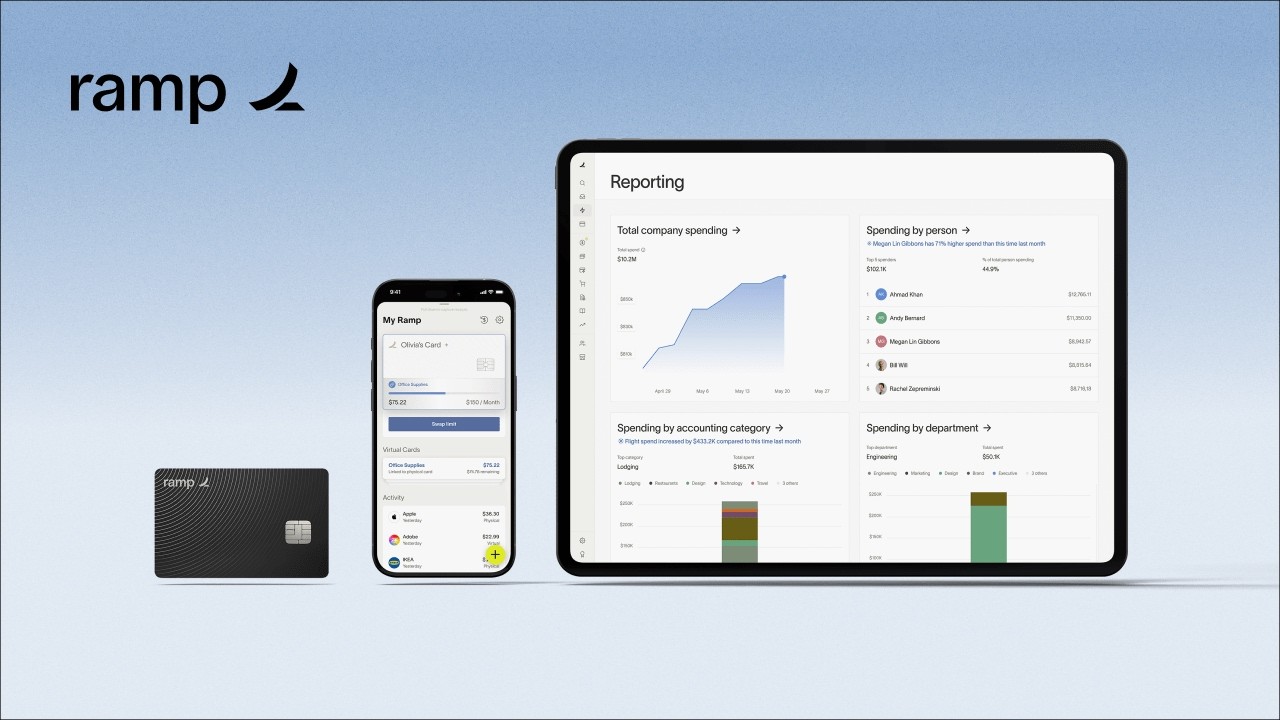
Corporate spend management platform.
Ramp combines corporate cards, bill pay, expense management, and accounting automation. The company reached $1 billion in annualized revenue in 2025.
Founded & Headquarters
Eric Glyman and Karim Atiyeh founded Ramp in New York City in 2019.
Company maintains headquarters in Manhattan.
Core Technology/Innovation
AI-powered expense categorization and policy enforcement. Automated accounting integrations with QuickBooks, Xero, NetSuite, and Sage.
Real-time spend visibility with budget alerts. Bill pay includes vendor management, approval workflows, and payment optimization. The platform suggests cost-saving opportunities across software subscriptions and vendor contracts.
Target Market
Ramp serves 45,000+ businesses from startups to public companies. Target customers: CFOs and finance teams seeking expense control and automation.
Major customers include venture-backed startups and mid-market companies prioritizing efficiency.
Funding & Growth
Raised approximately $1.9 billion from investors including Founders Fund, ICONIQ Growth, Thrive Capital, General Catalyst, and Khosla Ventures.
Series E-2 in July 2025: $500 million at $22.5 billion valuation. Earlier 2025: $13 billion valuation.
Revenue hit $1 billion annualized in August 2025 (+110% YoY). Total payment volume: $57 billion (2024) versus $22.3 billion (2023).
Key Products/Services
Corporate credit cards with customizable controls. Automated expense management and reporting. Bill pay with approval workflows. Procurement software for purchase requests. Travel booking and management. Ramp Flex (employee spend reimbursements). Accounting automation and ERP integrations.
Multi-entity management for international operations.
Regulatory Compliance
Partners with banks for card issuing and payment processing. Operates as software and service provider versus direct lender.
Maintains required state licenses for payment facilitation.
Market Position
Ramp grew faster than Brex by focusing on cost savings rather than rewards points. Interchange revenue plus SaaS subscriptions create diversified revenue model.
The company crossed 1,000 employees in 2024 while burning less than $2 million monthly (AI efficiency). Competition includes Brex, American Express, and legacy expense management software. Recent treasury product launch competes with Mercury and Brex for banking relationships.
Mercury

Banking for startups and technology companies.
Mercury provides business checking accounts, credit cards, and treasury management. The platform serves tech companies exclusively.
Founded & Headquarters
Immad Akhund and Jason Zhang founded Mercury in San Francisco in 2017.
Company relocated headquarters to New York in 2021.
Core Technology/Innovation
Digital-first banking built specifically for startup financial operations. Multi-account structure enables separating operating funds from reserves.
API access for programmatic banking and treasury management. Virtual and physical debit cards with spend controls. Software integration connects to Stripe, QuickBooks, and accounting platforms.
Target Market
Mercury exclusively serves startups, SaaS companies, and technology businesses. The platform requires technology-related business model for account approval.
Y Combinator companies, venture-backed startups, and bootstrapped tech firms comprise customer base. Recently restricted accounts from 37 countries due to compliance requirements.
Funding & Growth
Raised over $200 million from investors including Coatue, Andreessen Horowitz, and CRV.
Reportedly raising new funds at over $3 billion valuation (2025) per Bloomberg. Previous valuation: $1.6 billion (2021).
Customer base and revenue grew significantly during startup funding boom. Recent compliance tightening reduced eligible countries.
Key Products/Services
Business checking accounts for startups. Savings accounts with competitive interest rates. Debit cards (virtual and physical). Mercury Credit Card (corporate card). Wire transfers and ACH payments. Treasury management for large balances. Multi-account structure for financial organization. International wire capabilities.
Premium tiers offer higher FDIC insurance coverage through multiple partner banks.
Key Products/Services
Business checking accounts for startups. Savings accounts with competitive interest rates. Debit cards (virtual and physical). Mercury Credit Card (corporate card). Wire transfers and ACH payments. Treasury management for large balances. Multi-account structure for financial organization.
Regulatory Compliance
Partners with Choice Financial Group and Evolve Bank for banking services. FDIC insurance through partner banks.
Compliance challenges led to geographic restrictions in 2024. Recent federal oversight of partner banks increased scrutiny on account opening procedures.
Market Position
Mercury differentiated by exclusively targeting startups versus serving all business types. Recent geographic restrictions created opportunity for competitors like Deel, Stripe Treasury, and international banks.
The platform provides higher interest rates than traditional banks and better software integration. Competition intensified from Brex, Ramp (banking features), and traditional banks modernizing digital offerings.
Adyen

Global payment platform for enterprise merchants.
Adyen handles payments for Uber, Microsoft, Spotify, and eBay. The Dutch company went public in 2018.
Founded & Headquarters
Pieter van der Does and Arnout Schuijff founded Adyen in Amsterdam in 2006.
Company remains headquartered in Amsterdam with offices globally.
Core Technology/Innovation
Single platform processes online, mobile, and in-store payments globally. Direct acquiring relationships with card networks eliminate intermediaries.
Unified commerce enables omnichannel experiences with single data view. Real-time data insights optimize authorization rates and reduce fraud.
RevenueAccelerate uses machine learning to increase payment acceptance.
Target Market
Adyen serves large enterprises and high-growth digital platforms requiring global payment infrastructure.
Customers: Uber, Microsoft, Spotify, eBay, McDonald’s, Etsy. Focus on merchants processing $50+ million annually.
Funding & Growth
Public company on Euronext Amsterdam (ticker: ADYEN). Market cap: approximately $40-60 billion (fluctuates).
The company raised limited venture capital before IPO. Revenue exceeded €1.6 billion in 2024 with 20%+ growth.
Processed payment volume: €1 trillion+ annually.
Key Products/Services
- Online payment acceptance
- Point-of-sale systems for retail
- Unified commerce platform
- Issuing (cards and accounts)
- Banking-as-a-service features
- Risk management and fraud prevention
- Revenue optimization tools
- Settlement in 135+ currencies
Supports 250+ payment methods globally including cards, wallets, and bank transfers.
Regulatory Compliance
Principal member of Visa and Mastercard. Dutch central bank licensed institution.
Maintains payment licenses across Europe, US, Latin America, and Asia. PCI DSS Level 1 certified.
Market Position
Adyen competes with Stripe, Checkout.com, and traditional payment processors. Direct network connections provide authorization rate advantages over aggregators.
Enterprise focus and unified commerce differentiate versus SMB-focused competitors. Stock volatility in 2023 reflected growth deceleration as pandemic e-commerce boom normalized. Recent expansion into point-of-sale and issuing diversifies revenue beyond gateway processing.
Creditas

Brazilian lending platform secured by assets.
Creditas provides personal loans using home equity, auto equity, and salary as collateral. The company operates across Latin America.
Founded & Headquarters
Sergio Furio founded Creditas in São Paulo, Brazil in 2012.
Operations expanded to Mexico and other Latin American markets.
Core Technology/Innovation
Asset-backed lending reduces risk and enables lower interest rates than unsecured credit. Digital platform assesses collateral value and processes loan applications online.
Automated underwriting uses property valuations, vehicle data, and employment verification. Customers access lower rates by securing loans with homes or vehicles.
Target Market
Creditas serves middle-class Latin Americans seeking affordable credit for debt consolidation, home improvements, and major purchases.
Brazil’s high interest rate environment (300%+ for credit cards) creates demand for lower-rate secured lending. Target customers own homes or vehicles but lack access to affordable credit.
Funding & Growth
Raised over $800 million from investors including SoftBank Latin America Fund, Kaszek Ventures, QED Investors, and VEF.
Valuation peaked at $4.8 billion in 2021.
Loan portfolio exceeded $2 billion. The company pivoted toward profitability after rapid growth phase during pandemic.
Key Products/Services
Home equity loans (up to 80% LTV). Auto equity loans. Payroll-deducted loans (consignado). Insurance products (auto, home). Real estate marketplace. Debt refinancing and consolidation.
Digital end-to-end process from application to disbursement.
Regulatory Compliance
Licensed financial institution in Brazil. Maintains lending licenses required by Brazilian central bank.
Complies with consumer lending regulations across operating jurisdictions.
Market Position
Creditas pioneered asset-backed digital lending in Latin America. The company competes with traditional banks, other fintechs like Nubank (unsecured lending), and real estate financing companies.
High Brazilian interest rates create challenging environment for lending businesses. Recent market correction affected valuation but loan demand remains strong. Expansion into insurance and real estate services diversifies beyond pure lending.
FAQ on The Best Fintech Startups
What makes a fintech startup successful?
Successful startups solve real customer pain points with lower costs than incumbents. They maintain regulatory compliance while scaling user acquisition.
Strong unit economics matter more than growth at all costs. Companies with clear paths to profitability attract sustained funding even during market downturns.
Which fintech companies have the highest valuations?
Stripe leads at $91.5 billion, followed by Revolut at $75 billion and Nubank around $71 billion. Klarna went public at $17 billion in September 2025.
Ramp reached $22.5 billion while Checkout.com peaked at $40 billion. Valuations fluctuate based on market conditions and secondary share sales.
How do fintech startups make money?
Payment processors earn interchange fees on transactions plus subscription revenue. Digital banks generate income from interchange, interest on deposits, and lending.
Buy now pay later firms collect merchant fees and interest income. Infrastructure providers charge per-transaction or SaaS subscription fees to platform customers.
Are fintech startups regulated like banks?
Most partner with licensed banks rather than obtaining charters directly. SoFi and Chime operate through bank partnerships with FDIC insurance.
Some acquire banking licenses for better economics. Nubank holds Brazilian banking licenses while Revolut secured UK authorization. Regulatory requirements vary by product and jurisdiction.
Which fintech startups went public recently?
Chime completed its IPO in June 2025 at $11.6 billion valuation. Klarna went public in September 2025 raising $1.37 billion.
SoFi, Affirm, and Robinhood traded publicly for several years. Most large fintechs remain private, preferring secondary share sales over IPOs given market volatility.
What’s the difference between neobanks and traditional banks?
Neobanks operate entirely digital without physical branches, reducing overhead costs significantly. They offer mobile-first experiences with real-time notifications and modern interfaces.
Traditional banks carry legacy infrastructure and compliance costs. Neobanks often partner with chartered banks rather than holding licenses themselves, limiting product offerings initially.
How do buy now pay later services work?
BNPL providers offer interest-free installment plans at checkout, typically splitting purchases into four payments. Merchants pay fees ranging from 2-8% of transaction value.
Affirm and Klarna assess creditworthiness instantly using alternative data. Consumers avoid credit card interest but face potential overspending risks without careful budget management.
Which fintech startups serve businesses versus consumers?
Stripe, Brex, Ramp, and Gusto focus on business customers needing payment processing, corporate cards, or payroll services. Mercury exclusively serves technology companies and startups.
Chime, Revolut, and Robinhood target individual consumers. Some like SoFi and Nubank serve both markets with separate product lines for personal and business banking.
What role does AI play in fintech?
Machine learning powers fraud detection, credit underwriting, and customer service automation. Stripe Radar analyzes transaction patterns to block fraudulent payments in real-time.
Nubank uses AI for credit decisions and virtual assistance. Ramp’s AI categorizes expenses and suggests cost savings across vendor contracts and software subscriptions.
Why did fintech valuations drop from 2021 peaks?
Rising interest rates reduced investor appetite for unprofitable growth companies. The 2020-2021 venture bubble inflated valuations beyond sustainable revenue multiples.
Market corrections brought fintech valuations closer to fundamentals. Companies like Plaid and Klarna raised down rounds at 50%+ discounts from peaks while maintaining strong operational metrics.
Conclusion
The best fintech startups proved resilience matters more than hype. Companies that survived the 2022-2024 correction focused on unit economics instead of vanity metrics.
Stripe processes over $1.4 trillion annually while staying private. Nubank serves 122 million customers with better efficiency ratios than century-old banks.
Revolut crossed $75 billion valuation by expanding across continents and product lines.
Regulatory compliance separates temporary winners from lasting players. SoFi’s banking charter transformed economics. Chime’s public debut tested investor appetite for consumer fintechs.
The next wave won’t look like 2021’s funding frenzy. Profitability timelines matter now.
Stripe, Plaid, and Adyen built infrastructure platforms that other companies depend on. That defensibility creates compounding advantages as financial services digitize globally.
Market corrections eliminated weak competitors. The survivors control payment rails, customer relationships, and regulatory licenses that took years to build.
Watch companies solving real problems with clear monetization paths rather than chasing the next buzzword.

- 5 Best NinjaOne Alternatives for Focused Endpoint Management - October 10, 2026
- venv vs conda vs poetry: Which One for Which Project - October 9, 2026
- How to Prepare for a Web Design Project Before Hiring an Agency - October 9, 2026


