

AI call center solutions are becoming a competitive advantage because they answer routine requests instantly, help human agents resolve harder ones faster, and turn every call, chat and email into data a manager can act on. Customers now expect quick, personalized answers on whatever channel they pick, and traditional centers that depend on human agents for every interaction struggle with high volumes, unpredictable workloads and limited staff. Understanding how AI call center solutions improve CX starts with what they do day to day, and the sections below cover that, the main vendors and how to roll one out.
What do AI call center solutions actually do?
They combine automation, machine learning and real-time analytics inside the contact center platform. Virtual assistants take the simple requests, routing and classification run automatically, and agents get live suggestions during conversations. The value comes in three areas: customer experience, operations and personalization.
How does AI improve the customer experience?
AI-powered virtual assistants and chatbots handle routine inquiries such as order tracking, billing questions and password resets without a queue. Customers skip the hold music and the phone menus, and human agents keep their time for cases that need judgment and empathy. In this hybrid model, AI handles the routine and people handle the specialized work.
Sentiment analysis adds another layer. It reads the tone of a customer in real time, so an agent can adjust their wording and approach while the conversation is still going. Teams that adopt these tools typically look for gains in customer satisfaction, resolution time and first-contact resolution, though results depend on how well the system is set up and how good the underlying knowledge is. For a deeper look, see this overview of the future of AI in contact centers.
How does AI change call center operations?
Call routing, ticket classification and follow-up reminders are repeatable tasks that automation handles well, which cuts operational costs and human error. AI can also adjust staffing and workflows to the expected volume, so a center copes with peaks without over-hiring.
Workforce planning benefits directly. AI improves call center WFM by forecasting call volumes and flagging staffing gaps, so managers can balance workloads without paying for idle capacity. Shorter handling times, fewer escalations and lower training costs are the usual targets. If long queues are your main problem, a list of tools for reducing support wait time is a good companion read.
How does AI personalize service at scale?
By analyzing customer history, preferences and behavior, AI suggests the next best action to an agent or serves a tailored answer in self-service. A returning customer gets a solution that reflects their earlier requests, while another gets a proactive recommendation. The aim is relevant, context-aware replies across thousands of daily interactions, which supports engagement and retention.
Which AI call center solutions are worth considering?

Five platforms come up often in this space. They differ in focus, so match the choice to your main need instead of looking for a universal winner.
Bright Pattern
Bright Pattern offers an AI-powered contact center suite built around several channels in one system. Its key capabilities, as the vendor describes them:
- Voice, chat, SMS and social messengers in a single omnichannel platform.
- Real-time and asynchronous AI tools: virtual agents, chatbots, transcription, summarization, agent assist and quality management with auto-scoring.
- A conversational IVR and virtual assistant that understands natural language and can triage or route to agents.
- Quality assurance, analytics and sentiment analysis across all channels, for monitoring interactions and coaching agents.
- Support for large-scale operations, integrations with major CRMs and multiple languages.

It suits organizations that want voice and digital channels, AI assistance and quality management in one product.
Genesys Cloud CX
Genesys positions AI as built into the whole platform, covering intelligent routing, bots and analytics. It offers omnichannel experience orchestration with unified customer and employee journey management, and sells flexible pricing tiers with modular add-ons for voice, digital channels and workforce management. It fits teams that want to start with a core and add modules over time.
Uniphore Business AI Suite
Uniphore is an end-to-end suite with self-service agents, real-time agent assistance and conversation intelligence. It is strong on emotion and sentiment detection, intent recognition and after-call work automation, and it offers low-code automation for building flows and custom work processes without heavy engineering. It suits teams that want to build their own workflows.
PolyAI
PolyAI specializes in voice-first conversational AI and virtual voice agents. It is known for language understanding, handling interruptions and keeping a natural dialogue flow, which matters most when phone calls are a major channel for your business.
NICE CXone
NICE CXone is an enterprise-scale omnichannel contact center platform with strengths in analytics, sentiment and quality management, routing, IVR and workforce optimization. It fits large operations that need tight control, compliance support and deep reporting.
How do the five platforms compare?
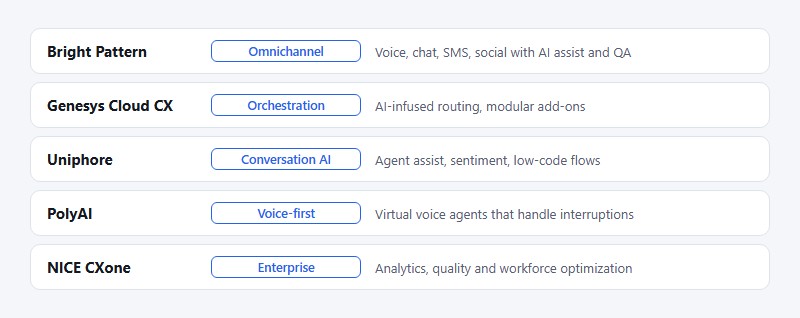
| Platform | Main focus | Best suited to |
| Bright Pattern | Omnichannel AI with QA and analytics | Teams wanting channels, AI and quality management together |
| Genesys Cloud CX | AI-infused routing and orchestration, modular pricing | Teams that add modules as they grow |
| Uniphore | Agent assist, conversation intelligence, low-code | Teams building custom workflows |
| PolyAI | Voice-first virtual agents | Phone-heavy operations |
| NICE CXone | Enterprise analytics and workforce optimization | Large operations with compliance needs |
For a wider view of the market, there is a roundup of AI customer service software.
How does AI support agents and surface insights?
The point of these tools is to help agents, not replace them. A live assistant offers suggestions, pulls up knowledge-base articles and shows how the customer feels, so the agent can decide with more information. Interaction tracking also works like a quiet coach: it highlights where an agent could improve, so skills build while people work.
The same data helps managers. Analysis of calls, chats and emails shows recurring questions and complaints, which point to broken processes, and sentiment trends show where agents need more training. Predictive analytics can go one step further and flag likely service delays or renewals so an agent contacts the customer before they call. A guide to AI bot analytics tools shows what to measure.
What results can a call center expect from AI?
- Lower volume and shorter waits. Routine requests are handled automatically, so queues shrink and a center can absorb more volume without hiring at the same rate.
- Better first-contact resolution. Guidance and sentiment cues during the call mean fewer follow-ups.
- Cost control. Automated routing, data entry and reminders cut manual work, and forecasting reduces over- or understaffing.
- Clearer customer insight. Patterns across channels feed training, process fixes and product decisions.
Measure these against your own baseline before and after rollout, since vendor figures rarely match every operation.
What should you watch for when adopting AI in a call center?
Poor knowledge content produces poor automated answers, so clean up your help articles first. Make sure a customer can always reach a human, keep an eye on privacy and recording rules in the countries you serve, and check that the platform connects to your CRM and ticketing tools. Start with one use case, such as password resets or order status, measure it and expand. Conversational design also matters, and this piece on designing human-like conversational AI covers it.
Frequently asked questions
Will AI replace call center agents?
Not in the cases the sources here describe. AI takes routine tasks and assists agents, while people handle complex or emotional cases.
What is a good first use case?
High-volume, simple requests with clear answers, such as order tracking, billing questions and password resets.
Which platform should I pick?
Choose by main need: voice-first, enterprise analytics, low-code workflows or one omnichannel suite. Ask each vendor for a pilot with your own data.
How do I measure success?
Track wait time, first-contact resolution, handling time, customer satisfaction and cost per contact against your earlier numbers.
How should you start with AI in your call center?
Pick one routine request type, shortlist two or three of the platforms above, and run a pilot that measures wait time and first-contact resolution. Add agent assist and analytics once the first use case works. Solutions such as Bright Pattern offer a way to combine these pieces in one platform if you prefer a single vendor.

- Best AI Presentation API for Developers in 2026: 6 Options Compared - November 26, 2026
- The Best Notepad++ Alternative for Every Platform - November 25, 2026
- SAP Regression Testing: Importance & Automation Strategies - November 25, 2026


