
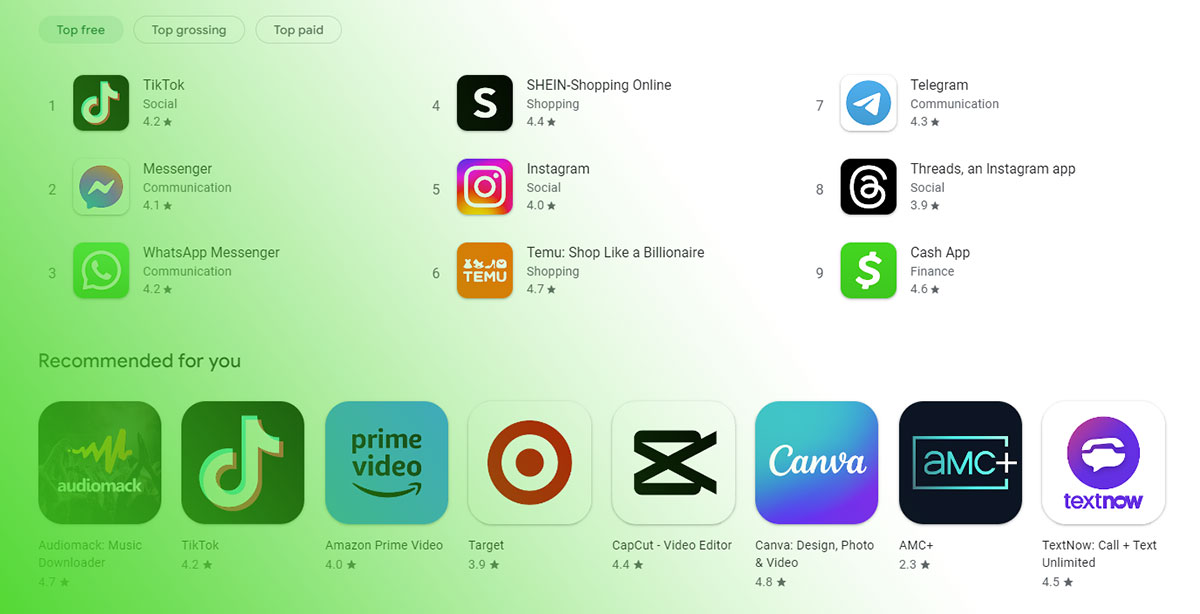
Your app icon is the only visual asset users see in Google Play search results. Not screenshots. Not videos. Just the icon, the title, and a star rating.
That makes learning how to design an Android app store icon one of the highest-leverage skills in the entire app launch process. A good icon drives taps. A bad one gets scrolled past, no matter how solid the app behind it is.
This guide covers the full process, from Google Play’s technical specifications and adaptive icon layers to color selection, silhouette design, and A/B testing with store listing experiments. You’ll also learn the specific mistakes that get icons rejected or ignored, and which tools (like Figma and Android Studio’s Image Asset Studio) actually speed up the workflow.
What Makes a Good Android App Store Icon

Your app icon is the single most viewed asset in your entire Google Play listing. It shows up in search results, category pages, the Explore tab, and on the user’s home screen after install.
And here’s the thing most people miss. On Google Play specifically, the icon is the only visual element that appears in search and Explore sections. Screenshots don’t show up there. Videos don’t either. Just the icon, the title, and the rating.
That means your icon carries more conversion weight on Android than on almost any other platform. AppTweak data from 2024 shows the average US Google Play conversion rate sits at 27.3%, but the gap between top and bottom performers within categories is massive. Auto & Vehicles apps convert at 70.5%, while Board Games barely hit 7.3%.
A lot of that gap comes down to how well the listing’s visual assets perform. The icon, in particular.
The qualities that separate good icons from forgettable ones
Recognizability at small sizes: Icons render as small as 48×48 dp on device. If your icon loses clarity at that scale, it fails the most basic test.
Visual distinctiveness: Your icon sits in a grid alongside dozens of competitors. A generic gradient or stock-looking symbol blends into the noise.
Brand alignment: The icon needs to signal what the app does or who made it within a fraction of a second. Spotify’s green-on-black, Duolingo’s owl, WhatsApp’s phone-in-speech-bubble. All instantly readable.
SplitMetrics research across hundreds of A/B tests found that icon design changes can produce conversion swings of up to fourfold between the best and worst variants. One case study showed the client’s least-favorite icon concept actually drove a 27.1% increase in downloads over their preferred design.
Trust the data, not your gut.
Common failures that kill performance
Too much detail is the biggest offender. Complex illustrations with thin lines, small text, or intricate patterns turn into muddy blobs at small sizes.
Text inside the icon almost always hurts. Google themselves recommend against it because legibility at launcher scale is terrible. The exceptions (Gmail’s “M”, Netflix’s “N”) work because they’re single, bold letterforms, not words or phrases.
Generic gradients are another problem. I’ve seen too many apps default to a blue-to-purple fade with a vague abstract shape. Looks fine in Figma at 512px. Disappears completely in a Play Store search grid.
With roughly 1.58 million apps competing on Google Play as of 2025 (Business of Apps), your icon is doing real work. It’s not decoration. It’s a conversion tool.
Google Play Store Icon Specifications
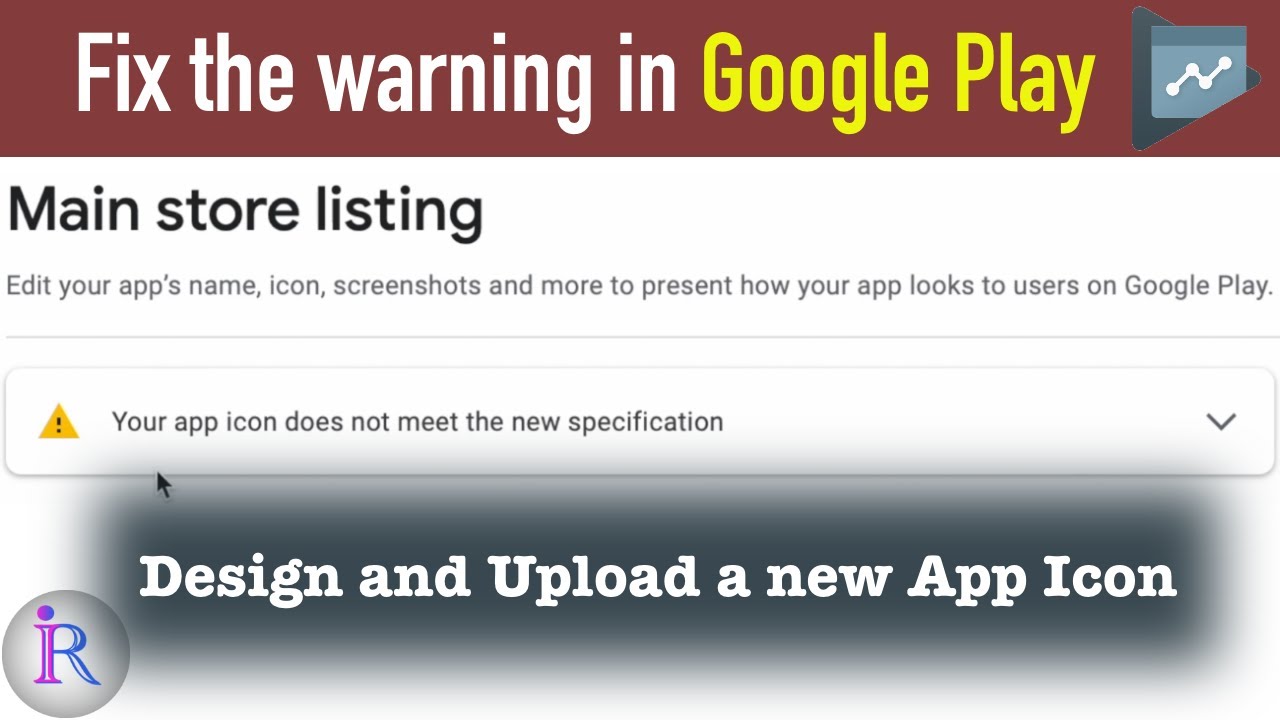
Google enforces specific technical requirements for store listing icons. Getting these wrong means your upload gets rejected, or worse, your icon renders badly across devices.
The store listing icon (what users see on Google Play itself) must be a 512 x 512 pixel PNG, 32-bit color, with a maximum file size of 1024 KB. No transparency allowed. Google dynamically applies corner radius at 30% of the icon size, so you upload a full square with no rounded corners baked in.
The in-app launcher icon uses the adaptive icon format, which is a different system entirely.
| Requirement | Store Listing Icon | Adaptive Launcher Icon |
|---|---|---|
| Size | 512 x 512 px | 108 x 108 dp per layer |
| Format | PNG, 32-bit | XML (vector or bitmap layers) |
| Transparency | Not allowed | Foreground can be transparent |
| Corner radius | Applied by Google (30%) | Applied by device OEM mask |
| Layers | Single flat image | Foreground + Background + Monochrome |
These are two separate assets. A mistake I see constantly is treating them as the same file.
Adaptive Icon Anatomy
Adaptive icons, introduced in Android 8.0, consist of two required layers and one optional layer. The foreground layer holds your primary logo or symbol. The background layer fills the space behind it with color, a gradient, or a pattern. Both are 108 x 108 dp.
Starting with Android 13, there’s a third layer: the monochrome layer. This is a single-color version of your icon that the system tints based on the user’s wallpaper theme. Google’s Material You design language pulls dynamic colors from the wallpaper, and themed icons adapt accordingly.
ASO World reported that Google announced plans to automatically apply monochrome theming to non-compliant icons starting with Android 16 QPR2. So if you don’t provide your own monochrome layer, Google generates one for you. The auto-generated result is rarely flattering.
Safe Zone and Masking
Each device OEM applies a different mask shape. Samsung uses rounded squares. Pixel phones use circles. Other manufacturers pick squircles or other variations.
Because of this, the outer 18dp on each side of your 108dp layers can get clipped. The safe zone is a centered 66dp circle, guaranteed to never be cut by any mask. All critical design elements (your logo, your primary symbol) must stay inside this circle.
Anything outside that 66dp center is “extra” content that only appears during motion effects or on devices with less aggressive masking. Placing your logo near the edge is a sure way to get it partially sliced off on half the devices out there.
Designing the Icon Shape and Silhouette
Before you open any design tool, you need to decide on a silhouette. This is the most underrated step in the whole UI/UX design process for icons.
A strong silhouette means your icon is identifiable as a solid black shape on a white background. No color, no detail, no gradients. Just the outline. If it reads clearly at that level, it’ll work everywhere.
Starting with a single bold shape
The most effective app icons are built around one dominant geometric form. Not a complex illustration. Not a collage of tiny elements. One shape.
Google’s Material Design icon grid provides four keyline shapes as starting references: circle, square, vertical rectangle, and horizontal rectangle. These aren’t rules you have to follow exactly, but they give your icon consistent visual proportions against other apps in the grid.
Look at the apps that dominate their categories. Spotify uses a circle. Instagram uses a rounded square with a simplified camera. Duolingo uses the owl’s face filling the frame. Each is a single, immediately recognizable form.
Testing at multiple sizes
Here’s where most designers get lazy. They design at 512px (the store listing size) and never check how it looks smaller.
You need to test your silhouette at three scales minimum: 16px (notification bar), 48px (device launcher), and 512px (Play Store listing). If your icon looks good at 512 but turns into an unreadable smear at 48, it’s broken.
Figma makes this easy. The platform, which holds roughly 40% market share in design tools according to multiple industry reports, has community templates specifically for Android adaptive icons that include preview frames at different scales. Well, actually, Android Studio does too, but Figma is where most of the visual design work happens before handoff to development.
Silhouette mistakes to avoid
Centering a tiny object in the middle of a large background. Your icon ends up looking like a postage stamp in the grid.
Using thin lines as the primary visual. Lines disappear at small sizes. Stick with filled shapes.
Symmetrical boredom. A perfectly centered, perfectly symmetrical design can look sterile. Slight asymmetry or a shape that “leans” creates visual interest. Not always, though. Sometimes symmetry is exactly right. Your mileage may vary.
Color Selection for Android App Icons
Color is the fastest signal your brain processes. Before anyone reads your app name or recognizes your logo shape, they register the color.
AppTweak’s ASO report from 2024 found that apps improving their ratings from 3.6 to 4.2 saw nearly 60% higher conversion rates. But rating is just one factor. The visual appeal of your listing, driven heavily by icon color, contributes to that first-impression decision of whether to tap or scroll past.
Keep the palette tight
Two to three colors maximum. That’s the sweet spot for most high-performing icons. One dominant color, one accent, and maybe a neutral for depth or contrast.
More colors than that and the icon becomes noisy at small sizes. Fewer, and you might not have enough contrast to make the design pop.
Look at the top free apps on Google Play right now. Almost all of them use a limited palette. WhatsApp: green and white. YouTube: red and white. Telegram: blue and white. The pattern is consistent.
Testing against launcher backgrounds
Your icon will sit on wallpapers you can’t predict. Bright photos, dark solid colors, animated backgrounds with shifting hues. If your icon uses a light gray background, it vanishes on a white wallpaper. If it’s dark blue, it disappears against a navy backdrop.
Material You on Android 12 and later makes this trickier. The system extracts colors from the user’s wallpaper and applies them to UI elements, including (if supported) themed icon tints. Designing with flexible color schemes that hold up across both light and dark modes isn’t optional anymore.
Colors that cause problems on Google Play
White backgrounds blend into the Play Store’s own UI. Your icon loses its defined edge and looks like it’s floating without a boundary.
Light grays have the same problem. And overly saturated neon tones can look great on screen but feel visually aggressive when placed next to subtler competitors.
Tools like Adobe Color, Coolors, and Figma’s built-in contrast plugins let you test your palette against accessibility standards and various background scenarios. A quick contrast check takes five minutes and saves you from shipping an icon that disappears on half your users’ devices.
Typography and Text in App Icons
Short answer: don’t put text in your icon.
Long answer: there are exactly two scenarios where text works, and everything else fails.
Why text usually fails

At launcher scale (48dp), even a short word becomes unreadable. The pixel density just isn’t there to render clean letterforms at that size. Google’s own design guidelines recommend following Material Design principles and specifically advise against placing text inside app icons.
Full words, taglines, or descriptions inside an icon are a guaranteed readability disaster on Android. And remember, your icon also appears in notification bars, recent apps, settings screens, and sharing dialogs. Some of those render even smaller than the launcher.
When a single letter or wordmark works
Gmail’s “M.” Netflix’s “N.” These work because they’re single, bold, high-contrast letterforms that fill most of the icon’s safe zone. They function as shapes, not as text you’re expected to read.
The key difference is font weight and scale. A heavy sans-serif letter at maximum size reads like a geometric symbol. A thin-weight letter or a multi-character abbreviation reads like text, and text at small sizes is just noise.
If your brand identity genuinely relies on a single letter or a very short wordmark (two characters max), it can work. But test it at 48dp before committing. If you squint and can’t immediately identify it, go back to a symbol-based approach.
Tools for Designing Android App Icons
The tool matters less than most people think. What matters more is whether your workflow supports the adaptive icon format and exports correctly.
That said, some tools make the process significantly easier than others, especially for the multi-layer adaptive icon system that Android development requires.
Figma for Adaptive Icon Design
Figma is where most teams start, and honestly, where most teams finish too. About 90% of designers chose Figma as their primary tool according to the UXTools 2023 survey, and that share hasn’t dropped.
The Figma Community has dedicated Android adaptive icon templates. Google even published an official design document through Figma for the launcher icon template. These templates include the foreground and background layer frames, the 66dp safe zone overlay, keyline shapes, and preview masks for circle, squircle, and rounded square rendering.
The workflow is straightforward. Design your foreground layer in one frame. Design your background in another. Toggle mask previews to see how different OEMs will crop your icon. Export.
Generating Icons with Android Studio’s Image Asset Studio
This is the tool most developers actually use for final icon generation, even if the visual design happened elsewhere. Image Asset Studio lives inside Android Studio and generates all the density-specific icon files your app needs (mdpi, hdpi, xhdpi, xxhdpi, xxxhdpi).
It also previews how your adaptive icon looks with different mask shapes applied. You import your foreground and background layers, adjust sizing and padding, and it outputs the correct XML and drawable resources.
For teams working across the full mobile app development process, Image Asset Studio bridges the gap between design and implementation. The designer exports layers from Figma. The developer imports them here and generates production assets.
Other tools worth knowing
Adobe Illustrator: Still preferred by some teams for precise vector work. Outputs at exact pixel dimensions. Overkill for icon design alone, but useful if your team already lives in the Adobe ecosystem.
Sketch: macOS only. Still used by some teams, but its market share has declined significantly (down to roughly 4.5% by 2023 per UXTools data). Supports adaptive icon templates through third-party plugins.
Inkscape: Free and open source. Gets the job done for vector icon work but lacks the polished adaptive icon templates and preview features that Figma and Android Studio provide. A reasonable option for solo developers who need open source mobile app development software.
Iconify: A plugin and resource library that integrates with multiple design tools. Useful for sourcing reference icons and exporting in various formats.
| Tool | Best For | Platform | Adaptive Icon Support |
|---|---|---|---|
| Figma | Visual design + team collaboration | Web, Desktop | Community templates |
| Android Studio | Final asset generation | Windows, Mac, Linux | Built-in Image Asset Studio |
| Adobe Illustrator | Precision vector work | Windows, Mac | Manual setup |
| Sketch | macOS design teams | Mac only | Third-party plugins |
| Inkscape | Free vector editing | Cross-platform | Manual setup |
Pick whatever your team already knows. The icon itself matters more than the tool that made it.
Testing Your Icon Before Publishing

Designing an icon you like is one thing. Designing one that converts is a completely different problem.
Your personal preference, your team’s opinion, even your designer’s gut feeling, none of it reliably predicts which icon will drive more installs. SitePoint documented a case where an icon the client liked least produced a 27.1% increase in downloads over their favorite design.
Test before you commit. Google gives you the tools to do it for free.
Google Play Store listing experiments
Store listing experiments are Google’s built-in A/B testing tool, available directly inside Google Play Console. You upload up to three icon variants alongside your current icon, set what percentage of store traffic sees each version, and let Google split the audience.
The system now measures two metrics: first-time installers and retained first-time installers (users who keep your app for at least one day). Google recommends running each test for a minimum of seven days to account for weekday vs. weekend traffic differences.
AppTweak’s 2025 ASO report found that 57% of top games on Google Play ran A/B tests on screenshots at least twice in 2024. Icon testing follows similar patterns among high-performing apps.
Previewing at actual Play Store scale
The grid test matters more than the solo test. Your icon never appears in isolation. It sits alongside competitor icons in search results, category listings, and “similar apps” suggestions.
Take a screenshot of a real Play Store search result in your category. Drop your icon into that grid using Figma or any image editor. Does it stand out or blend in? That five-minute exercise reveals more than hours of internal feedback sessions.
Also check how the icon renders in Google Play’s dark mode. The Play Store UI has both light and dark variants, and an icon that pops on white can fade against a dark background.
Testing across device themes
Android 12+ introduced Material You dynamic theming. Android 13 added themed icon support via the monochrome layer. These features mean your icon can look different depending on each user’s wallpaper and theme settings.
Check your icon across at least three scenarios:
- Default launcher appearance (no themed icons enabled)
- Themed icons on a light wallpaper
- Themed icons on a dark wallpaper
The Android Emulator in Android Studio lets you test all three without needing physical devices. But if you have a Pixel or Samsung device handy, test on hardware too. Emulators don’t always match real-world rendering exactly.
Exporting and Uploading the Final Icon
The export step is where small technical mistakes create big problems. Wrong color profile, wrong file format, wrong dimensions. Any of these can trigger a rejection or cause your icon to render poorly across devices.
Google blocked over 2.36 million policy-violating apps from publishing in 2024 alone, according to Google’s security blog. While most of those rejections involve code and permissions issues, store listing assets (including icons) that don’t meet specifications also get flagged.
Export settings for the store listing icon

Format: 512 x 512 pixel PNG, 32-bit color.
Color profile: sRGB. Not Adobe RGB, not Display P3. sRGB. Using the wrong color profile shifts your colors when Google processes the image, and you’ll end up with a muddy or oversaturated icon that doesn’t match what you designed.
No alpha channel. Google’s store listing icon doesn’t allow transparency. If your PNG has any transparent pixels, the upload will fail or the transparent areas will render as Google Play’s default background color.
Also worth noting: don’t bake in corner radius or drop shadows. Google dynamically applies a corner radius at 30% of the icon size and handles shadows on its own.
Preparing adaptive icon files for the app itself
The store listing icon and the in-app launcher icon are separate assets. The launcher icon uses Android’s adaptive icon XML format.
| File | Purpose | Location |
|---|---|---|
| iclauncherforeground | Main logo/symbol layer | res/drawable or mipmap |
| iclauncherbackground | Background fill layer | res/drawable or mipmap |
| iclaunchermonochrome | Themed icon (Android 13+) | res/drawable |
| ic_launcher.xml | Combines all layers | res/mipmap-anydpi-v26 |
If you’re working in a team that handles both design and mobile application development, the designer exports the layers from Figma. The developer then imports them through Android Studio’s Image Asset Studio to generate the density-specific drawables.
Since August 2021, Google requires all new apps to be uploaded as Android App Bundles (AAB) rather than APKs. The icon assets themselves are packaged inside the bundle, but the store listing icon is uploaded separately through Google Play Console’s store listing section.
Common upload errors
Transparency in the store icon: The most frequent rejection trigger for icon assets. Double-check your PNG export has no alpha channel.
Wrong dimensions: Must be exactly 512 x 512. Not 511, not 513. Pixel-perfect.
Exceeding file size: Keep the PNG under 1024 KB. If your icon includes complex gradients or detailed artwork, run it through a PNG optimizer before uploading.
Once everything passes, upload through the Google Play Console under the “Store listing” section. After your app passes review and goes live, the icon can still be changed later, ideally after running an A/B test with Google Play’s store listing experiments.
Mistakes That Get Android App Icons Rejected or Ignored
Some mistakes get your icon rejected by Google. Others just make it invisible in the store. Both are equally costly.
Google’s review process runs over 10,000 safety checks on each app before and after release, according to Google’s security blog. Your store listing assets are part of that review, and icons that violate guidelines get flagged alongside everything else.
Policy violations that trigger rejection
Misleading imagery is a direct policy violation. If your icon shows features your app doesn’t have, or implies a connection to a brand you’re not affiliated with, Google will reject the listing. This includes mimicking another app’s icon to confuse users.
Artificial badges, text overlays like “Top App” or “Sale” or “5 Stars” baked into the icon, get flagged during moderation. Both Google and Apple explicitly prohibit these. ASOMobile’s 2025 guidelines confirm that such additions result in automatic rejection on both platforms.
Technical errors that cause problems
| Error | What Happens | Fix |
|---|---|---|
| Transparency in store icon | Upload rejected or ugly default background | Export PNG without alpha channel |
| Elements outside safe zone | Logo gets clipped on some devices | Keep critical art inside 66dp circle |
| No monochrome layer | Auto-generated themed icon looks bad | Provide your own monochrome drawable |
| Wrong color profile | Colors shift after Google processes image | Export as sRGB, not Adobe RGB |
The monochrome layer one is increasingly relevant. With Google pushing themed icons as a standard and even auto-generating them for apps that don’t provide their own, skipping this layer means losing control over how your icon appears on a growing number of devices.
Design choices that hurt install rates
Over-detailed illustrations are the silent killer. An icon that looks beautiful at 512px on your monitor turns into an unreadable smudge at 48dp on a phone screen. Took me a while to learn this, but simpler is almost always better for icons.
Copying a competitor’s icon style too closely creates a different kind of problem. Even if it doesn’t trigger a trademark rejection, it makes your app indistinguishable in the store grid. You want to look like you belong in your category while still standing out. That balance is tricky, but it’s the whole game.
Every icon decision feeds back into the broader software development process. Design, test, measure, iterate. Then test again. The Google Play publishing process gives you the tools to run experiments and validate changes with real user data. Use them.
FAQ on How To Design An Android App Store Icon
What size should a Google Play Store icon be?
The store listing icon must be 512 x 512 pixels, exported as a 32-bit PNG with no transparency. The in-app adaptive launcher icon uses 108 x 108 dp layers. Google applies corner radius and shadows automatically, so don’t bake those in.
What is an adaptive icon on Android?
Adaptive icons use two separate layers (foreground and background) that the device masks into a unified shape. Each OEM applies its own mask, like circles or squircles. A third monochrome layer supports themed icons on Android 13 and later.
Can I put text in my Android app icon?
Generally, no. Text becomes unreadable at launcher scale (48dp). The only exception is a single bold letterform, like Gmail’s “M” or Netflix’s “N.” Full words, taglines, or abbreviations fail at small sizes every time.
What is the safe zone for Android adaptive icons?
The safe zone is a centered 66dp diameter circle within the 108dp icon layers. Anything outside this area may get clipped by device-specific masks. Keep your logo and all critical visual elements inside this boundary.
What tools are best for designing Android app icons?
Figma is the most popular choice, with community templates built for adaptive icons. Android Studio’s Image Asset Studio handles final asset generation. Adobe Illustrator and Inkscape work for vector design but need manual adaptive icon setup.
How many colors should an app icon use?
Stick to two or three colors maximum. One dominant, one accent, and optionally a neutral for contrast. More than that creates visual noise at small sizes. Test your palette against both light and dark launcher backgrounds.
How do I A/B test my app icon on Google Play?
Use Store Listing Experiments in Google Play Console. Upload up to three icon variants, set your traffic split, and run the test for at least seven days. Google tracks first-time installers and retained installers for each variant.
What file format does Google Play require for app icons?
A 512 x 512 pixel PNG in sRGB color profile, with no alpha channel. Maximum file size is 1024 KB. Using the wrong color profile (like Adobe RGB) will cause color shifts after Google processes the image.
Do I need a monochrome icon layer for Android?
Yes, if you want control over how your icon looks with themed icons enabled. Starting with Android 16 QPR2, Google auto-generates monochrome versions for apps that don’t provide one. The auto-generated results are rarely good.
What mistakes get Android app icons rejected?
Transparency in the store listing icon, misleading imagery, and artificial badges like “Top App” or “5 Stars” all trigger rejection. Using elements outside the safe zone won’t get rejected but will cause clipping on certain devices.

- MongoDB Cheat Sheet - October 20, 2026
- Adding AI Video Generation to a Software Product: Architecture, Cost Guardrails and QA - October 20, 2026
- Show Hidden Characters, Spaces, and Line Endings in Notepad++ - October 19, 2026


