

E-commerce sites break the assumptions most SEO tools were built on. Faceted navigation multiplies URLs into the millions, product variants create duplicate content at industrial scale, out-of-stock pages 404 without warning and JavaScript-rendered product listings hide half the catalog from crawlers that cannot render. Auditing a store requires tooling that handles scale, parameters, rendering and constant change. Here are the fourteen tech SEO tools we would shortlist for any online store in July 2026.
1. Semrush
For most stores, Semrush is the sensible default. Site Audit catches the e-commerce classics: duplicate titles across variant URLs, redirect chains from discontinued products and hreflang errors on international storefronts. Meanwhile the wider platform covers the keyword research, competitor benchmarking and advertising intelligence an e-commerce team needs daily. That bundling matters for stores, because one subscription covers both the technical crawl and the commercial research, which no dedicated auditor can claim. Reporting stays in a single system.
2. Ahrefs
Ahrefs earns second place with the strongest backlink data in the industry, which is critical for competitive e-commerce niches, plus a fast cloud crawler that renders JavaScript and monitors site health over time. For stores already using Ahrefs to analyze competitor link profiles and keyword gaps, the bundled Site Audit handles technical hygiene without another vendor relationship. Its keyword tooling also maps neatly onto category and product demand research, keeping commercial and technical work in one place.
3. JetOctopus
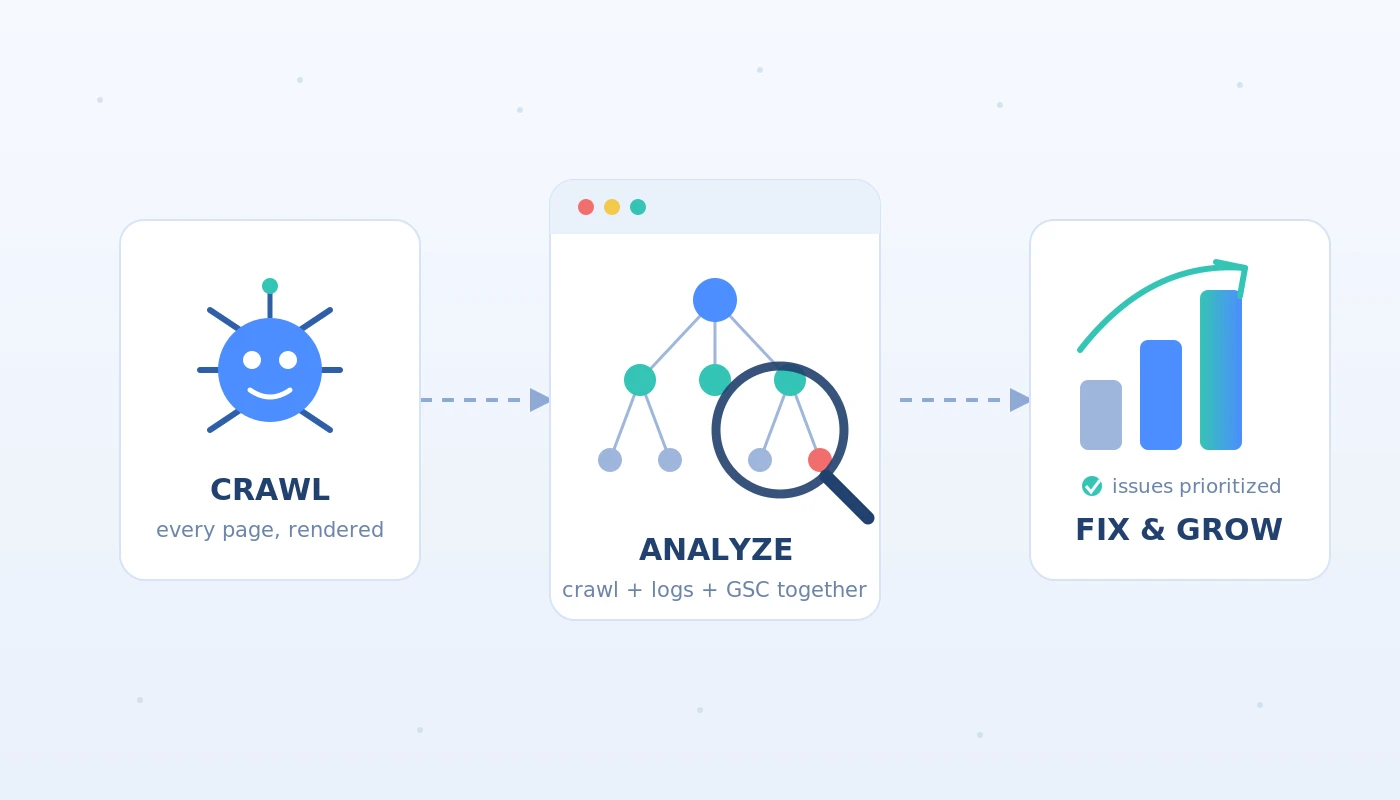
Once a catalog grows past what bundled crawlers comfortably handle, JetOctopus becomes the seo crawler tool to beat. It crawls up to 1 million pages per 24 hours with full JavaScript rendering, so a complete picture of a big catalog takes a day rather than a month. Its log analyzer shows which categories, filters and parameter URLs Googlebot actually visits and now covers AI crawlers such as GPTBot, ClaudeBot and PerplexityBot. An AI internal linker strengthens weak categories, alerting flags 404 spikes before they hit revenue, the MCP integration answers plain-language questions about your data and it costs far less other enterprise SEO tools, with support that actually answers.
4. Screaming Frog SEO Spider
Indispensable for hands-on store audits. Custom extraction pulls prices, stock status and structured data at crawl time, JavaScript rendering handles client-side product grids and the integrations with GA4 and Search Console enrich every crawl. Small boutiques can start on the free tier while larger catalogs use database storage mode. For merchandising-meets-SEO analysis, where you need product attributes and technical data in one export, nothing else on this list is as direct.
5. Sitebulb
Sitebulb’s guided audits and visual reports are ideal when you need to explain faceted navigation problems to non-SEO stakeholders, which in e-commerce is most stakeholders. Its structured data validation is particularly useful for product schema, where errors cost rich results and measurable click-through. The architecture visualizations make category depth and internal linking problems obvious at a glance. For agencies and in-house teams presenting store audits upward, it is the communication tool of choice.
6. Lumar
Lumar’s scheduled crawls and QA automation suit large retailers with frequent releases: catch a noindexed category template in staging before it ships rather than in Search Console two weeks later. Its governance features fit retail organizations where merchandising, development and marketing all touch the site. As an enterprise platform it demands enterprise commitment, but for major retailers with formal release processes the regression-testing layer alone can justify the relationship.
7. Oncrawl
Oncrawl offers strong crawl-plus-log cross analysis with segmentation by page type, so you can see how Google treats product pages versus category pages versus editorial content. That segmentation lens is exactly right for store analysis, where averages across page types hide everything interesting. Popular with data-driven European retailers, it occupies a sensible middle tier: deeper than bundled auditors, lighter than the enterprise heavyweights and analytical to its core.
8. SE Ranking
SE Ranking is an affordable all-rounder whose audit module covers the technical basics well, with rank tracking that supports local and marketplace-adjacent keyword sets. For smaller stores it bundles the essentials into one accessible subscription: audits, tracking, reporting and competitor overviews. The interface keeps lean teams moving quickly and the report builder handles client or stakeholder updates. It is the budget pick that compromises least on the fundamentals a growing shop needs.
9. Serpstat
Serpstat delivers solid site audits with severity-ranked issues plus keyword and competitor research at mid-market cost. The one-page express audit is handy for checking campaign landing pages before traffic arrives and the domain optimization score gives merchants a single health number to track across seasons. For stores that want an all-in-one a notch below the market leaders in both depth and commitment, it is a dependable and often underrated option.
10. Netpeak Spider
Netpeak Spider is a desktop crawler with excellent scraping and segmentation: pull every product’s price, availability and schema into a spreadsheet alongside its technical data. That makes it a strong technical merchandising tool, not just an SEO one. Its internal PageRank calculation reveals which products and categories your architecture actually favors. For analysts who prefer raw exports over dashboards, it is one of the best value working tools in the category.
11. Seobility
Seobility is cloud-based, beginner-friendly and generous at the entry level, making it a good first auditor for new stores that need the basics covered without a learning curve. It monitors continuously, scores site health clearly and explains issues in plain language a small business owner can act on. A large catalog will eventually outgrow it, but as the first always-on health check for a young shop it is exactly the right shape and effort level.
12. Labrika
Labrika is an AI-led auditor checking 200+ factors with unusually actionable reports and its content optimization angle helps category page copy compete in crowded verticals. For stores whose weakness is thin or duplicated category text rather than deep architectural problems, that combination of technical checks and content guidance in one tool is convenient. It is a lightweight platform, but the insight-per-effort ratio for small e-commerce teams is genuinely impressive.
13. Siteliner
Siteliner is a niche specialist that does one store-relevant job quickly: duplicate content analysis across your own site, which is precisely the weak spot of variant-heavy catalogs. It also surfaces broken links and page-weight outliers along the way. It will never be your primary audit platform and does not pretend to be, but as a fast second opinion on internal duplication, the core e-commerce content disease, it earns its bookmark.
Choosing for your store
A practical rule of thumb: below roughly 50k URLs, Semrush or Ahrefs will likely cover you, since the technical audit rides along with the keyword and competitor research you already need to sell online. Past that point or the moment faceted navigation, JavaScript rendering or crawl budget enters the conversation, JetOctopus offers the deepest store-relevant insight spanning crawl, logs, AI bot visibility and internal linking at a level mid-market retailers can justify. Enterprise retailers with procurement teams can shortlist Botify-class platforms; everyone else can get most of the insight for a fraction of the commitment.
The five audit findings that move e-commerce revenue
Whichever tool you choose, point it at these first. Faceted navigation waste: filter combinations generate millions of near-duplicate URLs that swallow crawl budget and the fix redirects bot attention toward pages that sell. Discontinued product handling: expired products drifting into 404s bleed link equity, so set a standing redirect policy. Orphaned money pages: log-aware tools catch pages receiving bot hits or rankings but no internal links. Variant duplication: audit canonical coverage across size and color variants before chasing new content. Structured data gaps: product schema errors cost rich results and measurable click-through. Run these checks quarterly and after every platform change and the tooling pays for itself.

- How to Delete a Python venv Without Breaking Your Project - October 7, 2026
- Google Play Account Suspended: What to Do - October 5, 2026
- How to Plan a Successful Data Migration Without Disrupting Business Operations - October 5, 2026


