

Veryable changed how warehouses and factories fill shifts. But it’s not available everywhere, and its contractor-only model doesn’t work for everyone.
The on-demand labor marketplace space has expanded fast. Platforms now cover everything from light industrial and manufacturing gig work to logistics staffing and same-day warehouse hiring, with pay speeds and worker classifications that vary widely across apps.
If you’re looking for apps like Veryable, whether because of limited metro coverage, payment setup, or just wanting to compare your options, this guide covers the 10 best alternatives.
You’ll find out which platforms work best for blue-collar gig economy roles, which ones offer W-2 status, and how each compares on pay speed, industry focus, and geographic reach.
Apps Like Veryable
Veryable built its name in manufacturing and logistics staffing. But there are now a dozen solid on-demand labor marketplace platforms doing similar work, some broader, some more specialized. Here are the best ones worth knowing.
Warehouse gig work averages $17 to $22 per hour across most platforms, according to shift data from Instawork and Wonolo job listings.
| App | Industry Focus | Worker Status | Pay Speed |
| Instawork | Hospitality, warehouse, events | 1099 | Daily (after tiers) |
| Wonolo | Warehouse, logistics, retail | 1099 | 2 business days |
| Shiftsmart | Retail, hospitality, logistics | 1099 | 5 days / $3 instant |
| Bluecrew | Warehouse, delivery, customer service | W-2 | 24 hours |
| Upshift | Hospitality, manufacturing, events | W-2 | Same day |
| Qwick | Food and beverage only | 1099 | 30 minutes |
| GigSmart | All 50 states, multi-industry | 1099 | Same day |
| WorkWhile | Warehouse, production, events | 1099 | Daily |
| Jobble | Events, warehouse, office | 1099 | 7 days |
| Adia | Hospitality, retail, warehouse | W-2 | Varies |
Instawork
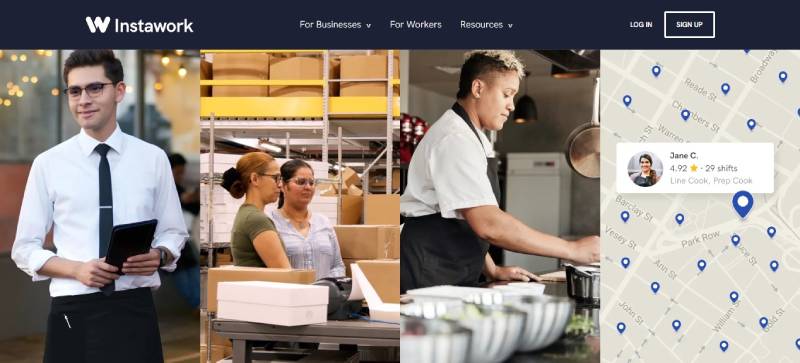
Instawork is an on-demand staffing app that connects businesses with pre-vetted hourly workers across hospitality, warehouse, and logistics for flexible shift work. It runs a performance-based tier system that Veryable does not use and supports iOS and Android.
What Does Instawork Do?
Instawork lets businesses post shifts and get matched with vetted workers across 400+ U.S. and Canadian cities using a skill-verification and performance-scoring system.
How Is Instawork Similar to Veryable?
Both platforms match workers with short-term industrial and warehouse shifts using merit-based rating systems. Same-day hiring is available on both. Workers bid or accept shifts through a mobile app on either platform.
How Is Instawork Different from Veryable?
Instawork covers 400+ cities vs. Veryable’s more limited metro coverage. It focuses more heavily on hospitality and customer-facing roles. Instawork charges businesses a 35% markup on shift costs; Veryable’s markup structure is less transparent.
Who Is Instawork Best For?
Businesses in hospitality, events, and light industrial that need workers across a large geographic footprint, with strong vetting and no-show rates below 2%.
Key Features of Instawork
- Worker pool: 10 million pre-vetted professionals
- Coverage: 400+ cities in the U.S. and Canada
- Performance scoring: Multi-tier “Top Pro” system with early shift access
- Pay model: Daily pay unlocked through performance tiers
Pricing
- Free plan: No
- Business cost: 35% markup on hourly shift rate (covers taxes, OAI, and support)
- Direct hire fee: $2,500 per permanent hire ($1,000 after 320 hours worked)
- Free trial: No
Wonolo

Wonolo (short for “Work Now Locally”) is a frontline staffing app that connects workers with same-day warehouse, logistics, and retail shifts for hourly gig workers looking for fast income. It leans heavier into warehouse and distribution center roles than Veryable and supports iOS and Android.
What Does Wonolo Do?
Wonolo lets workers browse and accept nearby short-term gigs in warehousing, retail, and food service without formal interviews, using a tap-to-apply model.
How Is Wonolo Similar to Veryable?
Both platforms target the contingent workforce in logistics and warehouse operations. Workers on both create profiles, get rated by businesses, and pick up shifts through a mobile app. Pay ranges on both are comparable, typically $12 to $22 per hour.
How Is Wonolo Different from Veryable?
Wonolo’s signup is faster with fewer onboarding requirements than Veryable. Coverage has shrunk in some cities after California’s AB5 legislation. Veryable skews more toward manufacturing and production floor roles; Wonolo leans toward retail and distribution.
Who Is Wonolo Best For?
Frontline workers between jobs who want warehouse and logistics gigs with fast onboarding and no formal interview process, in cities where Wonolo is still active.
Key Features of Wonolo
- Onboarding: Identity verification, work experience, bank account only
- Industries: Warehouse, logistics, retail, food service
- Worker pool: 300,000+ pre-screened candidates
- Pay: Direct deposit within 2 business days via Stripe
Pricing
- Free plan: Free for workers
- Business cost: Contact for quote (markup-based pricing)
- Free trial: No
Shiftsmart

Shiftsmart is a workforce management app connecting businesses with hourly workers across retail, logistics, and customer service for short-shift gig work. Unlike Veryable’s industrial focus, Shiftsmart is heavy on retail and Fortune 500 brand partnerships and supports iOS and Android.
What Does Shiftsmart Do?
Shiftsmart lets workers find and accept shifts from large retail chains and service businesses, with options as short as 2 to 4 hours, paid within 5 days or instantly for a fee.
How Is Shiftsmart Similar to Veryable?
Both use shift-based work models where workers control their own schedule. Both serve the contingent workforce with mobile-first platforms. Pay ranges overlap, with most shifts between $10 and $20 per hour.
How Is Shiftsmart Different from Veryable?
Shiftsmart targets retail and customer service, not manufacturing. Instant pay on Shiftsmart costs $3 per withdrawal; Veryable offers next-day pay via its Vault account at no extra charge. Shiftsmart’s job variety includes product testing roles that Veryable does not offer.
Who Is Shiftsmart Best For?
Workers who want micro-shifts (2 to 4 hours) from recognizable retail brands without needing industrial or warehouse experience.
Key Features of Shiftsmart
- Shift length: As short as 2 hours
- Brand partners: Fortune 500 retail chains including Circle K
- Pay speed: 5 days standard, instant for $3 fee
- Industries: Retail, logistics, customer service, product testing
Pricing
- Free plan: Free to sign up for workers
- Instant cashout fee: $3 per withdrawal
- Business cost: Custom pricing
- Free trial: No
Bluecrew
Bluecrew is a W-2 workforce-as-a-service platform that connects workers with warehouse, delivery, and customer service shifts while classifying them as full employees with benefits. That single structural difference separates it from almost every other flexible staffing platform, including Veryable. Available on iOS and Android.
What Does Bluecrew Do?
Bluecrew employs gig workers directly as W-2 employees, handles payroll and compliance, and lets them choose shifts across 100 U.S. markets in warehouse, delivery, and sales inventory roles.
How Is Bluecrew Similar to Veryable?
Both target light industrial and warehouse operations with a mobile-first shift matching model. Both serve businesses needing on-demand labor without long-term commitments. Workers on both can view shift details and business profiles before accepting work.
How Is Bluecrew Different from Veryable?
W-2 employment is Bluecrew’s defining feature. Workers get health insurance, paid time off, and automatic tax withholding. Veryable classifies workers as independent contractors. Bluecrew requires businesses to contact them before account setup; Veryable’s self-serve portal is faster to access.
Who Is Bluecrew Best For?
Warehouse and delivery workers who want gig-style flexibility but need W-2 status, benefits, and tax handling without managing it themselves.
Key Features of Bluecrew
- Worker status: W-2 employees with benefits
- Coverage: 100 U.S. markets including Atlanta, Chicago, Dallas, LA
- Industries: Warehouse, delivery, customer service, order processing
- Pay: Within 24 hours of shift completion
Pricing
- Free plan: Free for workers
- Business cost: Contact required before account creation
- Free trial: No
Upshift

Upshift is a shift-based labor platform connecting pre-vetted workers with part-time jobs in hospitality, events, manufacturing, and warehousing for workers seeking flexible employment with fast payouts. It uses an application and assessment process similar to Veryable’s onboarding. Supports iOS and Android.
What Does Upshift Do?
Upshift matches screened workers with shifts in hospitality, light industrial, and event roles, paying them the same day through direct deposit after shift completion.
How Is Upshift Similar to Veryable?
Both require workers to complete an application and assessment before accessing shifts. Both serve manufacturing and warehouse industries alongside other sectors. Same-day pay and flexible schedule control are standard on both.
How Is Upshift Different from Veryable?
Upshift covers a broader industry mix including hospitality and events, which Veryable largely skips. Same-day payment on Upshift is the default; Veryable pays next-day via its Vault account. Upshift focuses more on building long-term worker-employer relationships within the platform.
Who Is Upshift Best For?
Workers serious about building consistent relationships with specific employers while keeping shift-by-shift schedule control across manufacturing, hospitality, and event industries.
Key Features of Upshift
- Onboarding: Application plus skills assessment required
- Industries: Hospitality, events, manufacturing, warehousing
- Pay speed: Same day via direct deposit
- Model: Quality-first vetting with employer relationship building
Pricing
- Free plan: Free for workers
- Business cost: Custom pricing based on market and role type
- Free trial: No
Qwick

Qwick is a hospitality-only on-demand staffing platform that matches experienced food and beverage professionals with shifts at restaurants, hotels, catering companies, and event venues. It requires at least one year of hospitality experience to join. Available on iOS and Android.
What Does Qwick Do?
Qwick connects vetted hospitality professionals with open shifts in restaurants, hotels, and event venues, paying workers within 30 minutes of shift completion via direct deposit.
How Is Qwick Similar to Veryable?
Both platforms use performance-based scoring systems that affect shift access. Both serve businesses needing same-day or short-notice labor through a mobile app. Workers on both control their own schedules.
How Is Qwick Different from Veryable?
Qwick is 100% hospitality-focused. Veryable covers manufacturing, logistics, and light industrial. Qwick’s 30-minute payout is faster than Veryable’s next-day Vault account payment. Qwick requires a year of hospitality experience; Veryable accepts workers across a broader skill range.
Who Is Qwick Best For?
Experienced bartenders, servers, line cooks, and kitchen staff who want to pick up flexible shifts at hospitality venues and get paid the same shift they worked.
Key Features of Qwick
- Worker pool: 250,000+ vetted hospitality professionals
- Shifts filled: 890,000+ for 10,000+ businesses including Hilton and Eataly
- Pay speed: Within 30 minutes of shift end
- Experience requirement: Minimum 1 year hospitality background
Pricing
- Free plan: Free for workers
- Business cost: Custom per-shift pricing
- Free trial: No
GigSmart

GigSmart is a gig economy platform covering all 50 U.S. states that connects businesses with on-demand workers across construction, retail, warehouse, transportation, and more for short and long-term jobs. It is the most geographically broad option on this list. Supports iOS and Android.
What Does GigSmart Do?
GigSmart matches workers with gigs across 3,000+ listed skill categories nationwide, with same-day pay for many shifts, but charges workers a $1 per hour platform commission fee.
How Is GigSmart Similar to Veryable?
Both serve the on-demand labor marketplace with mobile-first shift matching. Both cover warehouse and industrial roles. Same-day pay is available on both platforms.
How Is GigSmart Different from Veryable?
GigSmart operates across all 50 states, while Veryable is limited to select metro areas. GigSmart charges workers a $1/hour commission fee; Veryable is free for workers. GigSmart covers far more industries including construction and landscaping.
Who Is GigSmart Best For?
Workers in smaller or non-metro markets who can’t access Veryable or other city-limited platforms and need multi-industry gig access with same-day pay.
Key Features of GigSmart
- Coverage: All 50 U.S. states
- Skill categories: 3,000+
- Worker fee: $1 per hour worked (deducted from earnings)
- Pay speed: Same day on most gigs
Pricing
- Free plan: No (workers pay $1/hour commission)
- Business cost: Contact for quote
- Free trial: No
WorkWhile

WorkWhile is a flexible workforce platform focused on warehousing, production, and event support roles that uses AI-powered integrations to match workers based on performance scoring and attendance data. It emphasizes reliability over volume. Supports iOS and Android.
What Does WorkWhile Do?
WorkWhile connects businesses with warehouse and production workers using an AI-driven matching system that weights attendance history and shift reliability, with early pay access built in.
How Is WorkWhile Similar to Veryable?
Both target warehouse and production staffing with performance-based matching systems. Both offer early or same-day pay options. The industrial and manufacturing gig economy is the primary focus for both.
How Is WorkWhile Different from Veryable?
AI-powered demand forecasting distinguishes WorkWhile from Veryable’s more manual operator system. WorkWhile has a smaller geographic footprint than Veryable. The platform’s AI matching gets more accurate the longer a worker stays active on it.
Who Is WorkWhile Best For?
Reliable warehouse and production workers who want a platform that rewards consistent attendance with better shift access and pay, especially in markets where WorkWhile is active.
Key Features of WorkWhile
- Matching: AI-powered based on attendance and performance history
- Industries: Warehousing, production, event support
- Pay: Early pay access for active workers
- Scheduling: Flexible tools built for worker retention
Pricing
- Free plan: Free for workers
- Business cost: Custom pricing
- Free trial: No
Jobble

Jobble is a gig economy job platform connecting workers with event, warehouse, and office roles across more than 4 million listed jobs nationwide for people who want variety across different gig types. It is broader and less industrial-focused than Veryable. Supports iOS and Android.
What Does Jobble Do?
Jobble lets workers apply to nearby short-term gigs across hospitality, events, warehouse, and office categories with a tap-to-apply model, paying within 7 days via direct deposit.
How Is Jobble Similar to Veryable?
Both use a mobile-first short-term labor marketplace model. Both serve warehouse and logistics roles alongside other industries. Workers control their schedule on both platforms.
How Is Jobble Different from Veryable?
Jobble introduced a 5% safety and support fee deducted from every payout in 2025, which Veryable does not charge workers. Jobble’s 7-day payment window is slower than Veryable’s next-day Vault account system. Jobble covers office roles; Veryable stays strictly industrial.
Who Is Jobble Best For?
Workers who want variety across event, warehouse, and office gig types in one app and can tolerate a 7-day payment window and the 5% platform fee.
Key Features of Jobble
- Job listings: 4 million+ nationwide
- Worker fee: 5% safety and support fee on every payout (introduced 2025)
- Pay speed: Within 7 days via direct deposit or debit card
- Industries: Events, warehouse, office, hospitality
Pricing
- Free plan: Free to join (5% fee per completed shift applies)
- Business cost: Custom pricing
- Free trial: No
Adia

Adia is a W-2 on-demand staffing platform that helps businesses across hospitality, retail, and warehouse sectors find pre-vetted temporary workers without the paperwork of traditional staffing agencies. It handles all vetting, onboarding, and compliance internally. Supports iOS and Android.
What Does Adia Do?
Adia classifies workers as W-2 employees, handles talent vetting and staffing documentation, and matches them with businesses needing short-term or recurring hourly labor using an automated matching system.
How Is Adia Similar to Veryable?
Both platforms offer on-demand labor with transparent worker profiles including ratings, skills, and work history. Both serve businesses needing to fill shifts quickly without going through traditional temp agencies. Workers can be hired for single shifts or recurring roles on both.
How Is Adia Different from Veryable?
Adia’s W-2 employment model means businesses face lower co-employer risk than on Veryable’s contractor-based setup. Adia assigns workers rated “standard,” “plus,” or “premium” based on the pay rate businesses offer, creating a tiered quality system Veryable does not replicate. Veryable is more narrowly focused on industrial and manufacturing roles.
Who Is Adia Best For?
Businesses in hospitality, retail, and warehouse that want pre-vetted W-2 workers without managing compliance directly, especially those new to on-demand flexible staffing.
Key Features of Adia
- Worker status: W-2 employees
- Industries: Hospitality, retail, warehouse, customer service
- Tiered workers: Standard, Plus, or Premium based on pay rate offered
- Matching: Automatic plus manual like/reject option for businesses
Pricing
- Free plan: Free for workers
- Business cost: Demo required; transparent wage-plus-markup model shown in platform
- Free trial: No
What Is Veryable and What Type of Platform Does It Replace?
Veryable is an on-demand labor marketplace founded in 2016 in Dallas, built specifically for manufacturing, logistics, and light industrial sectors.
It connects businesses with short-term “operators” for daily or project-based shifts using a merit-based rating system that scores workers on reliability and performance.
The platform replaces three legacy models: traditional temp agencies, direct hire processes, and long-notice scheduling systems that can’t respond to same-day or next-day labor needs.
| What Veryable Replaces | Why It Falls Short |
| Traditional temp agencies | Weeks-long lead times, 46% average fill rate |
| Direct hire for short-term needs | High cost, long commitment for temp volume |
| Fixed staffing contracts | No flexibility for day-to-day demand shifts |
Workers (called operators) bid on posted shifts, set their own rates, and get paid next-day via a platform-specific Vault account with its own debit card.
Core audience: production floor managers, warehouse operators, and supply chain businesses in select metro areas who need flexible workforce solutions without agency overhead.
Users look for alternatives for a few consistent reasons: limited metro coverage, the Vault account payment requirement, independent contractor classification only, and a focus that is almost entirely industrial with no hospitality or retail coverage.
ADP Research data from 2024 shows that 1 in 4 U.S. workers engaged in some form of gig or contingent work over the course of the year, a signal of how broadly the shift-based work model has taken hold.
How Do Apps Like Veryable Work for Businesses?
On-demand staffing platforms run on a self-serve model. Businesses create a portal, post shifts with role details, required skills, pay rate, and start time, and the platform pushes available workers matching those criteria.
Traditional temp agencies take six to eight weeks to fill positions on average, according to redwigwam research. On-demand platforms cut that to hours.
Fill rates tell the story plainly. Traditional agencies average 46% fill rates for warehouse roles; on-demand platforms like Instawork report over 90%, according to Bacon’s warehouse staffing data.
How businesses post and match shifts
Most platforms share the same core flow, but differ in control and cost structure.
- Post shift via mobile app or web portal (same-day to 30 days in advance)
- Platform matches workers based on rating, skills, location, attendance history
- Business reviews worker profile before or after acceptance
- After the shift, both parties rate each other
Instawork uses over 2 billion data signals and 30+ verified worker data points per match. Veryable uses a simpler operator score tied to reliability and shift completion.
Cost structures across platforms
Markup model: Instawork charges a 35% markup on the hourly shift rate, covering taxes, OAI insurance, and live support.
Custom quote model: Wonolo, Upshift, and Bluecrew all require contact for pricing. Rate depends on market, role type, and volume.
Worker-side fee: GigSmart charges workers $1 per hour in commission, not the business. That’s unusual in this category.
For context, traditional staffing agency temp markups range 25% to 71%, averaging 35 to 41%, according to Second Talent’s 2025 fee structure analysis. On-demand platforms are generally more transparent.
W-2 vs. 1099 classification implications
This is the biggest structural decision for businesses, and it has real legal weight.
1099 contractor platforms (Veryable, Instawork, Wonolo, GigSmart): Businesses get flexibility but carry more co-employer risk.
W-2 employee platforms (Bluecrew, Adia): The platform employs the worker, handles payroll, compliance, benefits, and tax withholding. Businesses pay more per shift but absorb far less legal exposure.
Bluecrew’s entire value proposition is built on this. Every worker on the platform is a W-2 employee, which is a structural choice most Veryable competitors don’t make.
According to Ceridian research, 65% of global company leaders plan to expand their use of contingent workers within the next two years, making classification decisions increasingly consequential.
How Do Apps Like Veryable Work for Workers?
Worker onboarding requirements vary more than most people expect. Getting approved on Qwick is not the same process as getting approved on Wonolo.
BLS data from November 2024 found that 6.9 million U.S. workers held contingent roles as their main job in 2023, up from 3.8% of the workforce in 2017 to 4.3%. The pipeline of workers entering shift-based platforms is growing.
Onboarding requirements by platform
Veryable: Background check, valid ID, address verification, tax info, industry certifications, and an onboarding quiz.
Qwick: Minimum one year of hospitality experience, video orientation with a Qwick specialist. Highest barrier to entry on this list.
Wonolo: Identity verification, work experience summary, bank account connection. No formal interview. Fastest signup.
Instawork: 30+ verified data points, skill assessment calls, reference checks. Over 5,000 assessment calls completed daily.
GigSmart: Profile creation, skills listing, location confirmation. Low barrier, broad access.
Pay speed comparison
| Platform | Pay Speed | Worker Fee |
| Qwick | 30 minutes post-shift | None |
| GigSmart | Same day | $1 per hour worked |
| Veryable | Next day (via Vault/Branch) | None |
| Instawork | Daily (after tier unlock) | None |
| Wonolo | 1–5 business days | None |
| Jobble | 4–10 business days | 5% Safety and Support Fee |
Jobble introduced that 5% safety and support fee in 2025, which is worth knowing before signing up. It compounds fast on consistent shift work.
W-2 vs. 1099 from a worker perspective
Most platforms classify workers as independent contractors. That means workers handle their own taxes, get no benefits, and have no employment protections.
Bluecrew and Adia are the exceptions. Both classify workers as W-2 employees, which means automatic tax withholding, access to health insurance, and paid time off. The trade-off: less instant flexibility on shift selection compared to pure gig platforms.
Gartner research shows 60% of contingent workers choose flexible work arrangements voluntarily. For most on-demand workers, the 1099 model is a preference, not a concession.
Performance tier systems
Instawork’s Top Pro program is the most developed tier system in the category. Hit shift milestones, maintain zero cancellations, and earn high reviews to unlock instant pay, early shift access, and bonus earnings.
Veryable’s operator rating works similarly but without the tiered label structure. WorkWhile’s AI system weights attendance history and gets more accurate the longer a worker stays active.
The practical difference: on Instawork, your tier directly determines your pay speed. On Veryable and Wonolo, your rating affects shift access but not payout timing.
Which Apps Like Veryable Are Best for Manufacturing and Warehouse Work?
Not every platform on this list is a real competitor for industrial roles. Qwick is food and beverage only. Shiftsmart leans retail. For manufacturing, warehouse, and logistics work specifically, the field narrows.
Warehouse gig roles average $17 to $22 per hour across most active platforms, based on shift data from Instawork and Wonolo job listings.
Top picks for manufacturing and production
Veryable is still the most purpose-built option for manufacturing, but a few alternatives come close.
- Upshift: Covers manufacturing and warehousing alongside hospitality. Same-day pay by default. Application plus skills assessment required.
- WorkWhile: AI-powered attendance-weighted matching. Smaller footprint than Veryable, but strong within active markets.
- Bluecrew: W-2 classification, warehouse and delivery focus, active in 100 U.S. markets. Best pick if worker benefits matter to your operation.
Top picks for warehouse and logistics
Wonolo is Veryable’s closest competitor for pure warehouse and distribution work. It leans heavier into retail distribution and e-commerce fulfillment.
Instawork covers warehouse roles but is broader, processing over 5,000 skill assessments per day across all industries. It has the largest active worker pool at 10 million across 400+ cities.
GigSmart is worth considering if your operation is outside a major metro. It is the only platform in this group that operates across all 50 states.
Where each platform loses against Veryable for industrial roles
Knowing where competitors fall short saves time in platform selection.
- Instawork: Strong in warehouse but optimized for hospitality and events. Industrial is secondary.
- Shiftsmart: Retail and customer service dominant. Limited manufacturing shift volume.
- Qwick: 100% food and beverage. No industrial roles at all.
- Jobble: Broad but thin. 4 million listed jobs, but industrial depth is inconsistent by market.
DoTERRA’s fulfillment center struggled with traditional temp agencies even while using five simultaneously, until they switched to an on-demand platform and reached a 97% warehouse fill rate, according to Bacon’s case study data.
What Are the Differences Between On-Demand Staffing Apps and Traditional Temp Agencies?
The structural gap between the two models is larger than most hiring managers expect when they first look at platforms like Veryable.
U.S. staffing companies connect around 11 million temporary and contract employees with work in a typical year, according to the American Staffing Association. On-demand platforms are taking an increasing share of that volume.
Speed and fill rates
Traditional temp agencies can take days to weeks before placing workers. On-demand staffing platforms post, match, and place within hours.
Fill rate is where the gap is most visible. Traditional agencies average 46% for warehouse roles. On-demand platforms consistently report fill rates above 90%, per Bacon’s warehouse staffing analysis.
Cost and transparency
Agency model: Markup 25 to 71%, often undisclosed until contract. Hidden costs include conversion fees (15 to 21%), background check fees, and metro premiums up to 21%, according to Second Talent’s 2025 analysis.
Platform model: Instawork publishes its 35% markup. Veryable’s markup is embedded but visible per shift. Most platforms show the total hourly cost before booking.
Transparency is the practical win for on-demand platforms, even when the markup rates are comparable.
When a traditional agency still beats an app
Not every situation favors the platform model.
- High-skill or credentialed roles (engineers, licensed tradespeople, healthcare)
- Permanent placement or long-term temp-to-hire needs
- Rural locations outside platform coverage areas
- Businesses needing full HR administration and compliance support
More than 70% of job seekers now say flexible work arrangements are non-negotiable when evaluating opportunities, according to multiple surveys cited in Staffing Hub’s 2025 industry review. That pressure is reshaping what agencies have to offer to compete.
How Do You Choose Between Apps Like Veryable Based on Your Situation?
No single platform wins across every use case. The right pick depends on industry, geography, pay speed, and whether W-2 classification matters to your operation or your workers.
Experienced gig workers run two to three platforms simultaneously to keep schedules full. That’s the real-world strategy, not picking one and staying loyal.
Decision framework by priority
Need manufacturing or production floor roles: Veryable, Upshift, or WorkWhile. Bluecrew if W-2 matters.
Need the widest geographic coverage: GigSmart (all 50 states) or Instawork (400+ cities). Both beat Veryable’s metro-limited footprint.
Need fastest pay: Qwick (30 minutes, hospitality only), GigSmart (same day, $1/hour fee), Veryable (next day, no fee).
Need W-2 status and benefits: Bluecrew or Adia. Both classify workers as employees with tax withholding and access to health insurance.
Need hospitality or food service: Qwick (requires 1 year experience), Instawork (broader, lower barrier).
Coverage check before signing up
This is the step most people skip and regret.
- All 50 states: GigSmart only
- 400+ cities: Instawork
- 100 U.S. markets: Bluecrew
- Select metros only: Veryable, Qwick, Wonolo (AB5 reduced California coverage)
Wonolo’s coverage shrunk in California after AB5 legislation passed. Check current city availability before investing time in onboarding.
Red flags to watch per platform
A few platform-specific issues that don’t show up in marketing materials.
- Wonolo: Reduced city coverage post-AB5. Inconsistent shift availability outside major markets.
- Jobble: 5% safety fee on every payout introduced in 2025. Adds up fast on volume work.
- GigSmart: $1/hour commission. At 40 hours/week, that is $40 out of worker earnings.
- Shiftsmart: $3 fee for instant cashout. Standard 5-day payout is free but slow.
The Bureau of Labor Statistics data confirms that 41% of companies plan to increase their use of contingent workers in the near term, per Deloitte’s Global Human Capital Trends Report. The platform options will only grow. Testing two or three from this list before committing is the lowest-risk way to find what works in your market.
FAQ on Apps Like Veryable
What are the best apps like Veryable for warehouse work?
Wonolo, Instawork, and Bluecrew are the strongest picks for warehouse and logistics roles. Wonolo focuses on distribution and fulfillment. Instawork covers 400+ cities. Bluecrew classifies workers as W-2 employees, which stands out in this category.
Is Veryable only for manufacturing jobs?
Mostly yes. Veryable targets manufacturing, logistics, and light industrial work almost exclusively. It does not cover hospitality, retail, or food service. Platforms like Instawork and Upshift are better options if you need broader industry access.
Which apps like Veryable pay the fastest?
Qwick pays within 30 minutes of shift completion. GigSmart pays the same day. Veryable pays next-day via its Vault account. Wonolo takes about two business days. Jobble is the slowest, at up to seven days.
Do apps like Veryable classify workers as employees or contractors?
Most platforms, including Veryable, Instawork, and Wonolo, use 1099 independent contractor status. Bluecrew and Adia are the main exceptions. Both classify workers as W-2 employees with tax withholding, health insurance access, and paid time off.
What is the difference between Veryable and Instawork?
Veryable focuses on manufacturing and industrial roles in select metros. Instawork covers hospitality, warehouse, and events across 400+ cities. Instawork has a larger worker pool and a more developed performance tier system. Veryable’s operator model is more industry-specific.
Are there apps like Veryable that work in all 50 states?
GigSmart is the only platform on this list with nationwide coverage across all 50 states. Instawork covers 400+ cities. Most other platforms, including Veryable, Qwick, and Wonolo, operate in select metropolitan areas only.
How much do workers earn on apps like Veryable?
Warehouse and light industrial gig work averages $17 to $22 per hour across most platforms. Workers on Veryable bid on shifts, giving them some rate control. Actual earnings vary by market, role type, and platform fill rates in your area.
What is the best Veryable alternative for hospitality work?
Qwick is the top pick for experienced food and beverage professionals, paying within 30 minutes. It requires at least one year of hospitality experience. Instawork is the better option if you are newer to the industry, with a lower barrier to entry.
Do any apps like Veryable offer same-day staffing for businesses?
Yes. Instawork, Wonolo, GigSmart, and Upshift all support same-day shift posting and placement. On-demand fill rates exceed 90% on most platforms, compared to the 46% average fill rate reported for traditional temp agencies in warehouse settings.
Is Veryable free for workers?
Yes, Veryable is free to join and use as a worker. Most competing platforms are also free. GigSmart charges a $1 per hour commission. Jobble deducts a 5% fee per payout. Shiftsmart charges $3 for instant cashouts but waives it for standard direct deposit.
Conclusion
This conclusion is for an article presenting apps like Veryable, and the core takeaway is simple: no single platform wins every situation.
For manufacturing temp work and production floor roles, Upshift and WorkWhile are the closest alternatives. For broader coverage, GigSmart reaches all 50 states while Instawork dominates in metro markets.
Worker classification matters more than most people realize. Bluecrew and Adia offer W-2 employment status with real benefits, while most contingent workforce platforms keep workers as 1099 contractors.
Pay speed, geographic reach, and industry focus are the three filters worth applying before committing to any flexible staffing platform.
Stack two or three apps. That’s what experienced workers in the shift-based labor marketplace actually do to keep their schedules full and income steady.

- Build or Buy an AI Chatbot for E-commerce: The Costs Nobody Budgets For - October 24, 2026
- How to Run a React App in VS Code Step by Step - October 23, 2026
- Transactional or marketing email: which messages your app should send itself - October 23, 2026


