Habitica turns your daily habits into an RPG, but the pixel art and party quests don’t click for everyone.
Maybe the gamification feels too heavy. Maybe you want something calmer, more data-driven, or with real financial stakes instead of virtual HP loss. Whatever the reason, there are strong apps like Habitica that cover the same ground in very different ways.
This list covers 10 alternatives across the full spectrum, from self-care companions like Finch to accountability tools like Beeminder, each with pricing, platform details, and a clear breakdown of who it actually suits.
Apps Like Habitica
Finch
Finch is a self-care and habit tracking app that lets users raise a virtual pet bird by completing daily wellness goals. It takes a gentler, more emotionally-driven approach than Habitica and supports iOS and Android.
What Does Finch Do?
Finch lets users build daily habits, track mood, journal, and do breathing exercises. Completing goals earns energy that sends your virtual bird on adventures.
How Is Finch Similar to Habitica?
Both apps use a virtual character that grows as you complete real-life tasks. Both include a reward system, positive reinforcement, and a social layer (friends can visit each other’s birds).
How Is Finch Different from Habitica?
Finch focuses on mental wellness and self-care, not RPG quests or combat. There is no guild system or group accountability mechanic. The tone is calm and supportive rather than game-like.
Who Is Finch Best For?
Finch suits users who want a soft, mental health-focused approach to daily habit building without the complexity of an RPG system.
Key Features of Finch
- Virtual pet system: Bird grows and evolves as you hit goals
- Mood journaling: Daily check-ins with guided prompts
- Breathing exercises: Built-in mindfulness tools
- Friends feature: Birds can visit each other via the Tree Town system
Pricing
- Free plan: Yes, core features included
- Paid plans: $9.99/month or $69.99/year (Finch Plus)
- Free trial: No standard trial; discounts unlock after 25, 50, 75 days of use
SuperBetter

SuperBetter is a gamified productivity app built on resilience psychology, using quests, power-ups, and ally support to help users tackle real-life challenges. It is free and supports iOS, Android, and web.
What Does SuperBetter Do?
SuperBetter turns personal challenges, like managing anxiety or building fitness, into a quest-based game. Users create a “Secret Identity,” defeat “Bad Guys” (negative habits), and collect “Power-Ups” (positive actions).
How Is SuperBetter Similar to Habitica?
| Feature | SuperBetter | Habitica |
| Quest-based tasks | Yes | Yes |
| Social accountability | Allies system | Guilds and parties |
| Goal tracking | Yes | Yes |
| Free to use | Fully free | Free with paid tier |
How Is Finch Different from Habitica?
SuperBetter skips character stats and inventory in favor of psychological resilience frameworks. No XP leveling or virtual gear. It is backed by a University of Pennsylvania clinical study showing improvements in depression and resilience after 30 days.
Who Is SuperBetter Best For?
SuperBetter suits users dealing with mental health challenges, recovery, or chronic illness who want a quest-based habit app grounded in clinical research rather than RPG aesthetics.
Key Features of SuperBetter
- Epic Win system: Users define a meaningful overarching goal
- Power Packs: Pre-built challenge sets for anxiety, depression, pain
- Squad Play: Group challenges for teams or classrooms
- Web + mobile: Available across all platforms
Pricing
- Free plan: Yes, full access to core features
- Paid plans: Hero account at $24.99/year; Host plans for organizations (custom pricing)
- Free trial: No trial needed, free plan is comprehensive
Fabulous

Fabulous is a science-backed routine building app that guides users through habit stacking using behavioral economics principles developed at Duke University. It supports iOS and Android.
What Does Fabulous Do?
Fabulous builds daily routines through themed “Journeys” (structured habit courses). It layers new habits gradually, using coaching prompts, meditation, and progress challenges.
How Is Fabulous Similar to Habitica?
Both apps reward daily task completion and focus on behavior change. Both include a community space and structured challenges. Both have a free tier with limited features.
How Is Fabulous Different from Habitica?
Fabulous has no character, RPG mechanics, or group quests. It is coaching-led and wellness-focused rather than game-driven. Fabulous has 37 million users and is incubated from Duke University’s Behavioral Economics Lab, something Habitica cannot claim.
Who Is Fabulous Best For?
Fabulous suits users who want structured habit coaching backed by behavioral science, especially beginners who prefer guided routines over open-ended game systems.
Key Features of Fabulous
- Habit Journeys: Themed 30-day courses for building specific routines
- Daily coaching series: Short written motivational sessions
- Circles community: Discussion groups by topic (anxiety, self-love, productivity)
- 1-on-1 coaching: Live sessions available via premium
Pricing
- Free plan: Yes, basic daily tracking included
- Paid plans: $39.99/year for full premium access
- Free trial: Yes, 7 days
Streaks
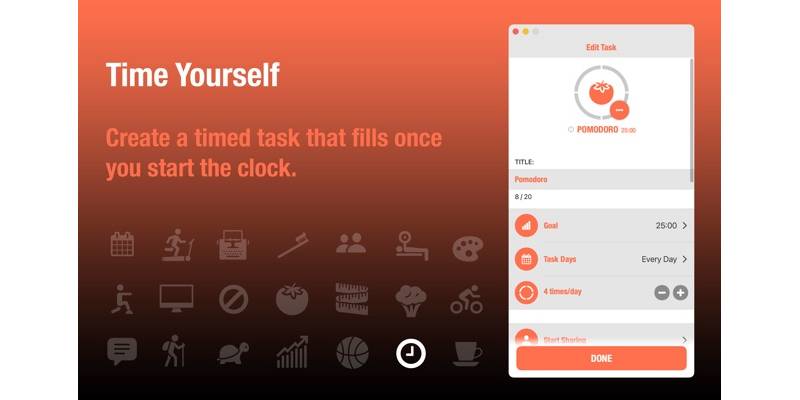
Streaks is a minimalist daily habit tracker that treats habits as a simple to-do list tied to a streak system. It is iOS and macOS only.
What Does Streaks Do?
Streaks lets users list up to 24 habits and tracks daily completion. It integrates with Apple Health to auto-complete health-based habits and syncs with Apple Watch.
How Is Streaks Similar to Habitica?
Both build on the idea that completing daily habits consistently creates progress. Both use visual feedback to show users how well they are doing over time.
How Is Streaks Different from Habitica?
No gamification whatsoever. No XP, no character, no social layer. Streaks scores a 4.8 rating on iOS and is designed for users who find RPG mechanics distracting rather than motivating.
Who Is Streaks Best For?
Streaks suits Apple ecosystem users who want a clean, no-fuss habit streak tracker without social features or game mechanics.
Key Features
- Apple Health auto-sync for health habits
- Apple Watch support with complications
- Up to 24 habits tracked simultaneously
- One-time purchase, no subscription
Pricing
- Free plan: No
- Paid plans: $5.99 one-time purchase (iOS/macOS)
- Free trial: No
Habitify
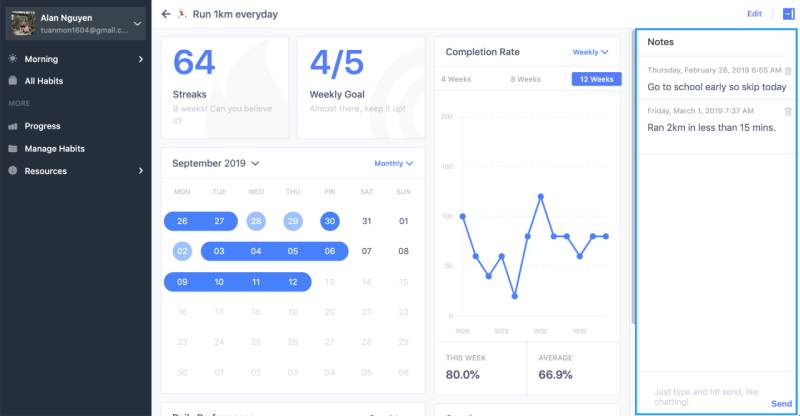
Habitify is a cross-platform habit tracking app focused on data, analytics, and clean design. It is available on iOS, Android, macOS, and web.
What Does Habitify Do?
Habitify lets users group habits by time of day, track mood, view completion rate data, and join social challenges. It supports Apple Health and Google Fit integrations.
How Is Habitify Similar to Habitica?
Both apps support social challenges and habit streaks. Both offer structured daily habit management and appeal to users who want to build better routines with some accountability layer.
How Is Habitify Different from Habitica?
Analytics-first design sets Habitify apart. There are no RPG elements, no character, no quests. Habitify suits data-driven users who want completion rates and pattern insights instead of XP and loot.
Who Is Habitify Best For?
Habitify suits users who enjoy reviewing detailed stats on their habits and want a cross-platform habit tracker with health app sync and social challenge features.
Key Features
- Habit grouping by time-of-day areas (Morning, Evening, custom)
- Apple Health and Google Fit integration
- Mood tracking with emoji-based logs
- Social challenges with friends or public groups
Pricing
- Free plan: Yes, limited to 3 habits
- Paid plans: From $29.99/year; $64.99 lifetime
- Free trial: No standard trial
TickTick
TickTick is an all-in-one task management and habit tracking app that combines to-do lists, a calendar, Pomodoro timer, and basic habit tracking in a single interface. It supports iOS, Android, Windows, macOS, and web.
What Does TickTick Do?
TickTick lets users manage tasks and habits together in one app using smart lists, calendar views, voice input, and the Pomodoro technique for focused work sessions.
How Is TickTick Similar to Habitica?
Both include habit tracking with streaks. Both allow recurring daily tasks and provide a progress view. Both have free tiers that cover the basics.
How Is TickTick Different from Habitica?
| Feature | TickTick | Habitica |
| Primary focus | Task + project management | RPG habit tracking |
| Gamification | None | Full RPG system |
| Pomodoro timer | Built-in | Not available |
| Platform support | iOS, Android, Windows, macOS, Web | iOS, Android, Web |
Who Is TickTick Best For?
TickTick suits professionals, students, and freelancers who need a full productivity app that handles both tasks and habits without switching between tools.
Key Features
- Pomodoro timer integrated into every task
- Calendar view with drag-and-drop scheduling
- Habit tracker with streaks and statistics
- Smart Lists based on priority, due date, or custom filters
Pricing
- Free plan: Yes (9 lists, 99 tasks per list, basic habits)
- Paid plans: $35.99/year or $3.99/month
- Free trial: No
Beeminder

Beeminder is a goal tracking app that uses real financial penalties to keep users on track. It charges your credit card if you miss a goal. It supports iOS, Android, and web.
What Does Beeminder Do?
Beeminder lets users set quantifiable goals and pledge money against them. Progress is plotted on a “yellow brick road” graph. Veer off the road, and you pay the pledge amount, which increases with each derailment.
How Is Beeminder Similar to Habitica?
Both apps use a consequence system to motivate daily habit completion. Both visualize progress and integrate with third-party data sources. Both appeal to people who need external pressure to stay consistent.
How Is Beeminder Different from Habitica?
Habitica uses virtual rewards and punishments (your character loses HP). Beeminder charges actual money. The stakes are objectively higher, and the tone is serious rather than playful. Beeminder also integrates with dozens of external apps including Fitbit, Duolingo, and GitHub.
Who Is Beeminder Best For?
Beeminder suits data-driven users who respond to financial accountability and want deep third-party app integrations to automate their goal tracking.
Key Features
- Real money pledges that increase after each derailment
- Yellow brick road progress graph
- Auto-sync with Fitbit, Duolingo, GitHub, and more
- Up to 3 free active goals with no pledge required
Pricing
- Free plan: Yes, 3 active goals
- Paid plans: Bee Plus from $8/month; Infinibee from $16/month
- Free trial: No
Loop Habit Tracker
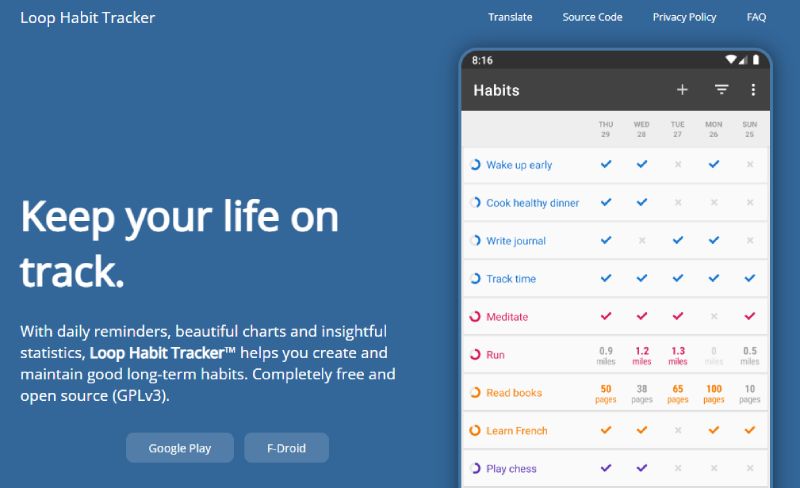
Loop Habit Tracker is a free, open-source habit tracking app for Android with no ads, no premium tier, and no subscriptions. It is Android-only.
What Does Loop Habit Tracker Do?
Loop tracks daily habits using streak calendars, a unique “habit strength” score, and detailed graphs. All data stays on the device. The GitHub repository is publicly available for anyone to modify.
How Is Loop Similar to Habitica?
Both track daily habit completion and visualize streaks. Both are free to use. Both help users build consistent routines through structured daily check-ins.
How Is Loop Different from Habitica?
Completely stripped of gamification. No character, no rewards, no social features. Loop’s strength is its habit strength score, a nuanced metric that does not drop to zero after a missed day the way a standard streak does.
Who Is Loop Best For?
Loop suits Android users who want a free habit tracker with solid analytics and zero distractions, and who have no interest in gamification or social features.
Key Features
- Habit strength algorithm (not just binary streaks)
- Fully offline, no account required
- Open-source (F-Droid and Google Play)
- Detailed graphs: bar, line, frequency distribution
Pricing
- Free plan: Yes, completely free
- Paid plans: None
- Free trial: N/A
StickK
StickK is an accountability app created by Yale behavioral economists that uses commitment contracts and financial stakes to help users stick to their goals. It supports iOS, Android, and web.
What Does StickK Do?
StickK lets users sign a digital “Commitment Contract.” If they fail, money goes to a friend, a charity, or an anti-charity they actively dislike. The loss-aversion mechanism is the core motivator.
How Is StickK Similar to Habitica?
Both use a penalty system to discourage failure. Both include a social component where others can see your progress. Both work for habit building and goal tracking.
How Is StickK Different from Habitica?
Habitica’s penalties are virtual (your character takes damage). StickK’s are financial and social. StickK also rates mediocre on app stores (3.3 on iOS, 3.8 on Android), so it is more of a commitment tool than a polished daily app.
Who Is StickK Best For?
StickK suits users who have repeatedly failed to stick to a high-stakes goal and need real financial consequences to create the pressure that positive reinforcement alone cannot.
Key Features
- Commitment Contracts: Formalized goal agreements with stakes
- Referee system: A trusted person verifies your progress
- Anti-charity option: Donate to a cause you oppose if you fail
- Community feed: See other users working on similar goals
Pricing
- Free plan: Yes, basic access with up to 2 Commitments
- Paid plans: All-Access from $19/month
- Free trial: No
Forest

Forest is a gamified focus app that lets users grow virtual trees during focused work sessions. Leaving the app kills the tree. It supports iOS, Android, and a Chrome extension.
What Does Forest Do?
Forest turns phone-free focus sessions into a tree-growing game. Completed sessions earn coins to unlock new tree species. The app also partners with Trees for the Future to plant real trees, with users having collectively funded over 1.5 million real trees since 2016.
How Is Forest Similar to Habitica?
Both use a virtual reward system for completing real-life tasks. Both add a game layer to otherwise mundane behavior. Both give users a visual character or environment that grows with consistent use.
How Is Forest Different from Habitica?
Forest focuses entirely on phone distraction and deep work, not habit variety. There is no character, no RPG mechanics, no guild system. It is a one-time purchase versus Habitica’s free RPG model.
Who Is Forest Best For?
Forest suits students and remote workers who struggle with phone addiction during focus time and want a low-cost, visually satisfying app to build deep work habits.
Key Features
- Timer-based tree growing (10 minutes to 2 hours)
- Tag sessions by project or activity
- Friends mode for shared focus sessions
- Real-world tree planting contribution
Pricing
- Free plan: No
- Paid plans: $3.99 one-time purchase (iOS/Android)
- Free trial: No
If you want to explore other apps similar to Finch that focus on self-care and virtual companions, there are several options worth checking out beyond what is listed here.
What Makes an App Similar to Habitica?
Not every habit tracking app qualifies as a Habitica alternative. The distinction matters, because picking the wrong replacement means losing the exact mechanics that made Habitica work for you in the first place.
Three core attributes define whether an app belongs in this category.
| Attribute | What It Looks Like | Habitica Version |
| Gamification mechanic | XP, levels, quests, virtual items | RPG character + gear system |
| Daily habit tracking | Recurring task completion log | Habits, Dailies, To-Dos |
| Reward or consequence system | Positive reinforcement or penalty | Gold/XP gain, HP loss |
Streaks and Loop Habit Tracker are good habit trackers. But they share almost nothing with Habitica’s RPG structure. An app earns a spot on this list by sharing at least two of these three attributes.
The spectrum runs wide. On one end sits Habitica and SuperBetter, with full gamified productivity systems built on character progression and quest mechanics. Forest and Finch occupy the middle, using light gamification (growing a tree, raising a virtual pet) as positive reinforcement without the RPG layer. At the other end, Beeminder and StickK skip rewards entirely and lean into financial consequences.
BJ Fogg’s Behavior Design framework explains why all three approaches can work. His model states that behavior occurs when motivation, ability, and a prompt converge simultaneously. Each gamification style targets a different variable. XP systems boost motivation. Simplified daily check-ins increase ability. Notifications and streak alerts act as prompts.
Self-Determination Theory adds the longer-term layer. Sustainable habit formation depends on autonomy, competence, and relatedness. Apps that check all three, like Habitica’s guild system or Fabulous’s coaching journeys, tend to retain users past the 30-day drop-off point that trips up most habit apps.
The global habit tracking app market was valued at USD 1.7 billion in 2024, according to Straits Research. The market projects a CAGR of 14.2% through 2033. That growth is driven by gamification, AI features, and social accountability layers, exactly the attributes Habitica popularized.
How Do Gamified Habit Apps Use Reward Systems to Build Consistency?
The reward system for tasks is the mechanical heart of every app in this category. Change the reward type and you change the entire user psychology.
Gamified habit apps use five distinct reward models. Each one targets a different motivational profile.
XP and Level-Up Systems
Habitica and SuperBetter both run on experience points and progression. Completing a task moves your character forward. Missing one either costs HP or stalls your progress.
The mechanism taps into operant conditioning. Variable reward schedules, where the next level-up isn’t always predictably close, keep engagement higher than fixed schedules. This is the same psychological structure that makes video games hard to put down.
SuperBetter’s “Epic Win” framework takes this further by grounding the quest in a personally meaningful goal. A 2013 clinical trial at the University of Pennsylvania found that SuperBetter users showed measurable improvements in depression, anxiety, and life satisfaction after 30 days.
Streak-Based Reinforcement
Streak tracking is the simplest gamification layer. Streaks, Habitify, and TickTick all use it. The logic: you already completed this habit 14 days in a row. Breaking the chain creates psychological friction. That friction is the motivator.
A 2018 study published in Obesity found that people who self-monitored their behavior consistently had better outcomes than those who did not, regardless of the specific method used. The act of tracking, not the app, drives adherence.
Habitify adds depth by pairing streaks with completion rate analytics, mood logging, and time-of-day grouping. TickTick layers the Pomodoro technique directly into each task so focused work sessions and habit completion happen in the same interface.
Virtual Companion Growth Models
Finch uses a bird that grows as you complete self-care goals. Forest grows a tree during focus sessions. Neither involves XP or levels.
Both exploit nurturing behavior as intrinsic motivation. Users report not wanting to “kill the tree” or neglect their bird, which is a surprisingly strong behavioral prompt. Forest has facilitated planting of over 1.5 million real trees through its partnership with Trees for the Future, adding a real-world purpose layer that pure RPG mechanics lack.
How Do Financial Accountability Apps Work?
StickK and Beeminder skip positive reinforcement entirely. They use loss aversion, the psychological principle that losing something feels approximately twice as painful as gaining the equivalent. Put money on the line and the habit stops being optional.
StickK’s model: Sign a Commitment Contract. Choose where the money goes if you fail (a charity, an anti-charity, a friend). A referee verifies your progress. A Yale University study analyzing StickK data found that users with financial stakes were 3x more likely to achieve their goals compared to those without.
Beeminder’s model: Set a quantifiable goal and plot it on a “yellow brick road” progress graph. Veer off the road and Beeminder charges your credit card. The pledge amount increases with every derailment, which adds escalating pressure over time.
Social accountability amplifies both models. Adding a referee or accountability partner to a StickK commitment increases goal success rates by an additional 20%, according to the same Yale research.
Which Apps Like Habitica Work Best for ADHD and Focus Problems?
ADHD creates specific friction with most habit apps. Executive dysfunction makes it hard to start tasks. Hyperfocus pulls attention away from scheduled check-ins. Standard streak-based apps punish the exact inconsistency that ADHD makes harder to avoid.
The apps that work best for ADHD users are the ones that reduce decision load, provide external structure, or make the cost of distraction immediately visible.
A 2024 study published in Digital Health found that regular self-monitoring of ADHD symptoms promotes symptom improvement through facilitation of self-reflection. The key finding: measuring behavior drives improvement, separate from any specific app’s gamification features.
Here is how the relevant apps perform for ADHD users specifically.
| App | ADHD Strength | Potential Friction |
| TickTick | Integrated Workflow: Pomodoro timer and habit tracking in one place prevents “app hopping” distractions. | Feature Density: The high number of settings and views can cause choice paralysis or overwhelm. |
| Forest | Immediate Barrier: Gamified phone locking removes the “decision” to stay off social media. | Single Focus: Does not provide structure or tracking for habits outside of active focus sessions. |
| Finch | Calm Engagement: Low-friction check-ins and a cute interface reduce the “task shame” common with ADHD. | Time Gaps: The 12-hour wait between bird interactions may lead to a loss of momentum for some users. |
| Fabulous | Scaffolding: Builds routines step-by-step to prevent the “all-or-nothing” burnout cycle. | Rigidity: The structured “journeys” and subscription prompts can feel restrictive or aggressive. |
| Habitica | External Pressure: Social “Guilds” and RPG health penalties provide the urgency needed for task initiation. | Steep Learning Curve: The retro UI and complex RPG mechanics require significant initial cognitive effort. |
TickTick consistently appears in ADHD-focused productivity lists. Its Pomodoro timer is built directly into each task. A 25-minute focused session starts from the same screen where you track the habit. No app switching, no interruption to the focus state.
Forest takes a more blunt approach. Once you plant a tree, leaving the app kills it. The cost of distraction is immediate and visible. For users who respond to visual, real-time feedback rather than abstract future rewards, this is often more effective than XP systems.
Finch and Fabulous both reduce what researchers call the “executive function load” at the start of a session. Finch’s daily check-in takes under two minutes. Fabulous guides users through habits step by step so there is no decision fatigue about what to do next.
Focus Bear is worth noting as an ADHD-specific alternative not covered in the main list. It locks your entire phone and computer until you complete your morning routine, taking the approach further than any app listed here.
Combining two apps, one for coping (coaching or CBT) and one for doing (focus timer or routine tracker), improved daily task completion by 37% on average in user testing cited by Mind Vortex, a platform focused on neurodivergent productivity tools.
How Do Habitica Alternatives Compare by Platform and Pricing?
Platform availability and pricing are the two filters that eliminate roughly half the options before any feature comparison begins. Android users cannot use Streaks. Budget-constrained users will react differently to Beeminder’s penalty model than to Forest’s $3.99 one-time cost.
| App | Platforms | Free Plan | Paid Starting Price | Model |
| Finch | iOS, Android | Yes (Full core) | $11.99/mo | Subscription (Finch Plus) |
| SuperBetter | iOS, Android, Web | Yes | Free / Enterprise | Research-backed / Free |
| Fabulous | iOS, Android | Limited | $39.99/yr | Subscription |
| Streaks | iOS, macOS, Watch | No | $6.99 one-time | One-time purchase |
| Habitify | iOS, Android, Web | Yes (3 habits) | $34.99/yr | Subscription / Lifetime |
| TickTick | iOS, Android, PC | Yes (5 habits) | $35.99/yr | Productivity Suite Sub |
| Beeminder | iOS, Android, Web | Yes (3 goals) | $8/mo + Stakes | Sub + Penalty-based |
| Loop | Android only | Yes (100%) | $0 | Open-source |
| StickK | iOS, Android, Web | Yes | Optional Stakes | Goal-setting / Stakes |
| Forest | iOS, Android, Web | No ($3.99) | One-time + IAP | Gamified Focus |
Completely free with no limits: Loop Habit Tracker (Android), SuperBetter core features (all platforms).
Best one-time purchase value: Forest at $3.99 and Streaks at $5.99 are the only apps here that require no ongoing subscription. For users who resist recurring fees, both are strong picks, though Streaks is locked out of Android entirely.
Widest platform reach: TickTick covers iOS, Android, Windows, macOS, and web. Habitify and SuperBetter are close behind. If you switch between operating systems regularly, TickTick is the safest cross-platform bet.
Around 52% of habit app users drop off within 30 days, according to Global Growth Insights market data. Pricing friction, especially unexpected subscription prompts after a free trial, is one of the primary churn drivers. Apps with a meaningful free tier, like TickTick or Habitify, tend to convert users more sustainably than those that gate core features immediately.
What Should You Consider Before Choosing a Habitica Alternative?
The best habit app is the one you open every day without thinking about it.
Most people switch apps not because the features are wrong but because the motivation model doesn’t match how they actually respond to pressure or reward. Get the motivation model right first. Everything else is secondary.
Matching Your Motivation Style to the Right App
Three distinct motivation profiles map directly to the apps in this list.
External pressure users perform best when failure has real consequences. They tend to dismiss virtual penalties as irrelevant. Beeminder and StickK are built for them, not as long-term habit tools but as short-term forcing functions. Financial-stakes users are 3x more likely to hit their goals according to research analyzing StickK usage data.
Positive reinforcement users respond to streaks, progress charts, and encouragement. Finch, Fabulous, and Habitify are the right category. The tone is supportive rather than punishing. These apps work best for building wellness habits like sleep routines, journaling, and exercise.
Playful challenge users need novelty and variety to stay engaged. Habitica, SuperBetter, and Forest give the daily routine a game frame that makes repetition feel less mechanical.
Social vs. Solo Habit Tracking
Some users track better alone. Others need someone watching.
- Social features: Habitica (guilds, parties), Habitify (challenges), StickK (referee system), SuperBetter (allies)
- Solo trackers: Loop Habit Tracker, Streaks, Forest
A 2025 study found that leaders who started with minimal viable habits and scaled up were 2.7 times more likely to maintain long-term habits than those who began with ambitious targets. The social layer works best when it adds accountability without adding pressure to perform at a level that triggers avoidance.
The Missed Day Test
The clearest way to pick between these apps: think about what happens when you miss a day.
Beeminder charges your credit card. Habitica’s character loses HP. Streaks resets your streak counter. Forest simply notes the gap. StickK can forfeit your pledged money. Loop shows the dip in your habit strength score but doesn’t punish it.
Pick the consequence that motivates without demoralizing. For most users, the apps that treat a missed day as data rather than failure (Loop, Forest, Fabulous) sustain longer-term use than those where missing triggers a cascade of in-app penalties.
The global habit tracking app market recorded more than 298 million active users in 2024, according to 360 Research Reports. With that much competition for your attention, the right app is simply the one that fits your daily rhythm and keeps you coming back on day 31.
FAQ on Apps Like Habitica
What is the best free app like Habitica?
SuperBetter offers full access to its core quest-based system at no cost. Loop Habit Tracker is completely free, open-source, and ad-free. Both are strong picks depending on whether you want gamification or clean streak tracking.
Is there a Habitica alternative with a virtual pet?
Finch is the closest match. You raise a virtual bird by completing daily self-care goals. It focuses on mental wellness rather than RPG mechanics, making it a calmer alternative to Habitica’s character progression system.
Which apps like Habitica work on Android and iPhone?
Finch, SuperBetter, Fabulous, Habitify, TickTick, Beeminder, StickK, and Forest all support both platforms. Streaks and Loop Habit Tracker are the main exceptions, available only on iOS and Android respectively.
What app is similar to Habitica but simpler?
Streaks strips everything down to a clean to-do list with daily streak tracking. No characters, no rewards, no social layer. It suits users who found Habitica’s RPG system more distracting than motivating.
Are there apps like Habitica that use financial penalties?
Beeminder charges your credit card when you miss a goal. StickK lets you pledge money to a charity or anti-charity if you fail. Both use loss aversion rather than rewards to drive habit completion.
What is the best Habitica alternative for ADHD?
TickTick combines a Pomodoro timer and habit tracker in one interface, reducing app-switching friction. Forest locks your phone during focus sessions. Both reduce the executive function load that makes standard habit apps hard to use consistently.
Is Habitica good for building daily routines?
Habitica works well for users motivated by RPG mechanics and group accountability. For structured daily routine building, Fabulous and its behavioral science-based habit stacking approach tends to produce more consistent long-term results for most users.
What app gamifies productivity without an RPG theme?
Forest grows virtual trees during focused work sessions. Finch uses a self-care pet model. Both apply gamification through visual growth mechanics rather than experience points, levels, or combat, which appeals to users who dislike the RPG aesthetic.
Which habit tracking app has the best data and analytics?
Habitify leads here. It tracks completion rates, mood correlation, time-of-day patterns, and streak history across iOS, Android, macOS, and web. Beeminder also offers detailed goal graphs for users who want quantified progress tracking.
Is there a Habitica alternative with a community feature?
Several options include social layers. Habitify has public and friend challenges. StickK uses a referee and supporter system. SuperBetter lets users recruit allies. Habitica itself remains the strongest community-driven option with guilds and party quests.
Conclusion
This conclusion is for an article presenting the strongest Habitica alternatives across every motivation style, platform, and budget.
No single app wins for everyone. Finch suits users who want a self-care companion. TickTick handles productivity and habit tracking in one place. Beeminder and StickK work best when positive reinforcement alone isn’t enough.
The right gamified productivity tool is the one that matches how you actually respond to rewards, streaks, or consequences, not the one with the most features.
Pick one app. Give it 30 days. If your daily routine improves and you’re still opening it consistently, you found your fit.
Still exploring? Check out similar roundups covering apps similar to Finch for more self-care and wellness-focused options.

- How to Share GitHub Repository Access With Collaborators - October 25, 2026
- Build or Buy an AI Chatbot for E-commerce: The Costs Nobody Budgets For - October 24, 2026
- How to Run a React App in VS Code Step by Step - October 23, 2026