

Laravel 13 was released on March 17, 2026, and version 11 stopped getting security fixes five days earlier. A vendor who proposes starting a new project on 11 has already told you something about the team.
Pin down the version and the scope first
Laravel ships a major release about once a year, and each one gets bug fixes for 18 months and security fixes for two years. The framework’s own support table shows where the recent versions stand.
| Version | PHP | Released | Security fixes until |
|---|---|---|---|
| 11 | 8.2 to 8.4 | March 12, 2024 | March 12, 2026 |
| 12 | 8.2 to 8.5 | February 24, 2025 | February 24, 2027 |
| 13 | 8.3 to 8.5 | March 17, 2026 | March 17, 2028 |
Write the version into the brief, along with the PHP version and who pays for the upgrade when the next major arrives. A quote often covers the build and says nothing about year two, which is where the surprise invoice tends to come from.
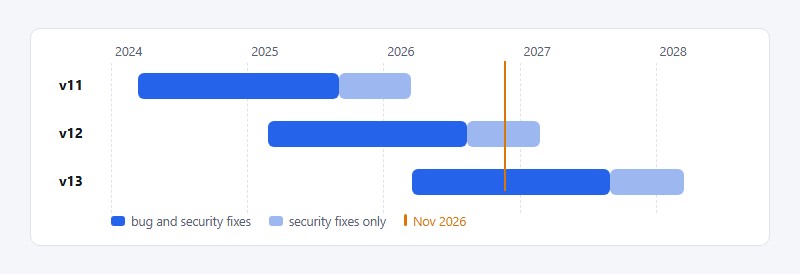
Who patches an app on version 11 now that its security window has closed?
Compare the hiring models
Outsourcing is one of four ways to get Laravel developers, and it is not automatically the cheapest.
| Model | Who manages the work | Cost shape |
|---|---|---|
| Full-time hire | You | Salary, benefits and overhead every month, whether or not there is work |
| Outsourced project | The vendor’s project manager | Fixed or time-based, no overhead on your side |
| Staff augmentation | You, with borrowed developers | Pay per person while you need them |
| Offshore team | The vendor, in another country | Often lower rates, with time-zone gaps to plan around |
Is outsourcing cheaper than hiring? Well, it depends on how long the work lasts: for a six-month build, usually yes, and for a product you will run for five years, often not.
When full-time wins
If Laravel is your core product and you will touch the code every week for years, hire. A team you own knows the codebase in a way a vendor rotation never will.
When a vendor wins
A bounded project with a clear end, such as a client portal or an internal tool, is where a partner fits better. (Staff augmentation sits between the two, and it only works if you have someone senior enough to direct the borrowed developers.) The dedicated team model is the middle road, and offshore development is worth a look if the budget is the main constraint.
Shortlist and talk to vendors
Start with a written list of requirements and the reason Laravel is the right fit. Then look for companies that offer outsource Laravel development and sort them by size, services and ratings on Clutch.
Read their case studies, portfolios, Google reviews and client testimonials, and check that the website describes real people and real work. Rankings written by other agencies are marketing, so use them to find names, not to pick one.
On the first call, discuss the engagement model, the budget, the team size and the NDA, and ask to see the profiles of the developers who would work on your project rather than the sales team’s. Then ask how they test. Laravel supports PHPUnit out of the box, and a team that cannot show you its test suite is guessing. Skills claims are cheap in this market, so a short paid trial task beats a long interview. Nobody enjoys that step, and most good vendors accept it.
What should the agreement actually say?
Get these in writing before work starts: budget, timeline, who owns the code, the technology stack, the size of the team and the NDA terms. Only sign when the vendor has answered every one of them in plain terms, and treat a vague answer on ownership as a no.
Code ownership deserves a second look. Ask for the repository to sit in your account from day one, so a dispute never means waiting for a zip file. There is also a legal side to outsourcing that varies by country, covered in a piece on legal issues in outsourcing development.
Add the version policy as well.
When a fixed price stops working
A fixed price only works when the scope can be written down. If you are still discovering requirements, pay by the sprint and review each one.

- The Best Notepad++ Alternative for Every Platform - November 25, 2026
- SAP Regression Testing: Importance & Automation Strategies - November 25, 2026
- Managed Detection and Response (MDR): Stopping Email-Led Ransomware Before It Spreads - November 24, 2026


